Person in this family
Matthew S. Leahey
This entry is about Matthew S. Leahey (3 June 1866 (compiled) – 18 July 1934). For other family members with the same first and family name, see Matthew Leahey (Born about 1903; death not recorded).
3 June 1866 (compiled) – 18 July 1934
Matthew S. Leahey, a Bayonne waterfront businessman of 9 Cottage Street, died of a heart attack on Wednesday, 18 July 1934, immediately after dancing at his wife’s niece’s wedding reception.
Proved by a record
Matthew S. Leahey owned and entered the small catboat Willet in an 1890 regatta, then became a Bayonne vessel captain, boat owner, ship carpenter and caulker whose compensation case reached New Jersey’s highest courts.
Died at Bayonne, Hudson County, New Jersey
Birth: From our family tree - no record found yet
How is this person related?
Andrew John Leahey’s great-great-grandparent's sibling
Gina D. Cacace’s spouse's great-great-grandparent's sibling (by marriage)
Abigail Ann Leahey’s great-great-great-grandparent's sibling
Marie C. Fitzgerald’s spouse's great-grandparent's sibling (by marriage)
Kevin Leahey’s great-grandparent's sibling
Worked out from the recorded parents and marriages. No sex is recorded for anyone in this archive, so the wording stays neutral.
How this person is related to Andrew:
Matthew S. Leahey is your 2× great-grandparent’s sibling.
Life
The 1880 Jersey City census now supplies Matthew’s place in the family: he was 14, born in New Jersey, and recorded as a son in Dennis and Ann Leahey’s household. Dennis worked as a “Boatman” and Matthew’s brother John worked “On Boat.” Matthew’s later career therefore documents a family waterfront trade shared by father and sons.
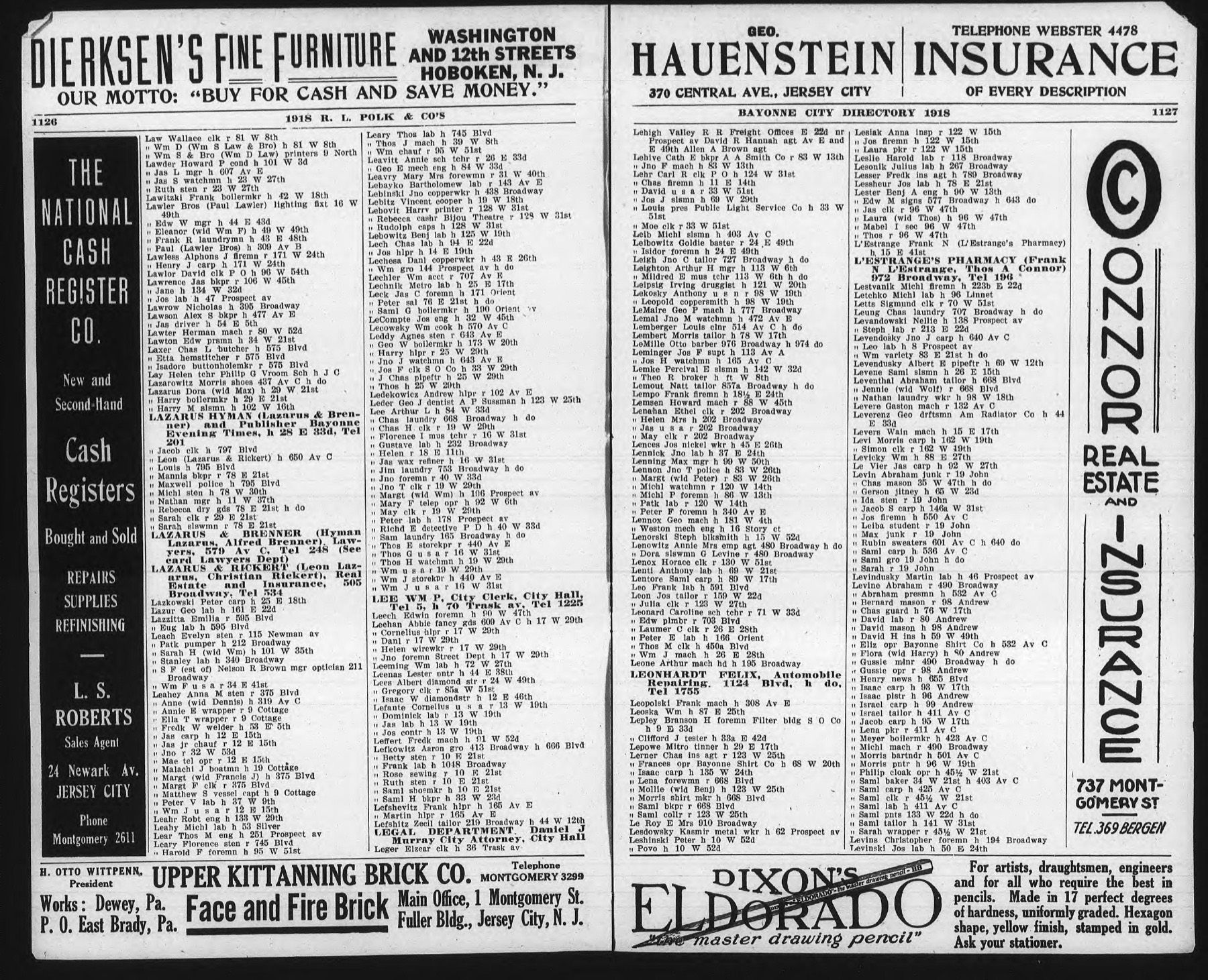
Matthew S. Leahey first appears here in the 1918 Bayonne directory as "Matthew S vessel capt h 9 Cottage." The fuller story comes from the official appellate record in Ramsey v. Leahey. Under oath, Thomas A. Ramsey identified his employer as "Matthew Leahey" of "9 Cottage Street, Bayonne, N. J." Asked Matthew’s business, Ramsey answered: "Boat owner, ship carpenter and caulker." That direct description replaces the directory’s bare shorthand with a much clearer picture of Matthew’s working life. Ramsey himself was "Captain of a coal barge."
The catalogue has a name discrepancy that should not be smoothed over. The State Library indexes the case as "Ramsey, Thomas A. v. Leahey, Matthew J.", while the 1918 directory gives "Matthew S vessel capt h 9 Cottage." The sworn papers themselves omit a middle initial and give the same 9 Cottage Street address and maritime occupation, an exact combination that identifies the same man; both conflicting initials remain recorded here.
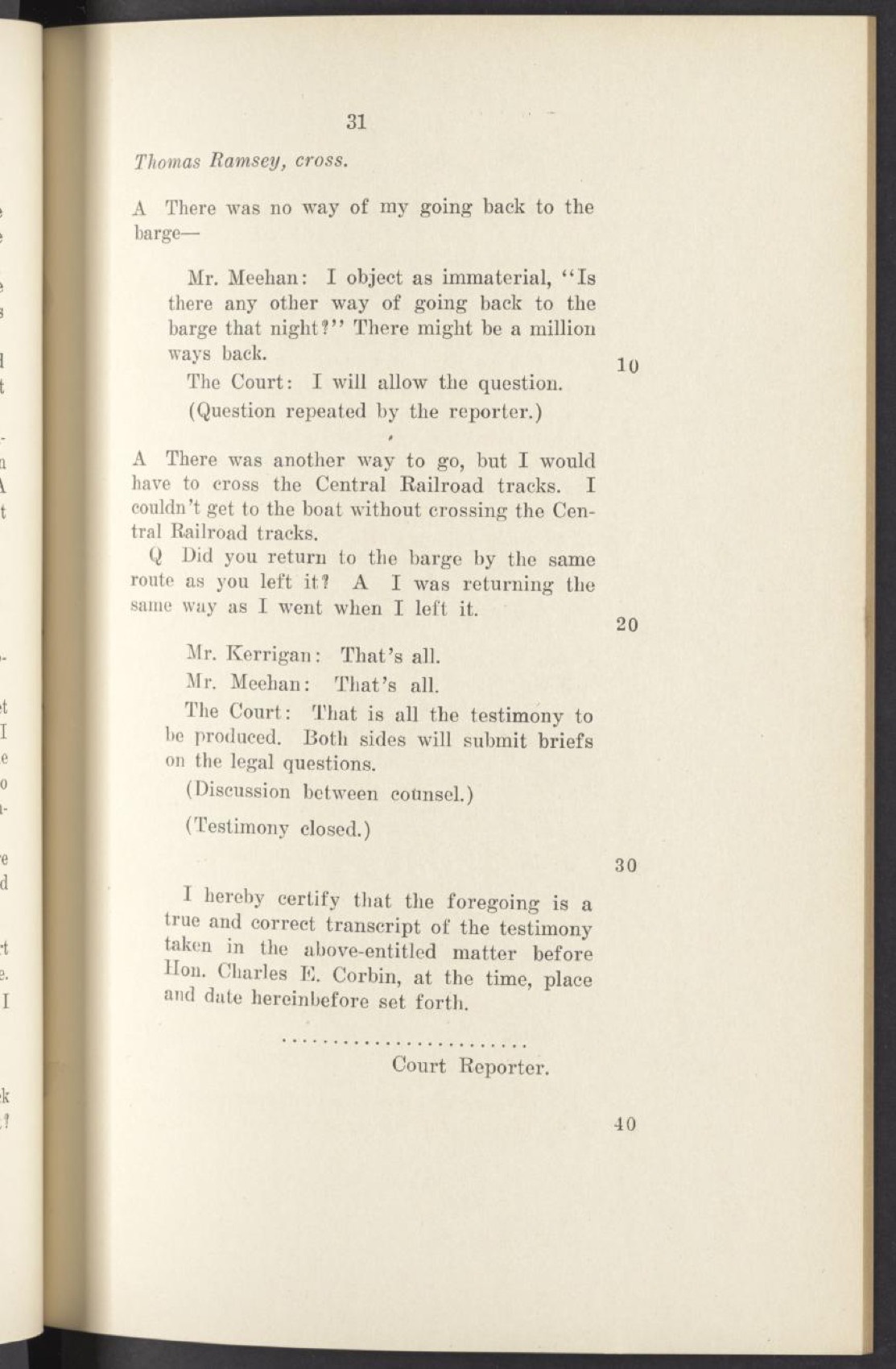
On 26 November 1924 Ramsey went ashore for provisions, visited a friend, and was returning to the barge when a locomotive backed across the street. He testified: "There was a train backing in across the street. I went to go around the locomotive. … my overcoat caught on the switch and ‘threw me under the locomotive.’" The injury was stipulated in stark terms: "Left arm taken off." The injured man was Ramsey, not Matthew.
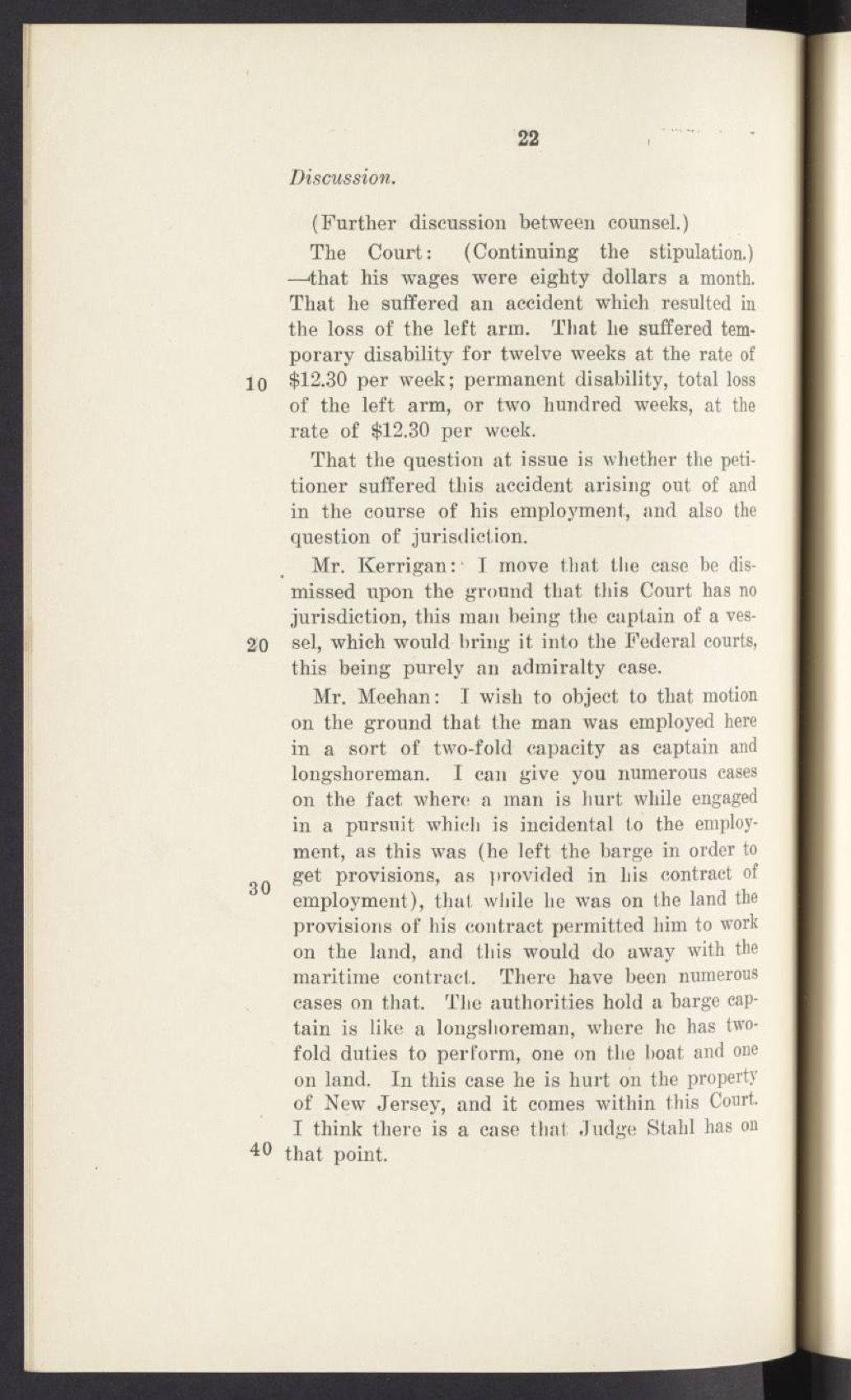
Matthew contested the compensation claim on two grounds. He argued that Ramsey’s errand was personal and outside his employment, and that a vessel captain belonged under federal admiralty jurisdiction rather than New Jersey’s compensation law. Ramsey's own testimony defeated the admiralty defence: "I never seen any Custom House papers while I was there. Never signed any," and he agreed there were "No Custom House papers on that boat." With no customs papers documenting a vessel, there was no federal admiralty jurisdiction, and New Jersey compensation law applied. The barge is never named anywhere in the 72-page record; that is a real limit on what can be learned about Matthew's vessel.
The award was 12 weeks of temporary disability and 200 weeks of permanent disability, each at $12.30 per week. Charles M. Egan, Judge of the Hudson County Court of Common Pleas, entered judgment on 16 January 1926. After argument in the May 1926 term, the New Jersey Supreme Court affirmed on 23 July, with the order entered on 24 July. Its opinion concluded: "We think the findings of fact as to the connection of the accident with the employment were justified, and the judgment will accordingly be affirmed." Counsel were Barent L. Visscher with Joseph C. Paul for Matthew Leahey, and John Joseph Meehan with Thomas F. Meehan for Ramsey.
Matthew appealed again to the New Jersey Court of Errors and Appeals. The last result is now known. The later published opinion Robinson v. Federal Telephone & Radio Corp. (external address omitted for offline reading) cites "Ramsey v. Leahey, 102 N.J.L. 513 (Sup. Ct. 1926), affirmed on opinion below, 103 N.J.L. 501 (E. & A. 1927)." The State Library likewise records the case as issued in 1927 by "Trenton, N.J.: Court of Errors and Appeals" at 103 N.J.L. 501. Matthew lost his final appeal three years after the accident, Ramsey's compensation award survived, and because Matthew fought the case that far it entered the published reports and is still cited today.
A completed surname sweep of the New Jersey appellate repository found no second case securely involving this family: Ramsey v. Leahey is singular, not the first of many, and that negative search need not be repeated without new identifying evidence.
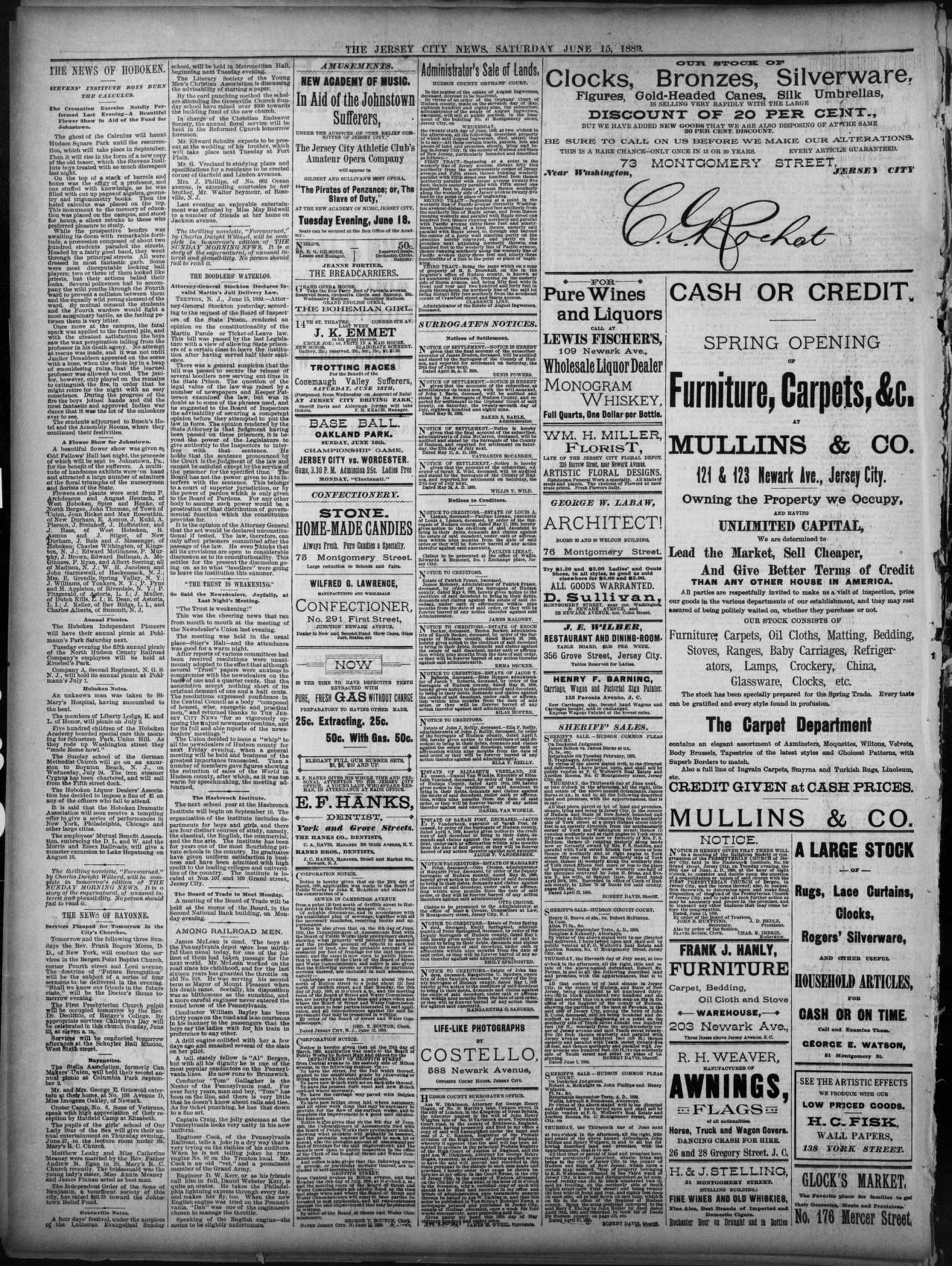
The newspaper record opens an earlier chapter of Matthew’s life. On 15 June 1889, The Jersey City News reported that Matthew Leahy and Catherine Meaney had married at St. Mary’s R. C. Church, with Catherine’s sister Annie Meaney as bridesmaid and James Finnan as best man. A Dempsey funeral-book entry for “Annie Leahey … 8/6/1894 … 95 Hobart Ave … Tom Meaney / Catherine … Aged 21y, deed to Dennis Leahy” may concern that sister Annie, but this is explicitly an inference; the entry does not state that she was the bridesmaid named in 1889.
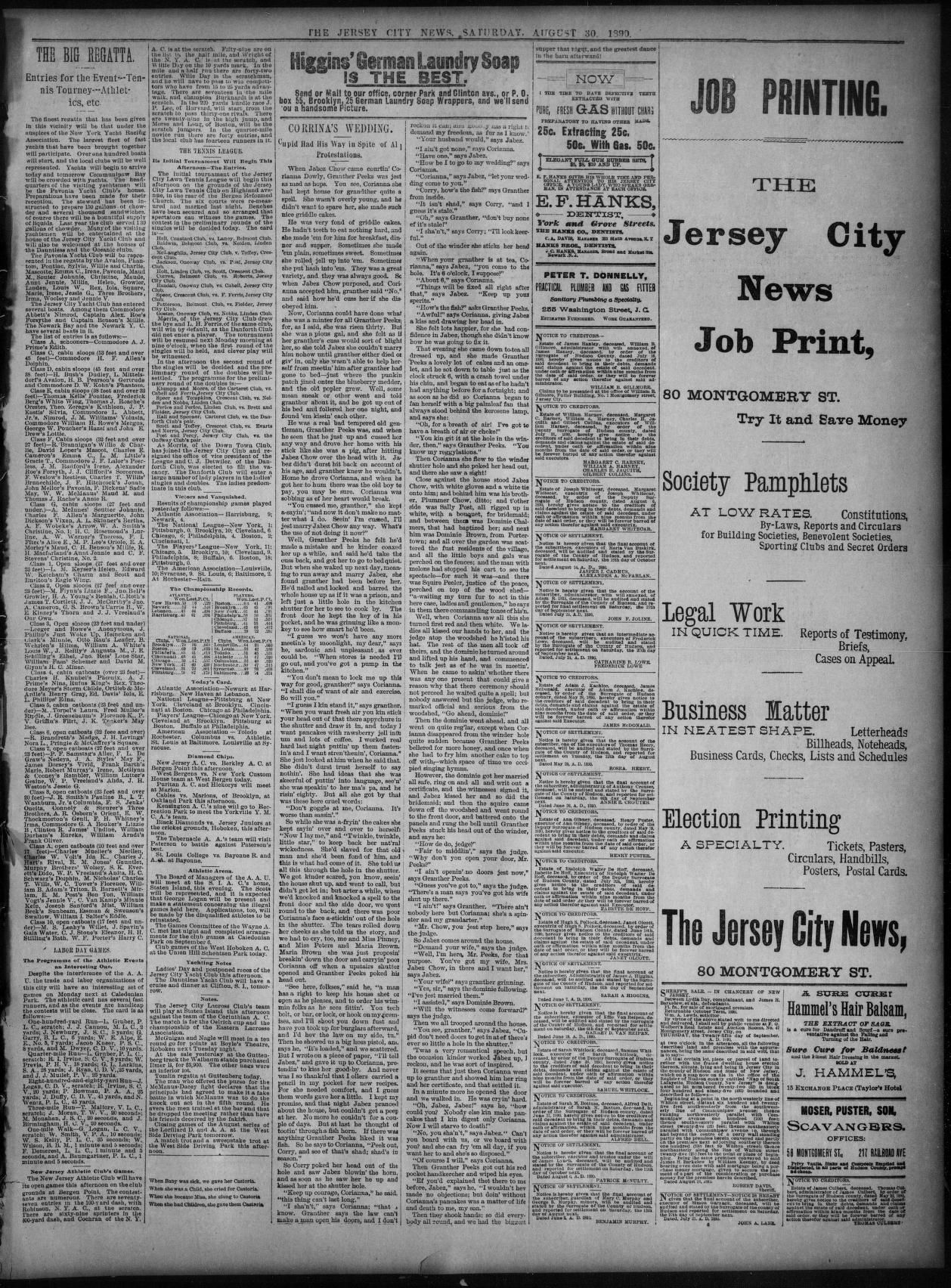
The next year, the paper’s wonderful account of a New York Yacht Racing Association regatta anticipated more than one hundred boats on Communipaw Bay. The Pavonia Yacht Club steward was told to prepare “150 gallons of chowder and several thousand sandwiches”, with “a bountiful supply of liquids”; the club had served 130 gallons of chowder the previous year. In the final class the entry list reads: “Class 10, open catboats (17 feet and under)—M. S. Leahy’s Willet.” The page’s Original records and What the records say sections preserve the full article transcription rather than a summary.
The limits matter. The notice proves that M. S. Leahy owned Willet and that the boat was entered in the regatta; it does not prove Matthew personally sailed her. Willet was a small open pleasure catboat, no more than seventeen feet long—not one of the commercial coal barges Matthew later owned. Identification with this Matthew is an inference resting on the exact initials “M. S.” plus the maritime context, against a man independently documented as a Bayonne boat owner, ship carpenter and caulker. No image of this small boat is known and none has been invented.
That evidence gives Matthew’s life a striking arc: in 1890, at about twenty-four, he owned a little pleasure catboat entered in a local regatta; by 1926, he was arguing federal admiralty jurisdiction before the New Jersey Supreme Court over an employee aboard one of his commercial barges.
How we know this: The 1880 census documents Matthew as Dennis and Ann’s son in the boatman household. The 1889 marriage notice documents Catherine Meaney as his wife. The 1890 newspaper proves ownership and entry of Willet; identification with Matthew rests on exact initials plus independently documented maritime context and is labelled as inference. The 1918 directory, official appellate record, 1927 catalogue and later opinion document his own maritime trade and court case; the conflicting middle initial and unnamed barge remain explicit limits. [1][2][3][4][5][6][7][8][9][10][11][12][13][14][15][16][17][18][19][20][21][22][23][24][25][26][27][28]
Death and burial
Evidence distinction: [RECORD] means text read from the photographed stone. [COMPILED] means volunteer-typed memorial information and is only a lead.
Find a Grave memorial 184119510
Why this memorial is attached
Matched by parents Dennis and Ann, spouse Catherine Meaney, and the archive’s 1889 marriage report for Matthew Leahy and Catherine Meaney. Find a Grave memorial 184119510 (findagrave.com).
Parents Dennis C Leahey Sr 1837–1907; Ann Galvin Leahey 1845–1919 | Spouse Catherine Elizabeth Meaney Leahy 1871–1939
[COMPILED] Volunteer-typed memorial fields
These fields are leads, not civil or church records, and do not replace documented dates. Find a Grave memorial 184119510 (findagrave.com).
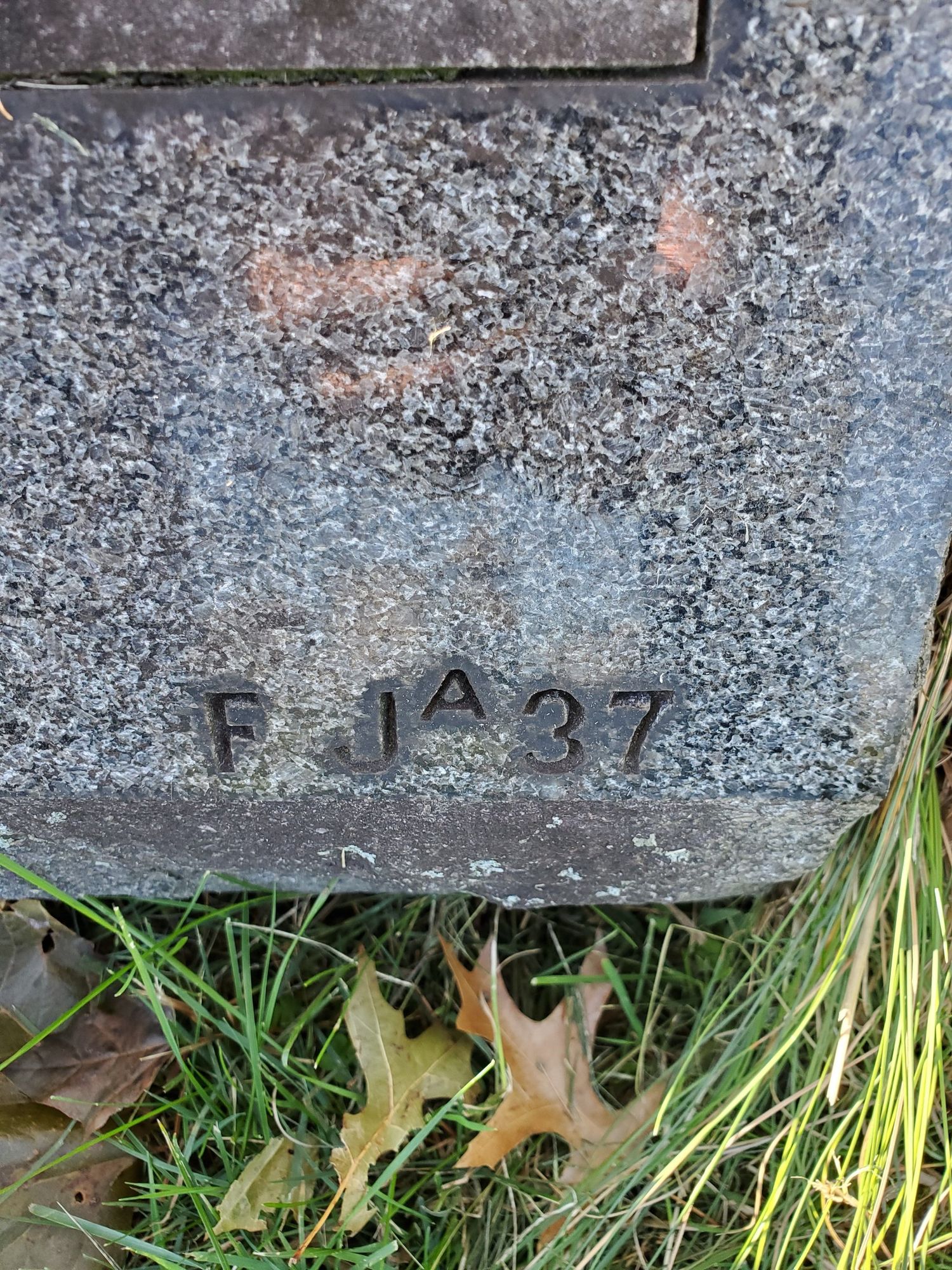
Name: Matthew Sylvester Leahy Birth: 3 Jun 1866 Death: 18 Jul 1934 (aged 68) Cemetery: Holy Name Cemetery and Mausoleum, Jersey City, Hudson County, New Jersey, USA Plot: Blk-F Sec-JA Gr-38 1D Family links: Parents: Dennis C Leahey Sr 1837–1907; Ann Galvin Leahey 1845–1919. Spouse: Catherine Elizabeth Meaney Leahy 1871–1939 (m. 1888). Siblings: John Leahey 1861–1887; James J Leahey 1864–1947;Show the full recordHide the full recordFull record, about 150 words
Dennis Charles Leahey Sr 1867–1957; Francis John Leahey 1868–1913; Anna Bridget ‘Annie’ Leahey Collins 1870–1905; Malachy Leahy 1870–1960; Catherine Theresa Leahey 1874–1955; Mary Ellen H Leahey Gorman 1875–1944; Peter Vincent Leahey 1876–1950; Hanorah Matilda Leahey Hedley 1879–1917; Michael Joseph Leahey 1880–1938. Children: Dennis C Leahey 1890–1968; Catherine Elizabeth Leahey Quinlan 1893–1940; Anna Estelle Leahey McNelis 1895–1964; Ellen Teresa Leahey 1897–1933; Helena Veronica Leahey 1900–1900; Thomas F Leahey 1902–1906; Bertha Marie Leahey Blackwood 1905–1953; Jean Cecilia Leahey Leary 1907–1981; Matthew Sylvester Leahey Jr 1912–1984; Matthew Leahey 1914–1914.
Photograph status: a photographed inscription is available and shown below. Find a Grave memorial 184119510 (findagrave.com).
[RECORD] Photographed inscription, transcribed verbatim
LEAHEY
Citation: Find a Grave memorial 184119510 (findagrave.com); monument photograph credited below.
Family
Parents
Siblings · birth order
- John Leahey
- James J. Leahey
- Matthew S. Leahey (this person)
- Dennis C. Leahey
- Francis John Leahey
- Malachy J. Leahy
- Anna Bridget Leahey Collins
- Catherine Theresa Leahey
- Mary H. Leahey Gorman
- Peter Vincent Leahey
- Hanorah Matilda Leahey Hedley
- Michael Leahey
Spouse
Children
See this family in the family treeWork and occupation
- boat owner, ship carpenter and caulker — 1924
What was the business of your employer? Boat owner, ship carpenter and caulker.
Citation: Ramsey v. Leahey appellate record (1926) [2]
- vessel captain — 1918
Matthew S vessel capt h 9 Cottage
Citation: Bayonne city directory — Leahey and Leahy entries (1918) [18]
- boat captain — 1922–1923
Matthew S (Cath E) boat capt h 9 Cottage
Citation: Bayonne city directory — Leahey and Leahy entries (1922–1923) [19]
Where they lived
- 1934: 9 Cottage Street, Bayonne, Hudson County, New Jersey
- 1918: 9 Cottage Street, Bayonne, Hudson County, New Jersey
- 1922–1923: 9 Cottage Street, Bayonne, Hudson County, New Jersey
- 1924: 9 Cottage Street, Bayonne, Hudson County, New Jersey
Use the place list first. The map below is optional.
Places listed on this page
- Jersey City, Hudson County, New Jersey
- Hoboken, Hudson County, New Jersey
- New York City, New York
- Holy Name Cemetery, Jersey City Cemetery or burial place
- New Jersey
- Ireland
- New York
- Holy Name Cemetery, Jersey City, Hudson County, New Jersey Cemetery or burial place
- Brick Township, Ocean County, New Jersey
- United States
- 11 Cottage Street, Bayonne, Hudson County, New Jersey
- 9 Cottage Street, Bayonne, Hudson County, New Jersey
The map could not load. The complete place list is above it.
The pins show approximate places. The line only joins them in time order; it does not prove the route travelled. 4 of the places listed above are recorded only as a county or country, so they are not pinned. Cemetery and burial places have red pins.
Images of these addresses and sites
Insurance maps show a historical footprint, while recent street photographs show the site today. A recent view is not proof that the family’s building survives.
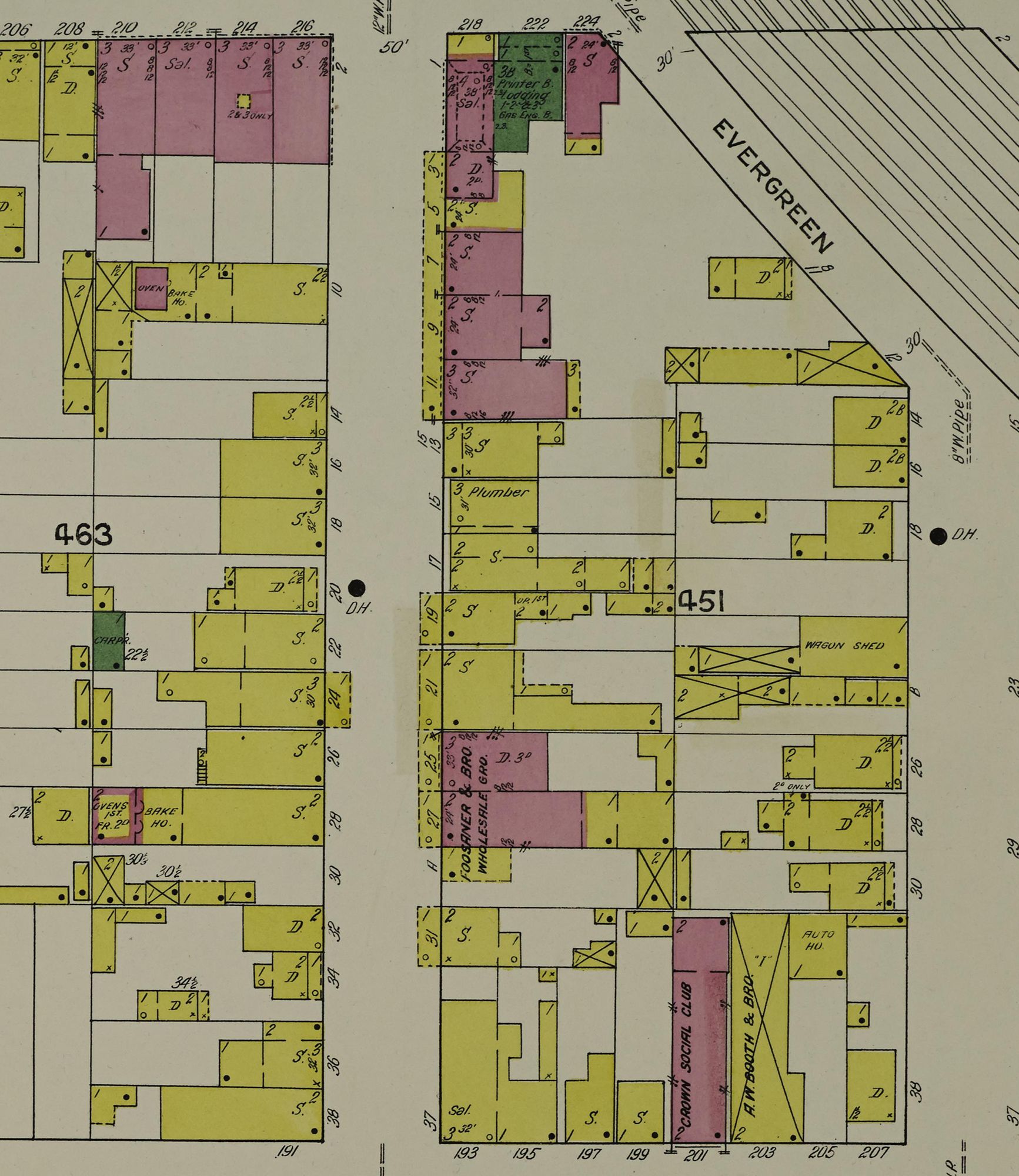
Historical insurance map, 1912 — a footprint or site plan, not a photograph.
Building survival: not established by this map.
Credit: Library of Congress, Geography and Map Division, Sanborn Maps Collection. Cropped from sheet 27.
Licence: Public domain
Timeline
Son in the boatman’s household
Matthew, 14, was Dennis and Ann’s son. Dennis was a boatman and John worked “On Boat.” [5]
Proved by a record
Married Catherine Meaney
The Jersey City News reported that Matthew Leahy and Catherine Meaney were married at St. Mary’s R. C. Church by the Rev. Andrew M. Egan; Annie Meaney was bridesmaid and James Finnan best man. [6]
The record itself
 Tap to open a larger copy
Matthew Leahy and Catherine Meaney marriage, The Jersey City News, 15 June 1889
Proved by a record
Married Catherine Meaney at Bayonne
New Jersey marriage index: married 10 June 1889 at Bayonne. The entry names his parents as Dennis Leahey and Anna Galvin, which is record proof that he was their son — the relationship had rested on newspaper obituaries. [27]
Proved by a record
Owned and entered the catboat Willet
The regatta entry names “M. S. Leahy’s Willet” in Class 10, open catboats of 17 feet and under. The exact initials and maritime context support identification with Matthew, but the notice proves ownership and entry—not that he personally sailed her. Willet was a small pleasure catboat, not one of his later commercial coal barges. [7]
The record itself
 Tap to open a larger copy
M. S. Leahy’s catboat Willet, The Jersey City News, 30 August 1890
Proved by a record
Possible owner of the catboat Willet [INFERENCE]
A Bayonne regatta list names “M. S. Leahy’s Willet” in the open-catboat class of 17 feet and under. The initials, surname variant, place and Matthew’s maritime work make this a possible match only; the notice does not prove Matthew personally sailed the boat or that it was commercial. [25]
From our family tree - no record found yet
9 Cottage Street mapped as brick store
Sanborn sheet 27 maps no. 9 as a three-storey brick store sharing walls in the row with no. 11. The later directory residence does not erase the map’s commercial classification. [15]
Proved by a record
Bayonne directory
The directory listed “Matthew S vessel capt h 9 Cottage.” [1]
The record itself
1918 Bayonne directory, Leahey entries
Proved by a record
Ramsey’s accident
Employee Thomas A. Ramsey, captain of a coal barge, lost his left arm beneath a backing locomotive while returning from shore with provisions. The record says Ramsey was Matthew Leahey’s employee; Matthew was not the injured man. [2]
The records themselves
Full extracted text (72 pages)
 Tap to open a larger copy
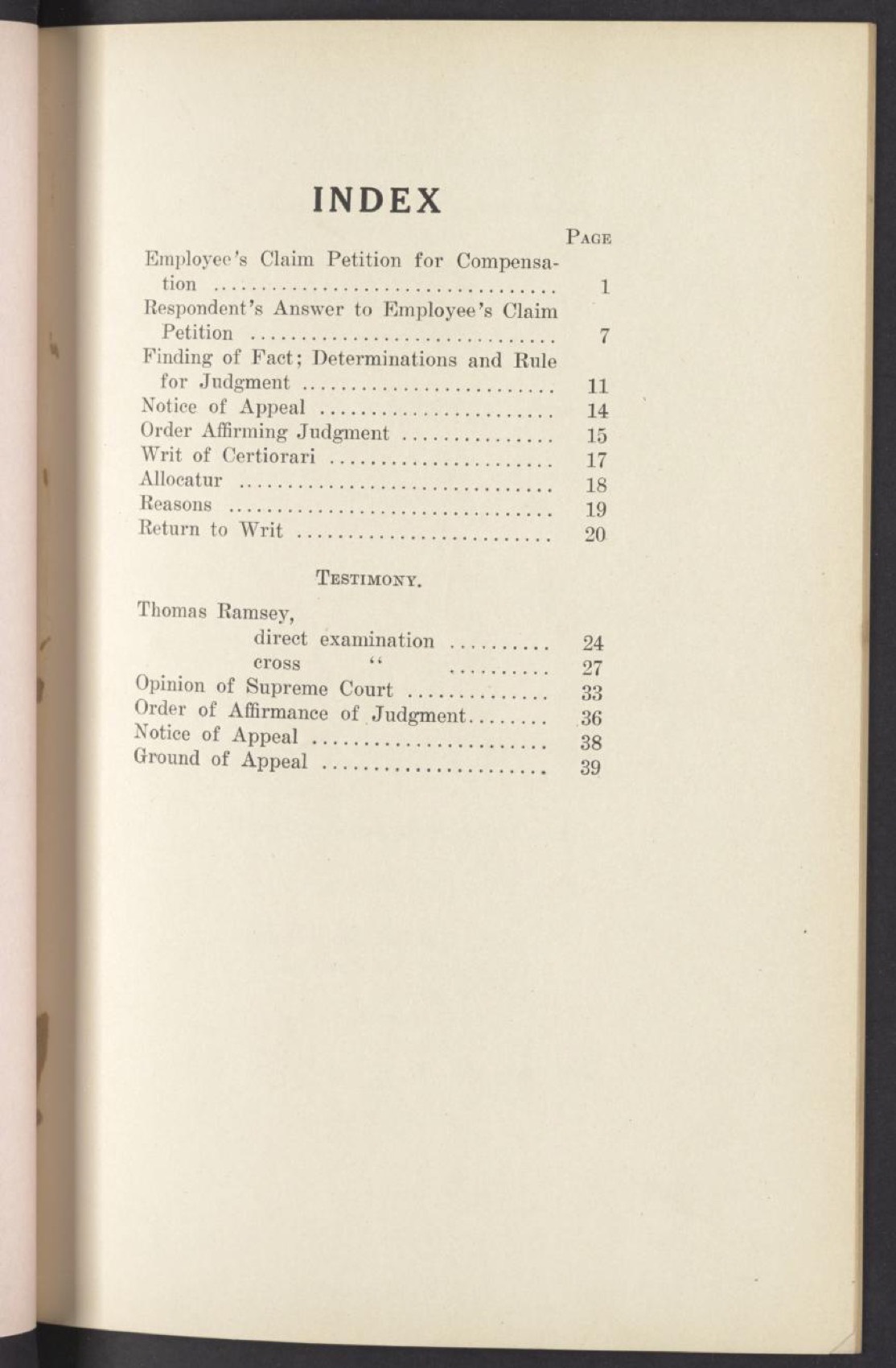
Ramsey v. Leahey appellate record — first page
 Tap to open a larger copy
Ramsey’s testimony
 Tap to open a larger copy
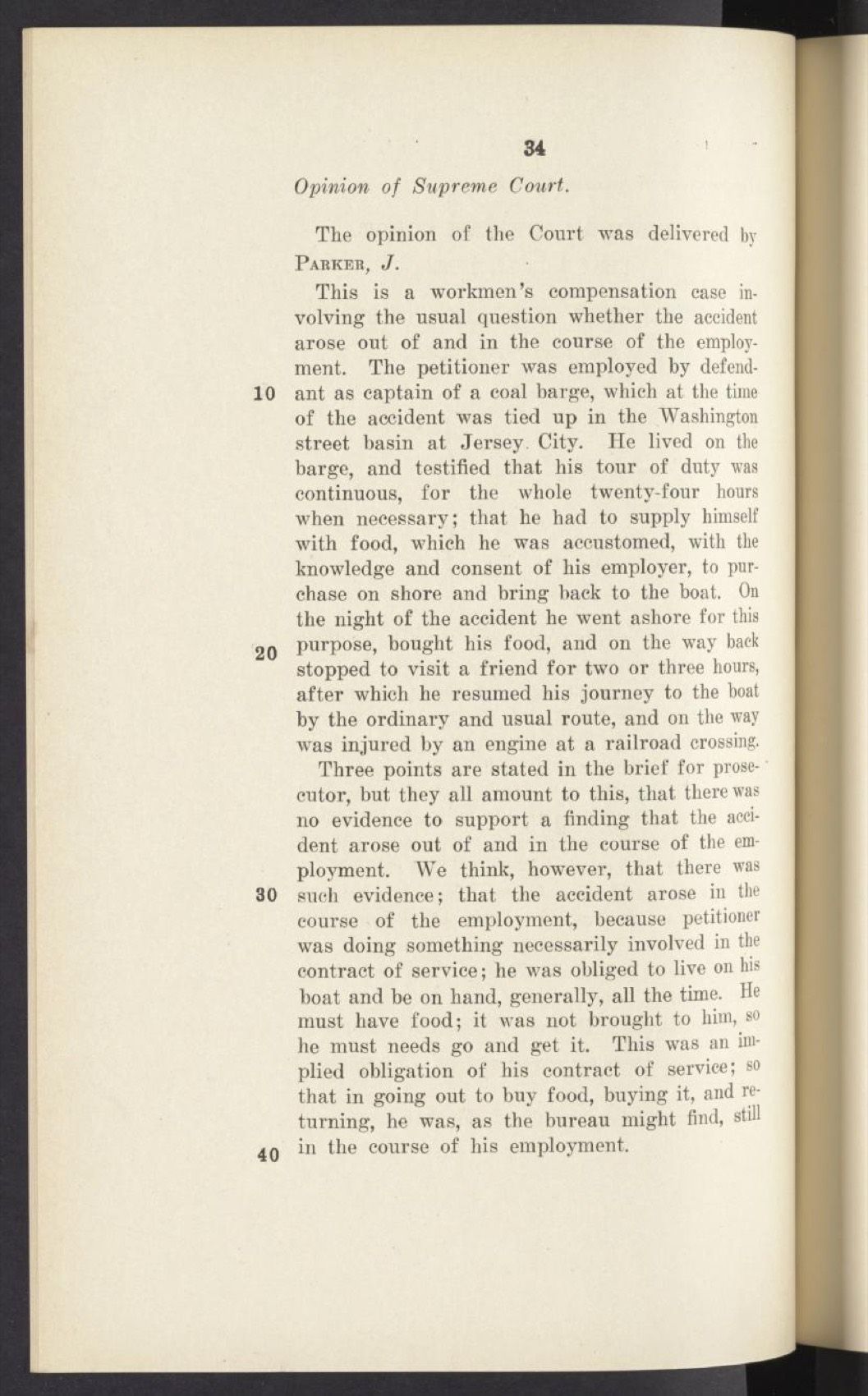
New Jersey Supreme Court opinion
 Tap to open a larger copy
Order of affirmance
Proved by a record
Coal-barge employment in Matthew’s business
The compensation claim identifies Matthew’s business at 9 Cottage Street as boat owner, ship carpenter and caulker; employee Thomas Ramsey was captain of a coal barge and was injured near Morris Canal Basin. The record does not identify the barge or connect it to Willet. [26]
Proved by a record
Period description of caulking trade
A federal manual explains that wood caulkers filled hull seams with materials such as cotton and oakum to make them watertight. It supplies context for Matthew’s proved caulker trade, not his exact methods or pay. [24]
Proved by a record
Compensation judgment
Charles M. Egan, Judge of the Hudson County Court of Common Pleas, entered judgment awarding Ramsey 12 weeks of temporary and 200 weeks of permanent disability at $12.30 per week. [2]
Proved by a record
New Jersey Supreme Court affirmance
After argument in the May 1926 term, the New Jersey Supreme Court affirmed the judgment on 23 July; the order was entered 24 July 1926. [2]
Proved by a record
Further appeal
Leahey appealed again to the New Jersey Court of Errors and Appeals. His ground of appeal was dated 4 August and served 12 August 1926; the 72-page record ends at this step. [2]
Proved by a record
The reasoning that beat him — Parker, J., in the Supreme Court
This archive had recorded only the final affirmance. There are two published reports, and this is the one that matters: Ramsey v. Leahey, 102 N.J.L. 513, 134 A. 91, the opinion of Mr. Justice Parker, 14 July 1926. Thomas Ramsey lived aboard the coal barge and was on call around the clock. He had to buy his own food ashore, which Matthew knew and allowed. On the night he was hurt he bought his food, stopped to visit a friend for two or three hours, and was struck by an engine on the ordinary way back. Matthew's case was that this put Ramsey outside his employment. Parker held it did not: a man obliged to live on a boat must eat, nobody brought him food, so fetching it was an implied term of the job. The court likened it to a workman crossing a street to relieve himself, and added that the English cases went the other way but "we have been rather more liberal in this state." [28]
Proved by a record
Final appeal lost
The Court of Errors and Appeals affirmed on the Supreme Court opinion below, 103 N.J.L. 501. Matthew lost his final appeal, Ramsey's compensation award survived, and the case entered the published reports. [3]
Proved by a record
Eleven judges to none
The Court of Errors and Appeals, then New Jersey's highest court, affirmed per curiam on Parker's opinion. The vote is recorded in the report: eleven for affirmance, none for reversal — the Chancellor and the Chief Justice among them. Matthew Leahey lost his last appeal unanimously. [28]
Proved by a record
Died after dancing at a wedding
The 19 July Bayonne Times report says he died ‘last night,’ and the follow-up explicitly says Wednesday night. The paper chronology, 1934 death-notice index and Smith–Kiley marriage index establish Wednesday, 18 July 1934. [10]
Proved by a record
A third account retained an address discrepancy
A local-news recap again places the collapse after a dance and the funeral on Saturday morning, but gives the Smith residence as 95 East Forty-first Street; the two fuller reports give 99. The discrepancy is retained rather than harmonized. [12]
Proved by a record
Fraternal memberships and burial
The death report lists Court Bergen Point, I.O.F.; Star of the Sea Council No. 371, Knights of Columbus; and St. Andrew’s Holy Name Society, followed by Holy Name burial. [10]
Proved by a record
Cited for thirty years, and beyond New Jersey
A search of the case-law database returns eleven later decisions citing Ramsey v. Leahey, from Rachels v. Pepoon in 1927 to Robinson v. Federal Telephone & Radio Corp. in 1957. It travelled out of the state: the Court of Appeals of Texas cited it in Southern Casualty Co. v. Ehlers (1929) and the Supreme Court of Iowa in Pohler v. T. W. Snow Construction Co. (1948). A Bayonne boat owner's refusal to pay his bargeman became a small piece of American workers' compensation doctrine, argued about in three states for thirty years. [28]
Proved by a record
Original records
8 further records are shown in the timeline, beside the event each one documents.
 Tap to open a larger copy
Bayonne city directory page with Matthew S. Leahey and relatives, 1918
A city directory is an old address book that often lists a person's home and job.
Open the larger document
Original source (digifind-it.com)
Machine-read text (may contain errors) · Partial machine reading
Automated reading aid only. The human-verified quotations elsewhere in the archive remain authoritative.
WASHINGTON GEO. TELEPHONE WEBSTER 4478

JIERKSEN'S FINE FURNITURE aeeeeeraes® | HAUENSTEIN INSURANCE

OUR MOTTO: “BUY FOR CASH AND SAVE MONEY.” 370 CENTRAL AVE., JERSEY CITY OF EVERY DESCRIPTION

1126 1918 KR. L, POLK & CO’S BAYONNE CITY DIRECTORY 1918

Law Wallace clk r 81 W 8th Leary Thos lab h 745 Blvd Lehigh Valley R R Freight Offices © 224 nr) Lesiak Anna Insp r 122 W 15th
1 Wm D (Wm 8 Law & Bro) h 81 W 8th w Thos J mach h 39 W 8th Prospect av David R Hannah agt Av B and | y Jos firemn h tee W 16th
Wm § & Bro (Wm D Law) printers 9 North | « Wm chauf r 95 W Sist nat E 49th Allen A Brown agt Laura pkr vr 122 W 15th
Lawder Howard P cond h 101 W 8d Leavitt Annie sch tehr r 26 1 33d Lehive Cath E bkpr A A Smith Co r 83 W 18th | Leslie Harold lab r 118 Broadway
Jas L mgr h 607 Av B Geo BE mech eng h 84 W 33d Jno F mach h 88 W 18th Lesonik Julius lab h 267 Broadway
u Jas § watchmn h 28 W 27th Leayry Mary Mrs forewmn r 31 W 40th Lehr Carl R clk P Oh 124 W Bist Lesser Fredk ins agt_h 789 Broadway
Lebayko Bartholomew lab r 143 Ay B Chas firemn h 11 © 14th Lessheur Jos lab h 78 B 21st

w Ruth sten r 23 W 27th
Lawitzki Frank bollermkr h 42 W 18th Lebinski Jno copperwkr h 438 Broadway avid us ar 33 W Olst Lester Benj A eng h 90 W 18th

P tH fixt 16 W| Lebitz Vincent cooper h 19 W 18th Jos J sismn_h 69 W 29th y vay 9
NAT ( \ Al Lawler Bros (Paul Lawler) Mghting txt Uanovie Harr rina 138 W BR ote Laula” pros, Publley Ligne, Berrie Cob: 83 WI eee ee ee ee
ont 44 B 48a Rebecca cashr Bijou Theatre r 12S Bist Sist } y
"Aino (wkd Wm Fh 40 W 49th Rudolph caps h 128 W. Bist Moo clk r 38 W Slat er ELE tllag
Frank R laundrymn h 48 B 48th Lebowitz Benj lab h 125 W 10th Leib Michl sismn h 403 Ay © Thon BOTY Pixon
1 Paul (Lawler Bros) h 809 Ay B Lech Chas lab h 4 1H 22d Leibowitz Goldie bastor r 24,1 49th He ety cei Salrange'a. Phariaey)
Lawless Alphons J fremn, ryitt W 2dth w Jow pe hy M4 BAG sansa Sati v sidor foremn nh 24 49h 16° diet :
Henry J carp W 24th B Copparw. Kae Po igh Jno C tailor 727 Broadway h do JEST E's P. ACY (F
Lawlor David clk P Oh 96 W. 54th FE gH Ayn Lelghton Arthur H mgr h 113 W 6th LET RAN Gn SPB AACS (eran
een Jas bkpr x 100 W. 46th Lechlor Wm acct r 70 AYE » Mildred E mus tchr 113 W 6th h do 972 Brondway, Tel 196 *
Jane h 184 W 32a io i c pid sh ATL Orlent | Leipsig Irving druggist h 121 W 20th Lestvanik Mich] firemn h 223b B 22a
v4 Jos lab sh 47 Prospect av cated 18 2st h do. | Lekosky Anthony us n r 98 W 19th Letchko Mich] lab h 96 Linnet
Lawrow Nicholas h 305 Broadway i) Estee Qc hallaeniee iB 100 Orient iv i 1 Leopold coppersmith h 98 W 10th Letts Sigmund clk r 70 W Bist
Lawson Alex § bkpr h 477 Ay B » Sami ollerm| h no W 4bth LeMaire Geo P mach h 777 Broadway Leung Chas laundry 707 Broadway h do
Jas driver h 54 B th LeCompte Jos eng h 3 Ouro Lemal Jno M watchmn_ h 472 Av B Levandowski Nellie hy 138 Proa pubes
Lawter Herman mach x 80, W524 rane ETL he ean ee ea TE se eh etd i steph lab r 23H 2a
. awton Bdw premn h 84 si Leddy A ect i a mber forris tailor h 78 W 17th i .
Laxer Chas L butcher b O75, Biva FT eR ed LoMillo Otto barber 976 Broadway h O74 ao HP Sarre iT orm
' y Jos F clk 8 0 Co h 33 W 29th | al B ‘ x. . Levendusky Albert E pipeftr h 69 W 12th
Lay Helen tchr Phillp G@ Vroom Sch h J © Lemke Percival B slsmn h 142 W 32a
New and Lavarowitz Morris shoes 487 Av Ch do J Chas plpeftr h 25 W 20th «Theo R broker h ft W 8th Taysne Gam isles Es ea
Lazarus Dora (wid Max) h 20 W 2lst reset ony Law CEs Lemout Natt tallor 857a Broadway h do AT RATHAL ES BEAUTE tae 3 968 Blvd
Se 4 Harry bollermkr h 20 © 21st Ledekowicr Andrew hipr 7 " Lempo Frank firomn h 18% B 24th ut be OAL a Blvd
Second Hane ‘Harry M sismn h 102 W 161 Leder G60 aE ee h 123 W 25th Lemsen Howard mach r 88 W 45th HUN AtH ane unary eA BR tees
LAZARUS HY) Lee Arthur Lh 84 W 88d Lenahan Ethel clk r 202 Broadwa evere Gaston mach r 182 Ay
ner) and Publisher | Bayonne | "Chis Jaundry G88 Broadway hn do Helen Mra h ,202 roadway x Tay crane net) dretetny Aa nad airs C01
7 ee Times, h 28 B 88d, Tel) | ryoronce 1 mus tehr y 16 W Bist 1) May oli «oe mca Levers Wain mach h 15 © 17th
Cash Tanne ile 707 Blvd n Gustave lab h 232 Broadway Lences Jos nickel wkr h 45 © 26th Levi Morris carp h 162 W 19th
ae 1 Leon (Lazarus & Rickert) h 650 Av © ee Ee Se itat Lennlck Jno lab h 87H 24th EE Taga
Louls Bly nes ne PKG venning Max mgr 50th 4 oe
Mannis bkpr r 78 B 2ist Jim laundry 708 ondway h do Lennon Jno T police h 88 W 26th Le Vier Jas carp h 92 W 27th
no foremn r ii | » Margt (wid Peter) r 88 W 26th Levin Abraham junk r 19 John

‘
. PME| '; Maxwell police h_ 705 Biva 0
iv st ‘ Taw Oth Jno T clk x 19 W 29th 1 Miohl watchman 7 120 W. 14¢ Chas mason 35 W 47th h do
Regis ers Michl.sten. h. 76 W 80m ‘Maret (wid Wm) h 196 Prospect ay Hirt ett eo Rr ae Gerson fitney h_ G5 W 28d

Ni mer h 11 W 87th i
Fee dey de: 8 ie alat h do Mary F telep opr h 92 W Oth w Path lab r 120 W 14th Ida sten r 19 John
Sarah clk r 29 B 2Qlst « May clk r 19 W 29th 5 . Peter F foremn h 340 Av B Jacob S carp h 146a W Bist
Sarah slawmn r 78 B 2ist Peter lab h 178 Prospect: ay sea Lennox Geo mach h 181 W 4th «Jos firemn h 650 Ay C
PGRN TE, GAZAKUS 0 DRENNIOR (man | ne ton: Broad Daw 88 Weston mech eng h 16 Story ct » Lelba student r 19 John
gat ane Lazarus, Alfred Brenner), Law- |." 52 Cee 5 Broa Lies in do Lenorsk! Steph blksmith h 15 W. 52a Max junk r 19 John
pana Ay OC, Mel 248 (See |" Thos B storekpr 1 440, Ay 1 Lenowitz Annie Mrs emp agt 480 Broadway h do | " Rubin sweaters 601 Av C h 640 do
card Lawyers Dept) v Thos Gu 8 $ r wap ar both 1 Dora slswmn G Levine r 480 Broadway Saml carp h 586 Av C
. . LAZARUS & RICKERT (Leon Lage |" thos H watchin hoot J ] = Lenox Horace clk r 130 W Bist Saml gro 19 John h do
REPAIRS ious, Christian. Rickert), Real |" Wm usar i) Wain Lenti Anthony lab h 69 W 2lst ‘Sarah y 19 John
‘ . xtate. and Insurance, 505 |" Wm J storekpr 16 Ww Stat Lentore Saml carp h 89 W 17th Levindusky Martin lab h 46 Prospect av
“DPT IES Broudway, Tel 4 wWm Jusar £ Leo Frank lab h 591 Blyd Levine Abraham r 490 Broadway
SUPPLIES Lazkowsk! Peter carp I LEB WM P, City Clerk, City Hall, — | Leon Jos tailor y 189 W. 22a ‘Abraham prosmn h 682 Av C
Lazur Geo lab h 161 B 224 Tel 56, h'70 Trask av, Tel 1225 | wv Julla clk r 123 W 27th Bernard mason r 98 Andrew
mC “ING Lazzitta Bmilia r 595 Blyd Leech Edwin foremn h 90 W 47th Leonard Caroline sch tchr r 71 W 334 Chas guard h 76 W 17th
REFINISHING 1 Bug lab h 595 Blyd Leehan Abbie fancy gds 609 Av © h 17 W 20th Edw plmbr r 708 Blvd DaylaetenreegO can arew
Leach Evelyn sten r 115 Newman av Cornelius hipr_r 17 W 29th  Laumer C clk r 26 B 28th David mason h 98 Andrew
 Patk pumper h 212 Broadway Dani r 17 W 20th Peter B lab h 166 Orient David H ins h 69 W 49th
Sarah H (wid Wm) h 101 W 35th Helen wirewkr r 17 W 20th jo Thos M clk h 450a Blya Eliz opr Bayonne Shirt Co h 532
Jno foremn Street Dept h17 W 20th Wm J mach h 26 B 28th Flora (wid Harry) h 80 Andrew

‘Stanley lab h 340 Broadway ‘ 4
‘8 F (est of) Nelson R Brown mgr optician 211) Leeming Wm lab h 72 W 27th Leone Arthur mach hd h 195 Broadway Gussie minr 490 Broadway h do
Broadway Licenas Lester ontr h 44 1, 38th } LEONHARDT FELIX, Automobile | " Gussie opr r 98 Andrew

L. § Meee Lees Albert diamond str v 24 W 49th Repairing, 1i2d Bed bh. do, |" Henry news 655 Blvd

Leahey Anna M sten r 375 Blyd u Gregory clk r 85a W Sist x oy Isaac carp h 98 W 17tI
Y \ Isaae W dlamondstr h 12 B 46th Tel 1755 Seer EN Oe aaron

» Anne (wid Dennis) h 319 Ay C
Ane TO Papas @Cotlage Lefante Cormelius us ar 13 W 10th Leopolski Frank mach h 908 Av B Teraals carps zoo Andrew
R BERTS MORSE’ Wrapeer rb Gatiage Dominick lab r 13 W 19th Leoska Wm h 87 B 25th eee Ripe Heall cared
» Fredk W welder h 58 EY Sth Jas lab h 13 W 19th Lepley Branson H foremn Filter bldg S 0 Co] 1 Jacob carp h 95 W 17th
. Jas carp h 12 B 15th 1 Jos contr h 18 W 19th ; h 9 B 83d Lena pkr r 411 Ay C
Sales Agent Jag jr chauf r 12 © 16th Lefrert. Fredk mach h 91 W 52a » Clifford J tester h 88a B 42a Meyer boilermkr h 428 Ay C
1 Jno r 82 W 58a Lefkowitz Aaron ero 413 Broadway h 666 Blvd Lepowe Mitro tinner h 20 B 17th Michl mach r 490 Broadway
, » Mae tel opr r 12 B 15th, « Betty sten r 10 F 21st Lerner Chas ins agt r 123 W 25th « Morris bartndr h 601 Ay C
ERA HILO NA “Malach! J boatmn h 19 Cottage Frank lab h 1048 Broadway Frances opr Bayonne Shirt Co h 68 W 20th] » Morris pntr h 96 W_ 19th
a | w Marge (wid Prancle J) ty 875 Blva Rose sewing 7, 10 2ist w Tsaae carp 185,.W 24th Philip cloak opr h 45% W_2lst f
INN ITY « Margt F clk r 875 Blvd uth sten 6 21 uw Lena forewmn r 668 Blyd 3 3.
A OVAMME REE! |, Matthew S vessel capt h 9 Cottage aml shoemkr h 10 1 2st : 1 Mollie (wid Benj) h 128. W 25th EET aan ae OATS 737 MONT-
uw Peter V lab h 37, W 9th  Saml H bkpr h 88 W 28d « Morris shirt mkr h 668 Blyd Saml clk r 4534 W 21st
\ wWm Jus ari?) 15th Lefshevitz Frank hipr h 165 Av 5 ‘aml bkpr r 668 Blvd Saml lab h 411 Ay C_ GOMERY ST
Phone Leahr Robt eng h 138 W 20th » Martin hipr r 165 Av B Pete Sami collr r 123 W 25th aml pnts 188 W 22d h do
. Leahy Mich! lab h 53 Silver Lofshitz, Zell tailor 219 Broadway 44 Wem Le Roy B Mrs 910 Broadway aml tailor h 141 W Bist any
COSMO | Lea" Thos Meng h ant Rroepect ay eer attomey, City Hall Vesdowsky Kasmir metal wkr n 02 Prospest av |» Sarah wrapper r 40% W 21st TEL.369 BERGEN
«Harold F foremn h 95 W 5ist Leger Elzear clk h 36 Trask av Povo h 10 W 52d es bay Cordstopiier # foromn hy 1a, Broadway

ror 2" UPPER KITTANNING BRICK CO. sori ee oe

Works: Dewey, Pa. Face and Fire Brick Main Office, 1 Montgomery St. 3 o pencils, Made in 17 perfect degrees
a aE

P, 0. East Brady, Pa. Fuller Bldg., Jersey City, N. J. aaa el ae

Ask your stationer.
What the records say
28 records transcribed.
Record exhibit
1918 directory, part 2
A city directory is an old address book that often lists a person's home and job.
Partly proved
Verbatim transcription currently held in this archive — reproduced in full.
Leahey Anne (wid Dennis) h 319 Av C | Leahey Anna M sten r 375 Blvd, | Annie E wrapper r 9 Cottage, | Ella T wrapper r 9 Cottage, | Matthew S vessel capt h 9 Cottage,
Record exhibit
Ramsey v. Leahey appellate record (1926)
This old record gives information about the person or family named here.
Proved by a record
Full verbatim transcription — reproduced in full.
IN D E X Employee’s Claim Petition for Compensation ............................................................... Respondent’s Answer to Employee’s Claim Petition ....................................................... Finding of Fact; Determinations and Rule for Judgment ............................................. Notice of Appeal ...................... Order Affirming Judgment ...........................Show the full recordHide the full recordFull record, about 16,200 words
Writ of Certiorari ........................................ Allocatur ............................................... Reasons ........................................................... Return to Writ .............................................. Pag e 1 7 n 14 15 17 lg 19 20 T e s t imo n y . Thomas Ramsey, direct examination .............. cross “ ................. Opinion of Supreme Court ......................... Order of Affirmance of Judgment............. Notice of Appeal ............................... .......... Ground of Appeal ......................................... 24 27 33 36 3g 39 E m p loyee’s Claim P etition fo r C om pensation. Employee’s Claim Petition for Compensation. Form No. 20 NEW JERSEY DEPARTM ENT OF LABOR Workmen’s Compensation Bureau Trenton, N. J. l0 Employee’s Claim Petition for Compensation T h o ma s A. R a m s e y , \ P etition er, / v s. \ Ma t t h e w L e a h e y , V R esp on d en t. J ------------------ -------------------------- ---------------------------' 20 Received at Trenton............................................. Claim Petition No................................................ Petition Prepared March 12th, 1925. Attorney for Petitioner John Joseph Meehan, 15 Exchange Place, Jersey City, N. J. (Address) To the W o rk m en ’s C om pensation B u reau o f N e w J ersey: The claimant respectfully alleges the following facts: 1. What is your name? Thomas A. Ramsey, 2. Where do you live? 35 Essex .Street, (Street Address) Jersey City, N. J. (City or Town) • Sex Male 4. Age 87 5. Married? No. 40 2 Em ployee’s Claim Petition for Compensation. 10 2Q 6. By whom were you employed at the time o f the accident? (Give name and business address) Matthew Leahey, (Name) 9 Cottage Street, Bayonne, N. J. (Street Address) (City or Town) 7. What was the business of your employer? Boat owner, ship carpenter and caulker. 8. Bid you give written notice to your employer at the time you were hired, or later, that the Compensation Law should not apply to you? No. 9. Did you receive such notice from your employer? No. 10. Did your employer have knowledge of your accident? Yes. 11. Did you notify your employer of your accident? Yés. 12. I f so, on what date? Nov. 28, 1924, came to see petitioner in hospital. 13. Have you made claim to your employer for compensation? Yes. 14. What was your regular occupation, and what kind of work were you doing at the time of the accident? Captain of a coal barge. 15. When did the accident happen? Nov. 26th, 1924,— 11:30 P. M. (State month, day, year and hour) 16. Where did the accident happen? Avenue, near Morris Canal Basin. 17. What was the nature of the accident, and how did it happen? Was struck by train on way to barge 30 40 «Jersey 3 Employee’s Claim Petition for Compensation. 18. On what date were you compelled to stop work because of the injury? Instantaneously 19. On what date were you well enough to work again? ................... ........................................... 20. If still disabled, on what date do you think you will be able to work? Indefinite. 10 21. Give nature of any injury from which you will recover Left arm taken off. 22. If any permanent injury has resulted, either amputation or loss of usefulness of any member, or impairment of any physical organ, explain fully Left arm severed. 23. Were your wages fixed by piece-work?___ 24. If so, what was your average weekly wage ?. 25. If wages were fixed by the hour, state rate per hour........... ............................... 20 26. Give number of hours in an ordinary working day 24 hours 27. Give number of days in an ordinary working week 7 days 28. State the amount of weekly wages ($90) Dollars per month. Ninety 29. How much money have you received from your employer as compensation (not medical aid) since your accident? None. 30. Has your employer promised to pay you any compensation ? No. 31. If so, how much ?...... 32. Was medical aid required? Yes. 33. Did you receive medical, surgical or liospital services? Medical and hospital. • Wd you request your employer to furnish pitd SerV1CeS? Taken M e d ia t e ly to hos- 40 4 Employee’s Claim Petition for Compensation. 35. 36. 37. 10 38. 39. 20 40. Were they furnished?.................................. I f so, between what dates?.......................... I f not, what sum did you expend for medical, surgical or hospital services? $15.00 for burying arm that was severed. Give name and address of physician and hospital Dr. Butler and Dr. Bartone, City Hospital, Jersey City, N. J. What other facts are there which you believe important? On March 12th, 1925, before Judge Stahl in the presence of petitioner and respondent’s representatives, an award was made as follows: Temporary disability for 12 weeks at $13.33 per week 100% permanent disability for 200 weeks at $13.33 per week. Are you willing that the Compensation Bureau endeavor to secure compensation for you, by agreement, before calling for an official bearing? Yes. Your Petitioner therefore prays that your Honorable Bureau will determine the amount of compensation due to your petitioner from the said defendant, under the Act entitled “ An Act prescribing the liability of an employer to make 30 compensation for injuries received by an employee in the course of the employment, establishing an elective schedule o f compensation and regulating procedure for the determination of liability and compensation thereunder,” approved April 4th, 1911, and the Acts supplemental thereto and amendatory thereof, and that your petitioner may be awarded his costs in this proceeding, and such other or further relief as may be proper. 40 Employee’s Claim Petition for Compensation. And your petitioner will ever pray, etc. THOMAS A. RAM SEY, (Petitioner) 35 Essex St., Jersey City, N. J. (Address) Jo hn Joseph Me e h an 30 St at e of Ne w Jer sey Co unt y of H udso n Thomas A. Ramsey of full age, being duly sworn according to law, on hiis oath deposes and says: That he is the petitioner named in the foregoing petition; and that he has read the same and is familiar with the contents thereof; and that the matters and things therein set forth are true according to the best of his knowledge and belief. 20 THOMAS A. RAM SEY, (Petitioner) Subscribed and sworn to before me, this 12th day of March, 1925, at 15 Exchange Place, JOHN JOSEPH MEEHAN. (This affidavit may be sworn to before a Deputy Commissioner or a Compensation R eferee, or any other person authorized to administer an oath.) 30 6 Employee’s Claim Petition for Compensation. TO THE RESPONDENT The foregoing claim petition has been presented by the petitioner to the Workmen’s Compensation Bureau for hearing and determination in accordance with the provisions of the Work- ^ men’s Compensation Act. W e hereby notify you that unless an answer shall within ten days after the service of this notice, be filed in duplicate with the Secretary of the Bureau, in the State House at Trenton, the facts alleged in the petition will be deemed to be admitted and no testimony will be required from the petitioner to prove such facts. W ORKM EN’S COMPENSATION BUREAU 20 Secretary. I, William E. Stubbs, Deputy Commissioner & Secretary of the Workmen’s Compensation Bureau, hereby certify the foregoing to be a true copy of the petition filed in this cause. W. E. STUBBS. 30 40 7 Respondent’s Answer to Claim Petition. Respondent’s Answer to Employee’s Claim Petition. Form No. 23 NEW JERSEY DEPARTM ENT OF LABOR Workmen’s Compensation Bureau Trenton, N. J. lo Respondent’s Answer to Employee’s Claim Petition T h o ma s A. R a m s e y , Petitioner, vs. Ma t t h e w L e a h e y , Respondent. Claim Petition No. 3748. April 14th, 1925. 20 Attorney for Respondent....................................... (Address) In answer to Claim Petition filed in this cause: 1. What is the petitioner’s name? Thomas A. Ramsey, 2. Where does he reside? 35 Essex Street, (Street Address) Jersey City, N. J. (City or Town) 6. Was the petitioner in your employ at the time of the accident? Yes. 7. State your business Marine Transportation. 8. Did you receive written notice from the Petitioner at the time of hiring, or later, that the Compensation Law was not to apply to him? No. 30 40 8 Respondent’s Answer to Claim Petition. 9. 10. *0 30 40 Did you give such notice to him? No. When did you first have knowledge of this accident? Nov. 27, 1924. 11. Did you receive notice of this accident from the Petitioner? No. 12. I f so, on what date? X X X 13. Has any claim for compensation been made? Yes. 14. What was the Petitioner’s regular occupation, and what kind of work was he doing at the time of the accident? Barge Captain, was not working at time of accident. 15. When did the accident happen? November 27, 1924. (State month, day, year and hour) 16. Where did the accident happen? On tracks of Jersey Central Railroad, on Jersey Avenue, J. C. 17. What was the nature of the accident, and how did it happen? Petitioner was crossing railroad tracks and was struck by a train. 18. On what date was the petitioner c o m p e lle d to stop work because of the injury? Nov. 27, 1924. 19. On what day was the injured well enough to work again? Eeb. 19th, 1925. 20. I f still disabled, on what date do you estimate he will be able to work? X X X X 21. Give your understanding of the nature of any injury from which he should recover?.. 22. Give your understanding of any p e rm a n e n t injury which has resulted, either a m p u ta tion or loss of usefulness of any m e m b e r or impairment of any physical organ. E x p la in fully. Amputation of left arm. 9 Respondent’s Answer to Claim Petition. 23. Were the wages fixed by piece-work?.......... 24. If so, what was the average weekly wage of the injured ?................................................ 25. If wages were fixed by the hour, state rate per h o u r ..................... .................................... 26. Give number of hours in an ordinary working day ........................................................... 27. Give number of days in an ordinary working w e e k ............................................................ 28. State the amount of weekly wages. monthly. 10 $80.00 29. How much money have you paid the injured as compensation (not including medical aid) since the accident? l^one. 30. Have you promised to pay compensation? No. 31. If so, how much? X X X X 32. Was medical aid required? 20 Yes. 34. Were you requested to supply the necessary medical service required by law? No. 35. Did you furnish this service? No. 36. If so, between what dates?........................... 37. If not, give reason for failure to do so. As accident did not happen at place of employment Petitioner was taken to Hospital be- 30 fore I had knowledge of his injuries. 38. Give name of physician and hospital rendering service at your direction................. 39. What other facts are there which you believe important? I f you deny that compensation is payable in this case, explain fully your reasons for this conclusion. As Captain of a vessel this Petitioner was engaged m a maritime pursuit and it is the Respondent s contention that his only recovery 40 10 Respondent’s Answer to Claim Petition. jq lies in the Federal Courts, the State Courts have no jurisdiction. Furthermore, the Petitioner at the time he sustained his injuries was not engaged in his employer’s interests, it was purely a personal errand 2Y2 miles away from the barge. Respondent contends that this accident did not arise out of and in the course of his employment as the Petitioner had left the barge about several hours prior to the accident. (Respondent) (Address) I, William E. Stubbs, Deputy Commissioner & Secretary of the Workmen’s Compensation Bureau, hereby certify the foregoing to be a true copy of the answer filed in this cause. W. E. STUBBS. 30 40 11 Finding of Fact; Determinations <b Rule. Finding of Fact; Determinations and Rule for Judgment. On Petition for Compensation. VS. Mat t h ew L ea h e y . Respondent. Finding of Fact; Determinations and Rule for Judgment. 10 Claim Petition #3748. A petition having been filed in the abovestated cause, praying for the compensation to which the petitioner may be entitled by virtue of the terms and provisions of an act of the Legislature of the State of New Jersey entitled An Act prescribing the liability of an employer to make compensation for injuries received by an employee in the course of employment, establishing an elective schedule of compensation and regulating procedure for the determinations of liability and compensation thereunder, ’ ’ approved April 4th, 1911, with several acts amendatory thereof and supplemental thereto, an a time and place of hearing having been xe and it appearing to the Commissioner that e said petition and order fixing the time and P ace of hearing have been duly served upon e respondent and the petitioner and respond- 1 Q9^ u ,ng appeared 0n the 5th day of June, r i>. beiore Deputy Commissioner Charles E. °rbm, at the Workmen’s Compensation Bureau 30 ,n 40 12 Finding of Fact; Determinations & Rule. Chambers, 571 Jersey avenue, Jersey City, N. J., the petitioner by John J. Meehan and the respondent by Charles Kerrigan, and the Commissioner having heard testimony adduced on behalf of each of the respective parties and briefs having been submitted; 10 I do find and determine from the evidence as follow s; That the petitioner, Thomas Ramsey, was on the 26th day of November, 1924, in the employ of the respondent, Matthew Leahey. F ir s t : That the said Thomas Ramsey received for his services, wages at the rate of $80.00 a month. Sec o nd: 2o That the said Thomas Ramsey on the 26th day of November, 1924, sustained personal injuries and the loss of his left arm as result of an accident, which accident arose out of and in the course of the petitioner’s employment and said employment was subject to Section 2, Chapter 95 of the Laws of 1911, known as the Workmen’s Compensation Act. F o ur t h : That the respondent has had actual knowledge of the occurrence of said accident. T h ir d : F if t h : T hat the accident arose out of and in the course o f his employm ent. Six t h : That the New Jersey C o m p en sa tio n Act applied to the case and the motion fo r dismissal on the ground of lack of jurisdiction, must be denied. Se v e n t h : That the New Jersey C om p en sa tion Court has jurisdiction and that the case is not one for admiralty jurisdiction. E ig h t h : That as result the petitioner lost 40 his left arm which caused a temporary disability 13 Finding of Fact; Determinations & Rule. for a period of twelve weeks from November 26th, 1924, and permanent disability, total loss of arm, for a period of two hundred weeks at the rate of $12.30 per week. Nin t h : I find, therefore, that the petitioner is entitled to temporary disability compensation for a period of twelve weeks and permanent disability compensation for a period of two hundred weeks at the rate of $12.30 per week. Te n t h : I further find that the petitioner’s attorney, John Joseph Meehan, is entitled to a. counsel fee which is fixed in the sum of two hundred ($200) dollars, to be paid by the respondent. I t I s , T h e r e f o r e , on this 24th day of August, 1925, O r d e re d , that judgment final be entered in favor of the petitioner, Thomas Ramsey, and against the respondent, Matthew Leahey, in the sum of twelve dollars and thirty cents ($12.30) a week for a period of twelve weeks for temporary disability and two hundred weeks for permanent disability, to be paid from the date of the accident, and in addition thereto, a counsel fee of two hundred dollars ($200), to be paid to John Joseph Meehan, attorney for the petitioner. CHARLES E. CORBIN, Deputy Commissioner. 20 30 40 Notice of Appeal. Notice of Appeal. NEW JER SE Y DEPARTM ENT OF LABOR. W o r k m e n 's C o m p e n s a t io n Jersey City, N. J. B ur eau. 10 T h o mas A . Ramsey, Petitioner, vs. M at t h e w 2q Respondent. Notice of Appeal. To William E. Stubbs, secretary, Trenton, N. J. To Clerk of Common Pleas, Hudson County. To John Joseph Meehan, 15 Exchange Place, Jersey City, N. J., attorney for petitioner. that the respondent, Matthew Leahey, does appeal from the judgment of the Workmen's Compensation Bureau of the State of New Jersey in the above cause, to the Hudson County Court of Common Pleas. Said judgment and the determination of the facts thereon, dated August 24, 1925, and signed by Charles E. Corbin, Deputy Commissioner of Compensation, and the effect of said judgment is to make an award against the respondent and the respondent appeals from the whole of said award, on the ground to wit: Pl ease 30 L e ah ey, On Petition, etc. Take N o t ic e , 1. That the accident did not arise out of or in the course of employment. 2. That the time of alleged accident the petitioner was engaged in maritime pursuit and Order. therefore the Workmen’s Compensation Court was without jurisdiction to entertain the cause. BARENT L. VISSCHER, Attorney for Respondent-Appellant. JOSEPH C. PAUL, Of Counsel. Order. HUDSON COUNTY COURT PLEAS. Th o mas A. R a m s e y , Petitioner-Appellee, vs. Mat t hew Leah ey, OF COMMON On Appeal. Order. Respondent-Appellant. This matter being heard before the Court, on oral argument, in the presence of John Joseph Meehan and Barent L. Visscher, attorneys for the respective parties, and the Court having considered the subject matter of the appeal, I t I s , on this 16th day of January, 1926, O r d e r e d , that the award to Thomas A. Ramsey, the appellee herein and petitioner below, made in favor of the said appellee herein and petitioner below, and against Matthew Leahey, appellant herein and respondent below, by Charles E. orbin, Deputy Commissioner of Compensation, Rowing temporary disability for a period of welve weeks and permanent disability for a 16 Order. period of two hundred weeks, at the rate of twelve dollars and thirty cents ($12.30) per week, and a counsel fee of two hundred ($200) dollars to be paid to John Joseph Meehan, attorney for the petitioner, be and the same is hereby affirmed. 10 I t I s F u r t h e r O r d e r e d , that John Joseph Meehan, counsel for the appellee herein and petitioner below, be awarded the sum of three hundred dollars as counsel fee, in addition to the $200 allowed by the Compensation Court, together with costs. A nd CHARLES M. EGAN, Judge of the Hudson County Court of Common Pleas. 20 30 40 17 Writ of Certiorari. Writ of Certiorari. Filed January Ne w , 192G. Je r se y, ss. (s e a l ) The. State o f New Jersey to the Court of Common Pleas in and for the County of Hudson, and John J. McGovern, Clerk of the said Court, G r e e t in g : We being willing for certain reasons to be certified of and concerning a certain determination and judgment rendered on the 16th day of January, 1926, by the Honorable Charles M. Egan, Judge of the said Court of Common Pleas, in and for the said County of Hudson, in a certain proceeding brought on behalf of Thomas A. Ramsey, petitioner, against Matthew Leahey, respondent, for the determination and recovery of compensation under an Act of the Legislature of the State of New Jersey, entitled “ An Act prescribing the liability of an employer to make compensation for injuries received by an employee in the course of employment, establishing an elective schedule of compensation and regulating procedure for the determination of liability and compensation thereunder,’ ’ approved pril 4, 1911, and the acts amendatory thereof and supplemental thereto, we command you, the said Court of Common Pleas in and for the County of Hudson and John J. McGovern, Clerk of the said Court, that the said determination an judgment, together with a transcript of the evidence and all proceedings for the making of e same and all things touching and concerning thm Same\ as fullJ and entirely as before you y remain, or are in your custody and control, ^ on 18 Writ of Certiorari. 10 you do certify and send, together with this writ, to our Justices of our Supreme Court of Judicature at Trenton, on the 4th day of March, 1926, that therein may be caused to he done what of right and according to law ought to be done. W it ne s s , the Honorable W il l iam S. Gummebe, Chief Justice of our said Supreme Court at Trenton, this 25th day of February, 1926. EDW ARD J. KELLEHER, Clerk. B ar ent V is s c h e r , Atty. for Prosecutor. C. P a u l , Of Counsel for Prosecutor. Jo seph 2o This writ allowed. Let it be sealed. February 18, 1926. JAM ES F. MINTURN, J. S. C. 30 40 19 Reasons. Reasons. NEW JERSEY SUPREME COURT. T h o mas A. R a m s e y , PetitionerDefendant in Certiorari, vs. Mat t h e w On Certiorari. 10 Reasons. Leah ey, ) RespondentProsecutor in Certiorari. The prosecutor presents the following reasons for setting aside the determination and judgment brought before this Honorable Court by the writ of certiorari in the above-entitled cause: 20 First: That the accident did not arise out of and in the course of employment. Second: Because the findings of the Court of ^ ommon Pleas is unsupported by any legal eviThird. Because the said determination and ju gment aie in divers other respects irregular, unjust, illegal and oppressive to the prosecutor. b a r e n t 30 l . v is s c h e r , Attorney for Prosecutor. JOSEPH C. PAUL, Of Counsel. 40 20 Return to Writ. Return. St at e o f Co unt y 10 20 N ew o f J e r s e y ., H udso n. I, C h a r l e s ’ M. E g a n , Judge of the Court of Common Pleas in and for Hudson County, do hereby certify and return to the Supreme Court of Judicature of the State of New Jersey the proceedings, had before Hon. Charles E. Corbin, Deputy Commissioner, New Jersey Department of Labor, Workmen’s Compensation Bureau, and the proceedings had before the Court of Common Pleas in appeal and the order dismissing the appeal and all things touching and concerning the same as by the within writ to me directed, I am commanded. W i t n e s s W h e r e o f , I have hereunto set my hand and the seal of the said Court at Jersey City, N. J., this 1st day of March, 1926. CHARLES M. EGAN, Judge of the Court of Common Pleas of Hudson County. 30 40 Discussion. NEW JERSEY DEPARTM ENT OF LABOR. W o r k m e n ’s C o m p e n s a t io n B ur eau. Jersey City, Hudson County Dist. Th o mas R a m s e y , Petitioner, vs. Ma t t h e w Leah ey, Respondent. Transcript of stenographic notes of testimony taken in the above-entitled matter before Hon. Charles E. Corbin, Deputy Compensation Commissioner, at the Department of Labor Building, 571 Jersey avenue, Jersey City, New Jersey, on the 5th day of June, A. D. 1925, at 11:20 A. M. Appearances: J. J. Meehan, Esq. (Sulli van & Meehan, Esqs.), for the petitioner. Charles F. Kerrigan, Jr., for the respondent. The Court: Can you reach any stipulation on the facts? You can admit the accident, can’t you? Mr. Kerrigan: Yes, sir. (Discussion as to stipulation.) The Court: It is stipulated and agreed by and between the attorneys for the petitioner and respondent that the petitioner, Thomas Ramsey, vas working on November 26th for the respondent, and that his wages— Mr. Meehan: There is a dispute on the wages. e claims eighty dollars a month and we claim ninety dollars. 22 Discussion. (Further discussion between counsel.) The Court: (Continuing the stipulation.) —that his wages were eighty dollars a month. That he suffered an accident which resulted in the loss of the left arm. That he suffered temporary disability for twelve weeks at the rate of 10 $12.30 per week; permanent disability, total loss of the left arm, or two hundred weeks, at the rate of $12.30 per week. That the question at issue is whether the petitioner suffered this accident arising out of and in the course of his employment, and also the question of jurisdiction. Mr. K errigan :1 I move that the case be dismissed upon the ground that this Court has no jurisdiction, this man being the captain of a ves20 sel, which would bring it into the Federal courts, this being purely an admiralty case. Mr. Meehan: I wish to object to that motion on the ground that the man was employed here in a sort of two-fold capacity as captain and longshoreman. I can give you numerous cases on the fact where a man is hurt while engaged in a pursuit which is incidental to the employment, as this was (he left the barge in order to 2 Q get provisions, as provided in his contract of employment), that while he was on the land the provisions of his contract permitted him to work on the land, and this would do away with the maritime contract. There have been numerous cases on that. The authorities hold a barge captain is like a longshoreman, where he has twofold duties to perform, one on the boat and one on land. In this case he is hurt on the property of New Jersey, and it comes within this Court. I think there is a case that Judge Stahl has on 40 that point. 23 Discussion. The Court: I am not prepared to pass on the law today. I haven’t had the opportunity to cover the law on that. Is that the only fact you really question in this case? Mr. Kerrigan: Yes, and there is the issue of arising out of and in the course of his employment. jo» The Court: Can’t you submit a stipulation on the case and submit briefs on it? Mr. Kerrigan: In regard to the jurisdiction? The Court: On the whole case. Mr. Kerrigan: I think we might, but I think this man is unquestionably the captain of a vessel. I don’t think there is any question in anyone’s mind but that if he is the captain of a vessel, that is purely a maritime occupation. The Court: The only question is he was not 20 on board ship. Whether that throws him out of the jurisdiction or not, I am not prepared to say. Mr. Kerrigan: I have a case here, federally reported, 241, although it is not exactly parallel, I think it has some bearing on it. The Court: I am not in any position to pass on that without looking up the law. My thought was you submit briefs on it. (Further discussion.) Mr. Kerrigan: Mr. Ramsey is here. like to get his testimony. 30 I would The Court: Then, suppose we put him on and then submit briefs on the question of jurisdiction. 40 24 Thomas Ramsey, direct. THOMAS RAMSEY, the petitioner, sworn. Direct examination by Mr. Meehan. Q Mr. Ramsey, where do yon live? A At the present time I live at 30 Morris street. Q Yon were employed by Matthew Leahey ^ on November 26, 1924? A Yes, sir. Q How long have you been working for Matthew Leahey? A I been working for him since about the sixth or seventh of September. I forget the exact date. Q What was your title, or contract of employment, if any? A What was my title on there? Qi Yes. A Captain of a coal barge. Q What were your duties as such? A Look 20 after and take care of the boat, and see she was loaded and unloaded properly, and take care of the lighting, and so forth. Q How many hours a day did you work? A Twenty-four, when necessary. Q Twenty-four hours. Did you have any cause to go off your boat at any time ? A I had to go off the boat for to get provisions and to get clean clothes. Q Your employer knew that you had to go off? A Knew and authorized me to go off. Q It was customary for you to off the boat and to obtain provisions, and then to bring the provisions back on the boat; is that right? A Yes, sir; not only me, but all other boat captains. 40 Mr. Kerrigan: I object to that» The Court: That is not responsive. Strike out the answer. Mr. Meehan: That is, just strike out the last part, not the first part? 25 Thomas Ramsey, direct. The Court: Yes. Q You have a room on the barge? A Yes, sir. Q You tell the Court, briefly now, just how the accident took place. First, what you did prior to the accident, and just right up to the time of the accident. A I left my boat to go and get provisions, and came over to Jersey City. I trade in the A. & P. on Washington street, and I went there and got what I wanted there, and then I had a friend living within—I had to pass within a block of his house, and I went there and spent two or three hours visiting with him and his mother. I left there and came up Grand street to Jersey avenue, and went down Jersey avenue. I got down there, almost to the barge. There was a train backing in across the street. I went to go around the locomotive. When I struck the train there was only one car between me and the locomotive. I went to go around the locomotive, not to detain me, and my overcoat caught on the switch and “threw me under the locomotive. Q You were on your way back to the barge then? A I was on my way back to the barge then. Q It was your duty to take care of any matters pertaining to your barge for the period of twenty-four hours a day; is that right? A Yes, sir. * 10 20 30 Q You say you bought the provisions at ai A. & P. store? A Yes, sir. Q For yourself? A Yes, sir. T ^ f Î en you brought the provisions back? 1 7 * 7 T P r is io n s with me. I had them in nr hand when I fell and was hurt. 40 ' 26 Thomas Ramsey, direct. Q What was the work done on this barge? A What was the work? What my dnty comprised of? 10 Q No, what was the captain of the barge’s duties with reference to the work that went on. there? A Well, as I told yon before, I had to look after the boat, take care of the lights, see she as loaded and unloaded properly. Place her in tow, when she was to be towed, properly. Q Is that barge under the Custom House rules? A Not while I was on her. I never seen any Custom House papers while I was there. Never signed any. Q No Custom House papers? House papers on that boat. 20 A No Custom Mr. Kerrigan: I object to that. no bearing on the case. It has Mr. Meehan: It has a bearing for this reason: It is liable to go into interstate commerce— The Court: I f it is liable to go into interstate commerce, I am not interested in that. Mr. Meehan: I want to do away with that; all of that. 30 Mr. Kerrigan: I don’t think he is qualified to say whether it was under Custom House rules or not. Mr. Meehan: All right; I will consent to strike it out, then. Q Your employer, Matthew Leahey, knew that you had to go off the boat for provisions, didn t he? A He certainly did know that I had to go 40 oft 27 Thomas Ramsey, cross. Q Did you do it regularly, as a matter of custom? A Done it twice or three times a week, went off the vessel. Q Matthew Leahey, your employer, knew it? A Yes, sir. Q Did he acquiesce at any time with your making on occasional visit to a friend’s house ? A Certainly. Nearly every time I went over there I go and stay with him, if it was only ten or fifteen minutes. Q Your employer knew that? A Yes, sir. Q And it was the custom? A And it was the custom. Q Did you sleep on the boat? A Yes, sir. Q Outside of the incidental occasion' of going off for provisions, your duty was on the boat for twenty-four hours? A Yes, sir. Mr. Meehan: That’s all. -j q 20 Cross examination by Mr. Kerrigan. Q Did you ever have any time off, Mr. Ramsey, that you could use as you saw fit? A Sir? Q Did you ever have any time off, that you could use as you saw fit? A The only time was when the boat would be lying up, they wouldn’t want to use it. That is the only time, when the boat would be lying up. 30 ^ ^ C°Uld y° U do ^Ust as you Please, leave e boat or stay on it, go anywhere you wanted? o t* She WaS loading’ 1 had t0 stay there. Vi the boat was unloaded, in ship-shape condition, could you leave the boat and do anymg you wanted? A I could, Mr. Leahey knowing that I went off. Q On the night of this accident, what time did you leave the boat? A Well, I left the boat 40 28 Thomas Ramsey, cross. about five minutes before the whistle blew there, at a quarter-past four. Q In other words, you left the boat at ten minutes past four, heh? A What is that? Q In other words, you left the boat at ten minutes past four? A At ten minutes past four 10 I left the boat. Q In the afternoon? A In the evening; yes. Q You went to get some provisions? A Yes, sir. Q Did you pay for those or did Mr. Leahey pay for those? A I paid for them. Q What time did you get the provisions? A I got the provisions between five and six o ’clock. Q How far from the boat was the place where you went to get provisions? A I don’t know exactly the distance, but it was on Washington street, between Morris and Essex. Q: How long did it take you to go from the barge to this place on Washington street, between Morris and Essex? A About an hour, ordinary walking. Q You went straight from the barge to there? A Yes, sir. Q Bought the provisions and paid for them. 30 Then what did you do? A After I got the provisions I went just about a block further down on Morris street to visit this friend and his mother. Q Went a block further away from the barge then, after you got the provisions? A Yes, sir. Q What time did you arrive at the friend’s house? A I didn’t look at the time, but it was about six o ’clock. Q What time? A About six o ’clock in the 4 o evening. 29 Thomas Ramsey, cross. Q How long did you stay there? A I stayed there until a little after eleven. Q You stayed there until a little after eleven. Then what did you do? A I went direct— started to go direct to the boat, and on my way I was hurt, on Jersey avenue. Q Did you have any work to do on the boat that night? A I didn’t, any more than look around and see that things were all right, before I went to bed. Q Was it necessary for you to go back to the boat that night? A It was necessary for me to go back to the boat that night to see the boat was all right. I didn’t know but what some tug from below would come and take her out, and she wouldn’t be properly tied up. It wouldn’t be the safe way. It wouldn’t be my duty. Q It was your duty then— A It was mv duty to go back to the boat. Q That is the only reason you did go back that night, because you felt it was your dutv^ A That is the only reason. Q Did Mr. Leahey, your employer, know you were going to a friend’s house to stay there approximately live hours that night? Mr. Meehan: I object to what Mr. Leahey knew. J iq ^ 30 Mr. Kerrigan: That is permissible on cross examination. He testified on direct that Mr. Leahey always knew when he left the boat. A I (prln n pardor I r .c 4 - Z .c ~ i i 40 30 Thomas Ramsey, cross. 10 2 0 Q Did Mr. Leahey know this night you were going to a friend’s house and stay about five hours? A He did not. Q Did he know anything about what you were doing that evening? A He knew that I was going for provisions; so did his son. Q Did he have any idea how long it would take you to get the provisions? A I don’t now whether he ever formed any idea, or not. Q Did it ordinarily take you from ten minutes past four in the afternoon to about eleven that night to get provisions for your meals? A I said I visited at my friend’s house from about six to a few minutes after eleven. Q Please answer the question. (Question repeated by the reporter.) A No, it didn’t take me all that time to get provisions. Q How long did it generally take you to get provisions, after you left the barge? A If I went right over to that A. & P. store and got the provisions and went right back, I couldn’t do it short of two hours and fifteen or twenty minutes. 30 Q Did Mr. Leahey have any idea you were going to take seven hours that night? A He did not, nor he wouldn’t have cared if I had. Mr. Kerrigan: I object to the last part and ask it be stricken out as not responsive. Mr. Meehan: It is directly responsive, I think. The Court: Strike out the last part. 40 Q Is there any other way of your going back to the barge except the way you took that night. 31 Thomas Ramsey, cross. A There was no way of my going back to the barge— Mr. Meehan: I object as immaterial, “ Is there any other way of going back to the barge that night?” There might be a million ways back. The Court: I will allow the question. (Question repeated by the reporter.) ^ i A There was another way to go, but I would have to cross the Central Railroad tracks. I couldn’t get to the boat without crossing the Central Railroad tracks. Q Rid you return to the barge by the same route as you left it? A I was returning the same way as I went when I left it. 20 Mr. Kerrigan: That’s all. Mr. Meehan: That’s all. The Court: That is all the testimony to he produced. Both sides will submit briefs on the legal questions. (Discussion between cotinsel.) (Testimony closed.) 30 I hereby certify that the foregoing is a true and correct transcript of the testimony taken in the above-entitled matter before Hon. Charles E. Corbin, at the time, place and date hereinbefore set forth. Court Reporter. 40 Opinion■of Supreme Court. OPINION OF SUPREME COURT. Filed July 14, 1926. NEW JERSEY SUPREME COURT. No. 236, May Term, 1926. Th o ma s A. R a m s e y , Petitioner, Defendant in Certiorari, vs. Ma t t h e w Leah ey, Respondent-Prosecutor. Submitted May 4, 1926; decided July , 1926. Petitioner, captain of a coal barge, was required by the conditions of his employment to supply his own food, and to that end it was necessary that he should leave the barge, where his duty was continuous, and go ashore to buy such food. On the occasion in question, he had gone ashore for this purpose and while returning to the barge by the usual route was injured at a railroad crossing. Held, that the Trial Court was justified in finding that the accident arose out of and in the course of the employment. Certiorari to Hudson County Court of Common Pleas. Before Justices Parker, Black and Campbell. For Paul. the prosecutor-respondent, Joseph For the petitioner, John J. Meehan. C. 34 Opinion of Supreme Court. The opinion of the Court was delivered by Pa r k e r , J. This is a workmen’s compensation case involving the usual question whether the accident arose out of and in the course of the employment. The petitioner was employed by defendi ó ant as captain of a coal barge, which at the time of the accident was tied up in the Washington street basin at Jersey. City. He lived on the barge, and testified that his tour of duty was continuous, for the whole twenty-four hours when necessary; that he had to supply himself with food, which he was accustomed, with the knowledge and consent of his employer, to purchase on shore and bring back to the boat. On the night of the accident he went ashore for this 20 PurPose> bough! his food, and on the way back stopped to visit a friend for two or three hours, after which he resumed his journey to the boat by the ordinary and usual route, and on the way was injured by an engine at a railroad crossing. Three points are stated in the brief for prosecutor, but they all amount to this, that there was no evidence to support a finding that the accident arose out of and in the course of the employment. We think, however, that there was 30 such evidence; that the accident arose in the course of the employment, because petitioner was doing something necessarily involved in the contract of service; he was obliged to live on his boat and be on hand, generally, all the time. He must have food; it was not brought to him, so he must needs go and get it. This was an implied obligation of his contract of service; so that in going out to buy food, buying it, and returning, he was, as the bureau might find, still 40 in the course of his employment. 35 Opinion of Supreme Court. A finding that the accident arose out of the employment was also legitimate. The case is not like Hulley v. Moosbrugger, 88 N. J. L. 161, in which the servant was injured by a skylarking companion. It is closely similar to Zabriskie v. Erie R. R. Co., 86 Id. 266, in which the servant for need of responding to a call of nature was obliged to cross a street, and was injured in so doing. We see no substantial difference between being accustomed, with the employer’s knowledge and consent, to leave the place of work to visit a convenience, and being accustomed with like consent, to go out to buy food. And in that case, as in this, the injury was inflicted by an outside agency. The English cases look somewhat the other way, but they construe the law strictly, and we have been rather more liberal in this State. Terlecki v. Strauss, 85 N. J. L. 454, 86 Id. 708, is on similar lines, though not so close on the facts. The opinion of the Supreme Court in Steers v. Dunnewald may seem to the contrary of the views above expressed; but in affirming the judgment, 89 Id. 601, the Court of Errors and Appeals refused to adopt the opinion, and placed its affirmance on an entirely different ground. We think the findings of fact as to the connection of the accident with the employment were justified, and the judgment will accordingly be affirmed. jn „ 30 It is proper to add that the question discussed by the Court of Errors and Appeals in the recent case of March v. Vulcan Iron Works, 4 Adv. 222, 132 Atl. 89, has not been raised in the case at bar and therefore has not been considered by us. 40 36 Order of Affirmance of Judgment. ORDER OF AFFIRM AN CE OF JUDGMENT. NEW JERSEY SUPREME COURT. T ho ma s A. R a ms e y , 10 Petitioner, Defendant in Certiorari, vs. Ma t t h e w L e a h e y , Respondent, Prosecutor in Certiorari. On Certiorari. Order of Affirmance of Judgment. This case having been duly argued at the May Term, 1926, of this Court, by Barent L. Visschei, attorney fo r respondent-prosecutor in 20 certiorari, and Joseph C. Paul, of counsel, and John Joseph Meehan, attorney for petitionerdefendant in certiorari, and Thomas F. Meehan, of counsel, and the Court having considered the same and finding no error in the order and judgment of Charles M. Egan, Judge of the Hudson County Court of Common Pleas, I t I s , thereupon, Or de r e d and A dj udg e d , that the order and judgment of Charles M. Egan, gg Judge o f the Hudson County Court of Common Pleas, made the 16th day of January, 1926, removed by writ of certiorari in this cause, be affirmed, and that the record be remitted to the Hudson County Court of Common Pleas to be proceeded with in accordance with this judgment and the practice in such case made and pro vided. Dated July 23, 1926. 40 37 Order o f Affirmance o f Judgm ent. Entered July 24, 1926, On motion of JOHN JOSEPH MEEHAN, Attorney for PetitionerDefendant in Certiorari. THOMAS F. MEEHAN, Of Counsel. 10 20 30 38 N otice o f A p p ea l. NOTICE OF APPEAL. NEW JERSEY SUPREME COURT. T ho ma s A. R am s e y , 10 P etition er, D efendan t in C ertiorari, On Appeal. Notice of of Appeal. v s. Ma t t h e w L e a h e y , R esp on d en t-P rosecu tor. To John J. Meehan, Esq., attorney of petitionerdefendant in certiorari, 15 Exchange Place, Jersey City, N. J. 20 Si r : T ak e N o t ic e , that the respondent-prosecutor, Matthew Leahey, appeals to the New Jersey Court of Errors and Appeals, court of last resort of all causes in New Jersey, from the whole o f the judgment entered in this cause in the New Jersey Supreme Court. Dated, August 4, 1926. an Yours, etc., BARENT VISSCHER, Attorney of Respondent-Prosecutor. J o s e ph C. P a u l , Of Counsel. Service of the within notice of appeal is hereby acknowledged this 12th day of August, 1926. JOHN J. MEEHAN, Atty. for Petitioner-Defendant in Certiorari. 39 Ground of Appeal. GROUND OF APPEAL. NEW JERSEY COURT OF ERRORS AND APPEALS. T ho ma s A. R a m s e y , I Petitioner, I Defendant in Certiorari, I vs Ma t t h e w L e a h e y , 19 Appeal* ) Reasons on l ‘ Appeal. 1 Respondent-Prosecutor, / The respondent-proseentor writes the following ground upon appeal from the New Jersey Supreme Court to the New Jersey Court of Errors and Appeals in the above-entitled matter: 20 1. That the New Jersey Supreme Court affirmed the judgment of the Hudson County Court of Common Pleas in the above-entitled cause, although there was error in so doing. Dated, August 4, 1926. BARENT VISSCHER, Attorney of Respondent-Prosecutor. J os eph C. P a u l , Of Counsel. 30 Service of the within reasons on appeal is ereby acknowledged this 12th day of August, 1926. JOHN J. MEEHAN, Attorney of Petitioner-Deft, in Certiorari. 40 N ew Jersey State Library pm Kw ijj of (êtm$ and appeals. Th o m a s A . R a m s e y , Petitioner, Defendant in Certiorari, Respondent, YS. On C e rtio r a ri. ► On A p p e a l fro m M a t t h e w J. L e a h y , S u p rem e C o u rt. R espondent, P rosecutor in C ertiorari, A pp ella n t. BRIEF ON BEHALF OF APPELLANT. The Suprem e C ourt, on w rit o f certiora ri, a ffirmed a ju dgm en t o f the H u d son Com m on Pleas, which had previou sly affirm ed a determ ination and order o f the C om pensation B u reau a llow in g com pensation to T hom as A . R am sey in the sum o f $2,607.60 and a counsel fee o f $500. Thomas A . R am sey w as em ployed as a captain o f a coal barge ow ned by M atthew Leahy. R a m sey’s duties w ere to look a fte r and take care o f the barge, see that she w as loaded and unloaded p r o p erly and attend to the ligh tin g. H e testified that his w orking hours w ere “ tw en ty -fou r w hen necessary” (S. o f C., p. 24, lines 10-24). H e w ent off the barge at tim es to get provision s and to get clean clothes. H e said that he traded at an A tla n tic & Pacific store on W a sh in gton Street, Jersey City, about one h ou r’s w alk fro m the barge. A b o u t 4 2 o’clock in the afternoon of November 26,1924, Ramsey left the barge to get provisions (S. of C., p. 28, lines 10-25). He had a friend living a block further away from the barge than the location of the grocery store, and after buying provisions, he went to this friend’s house and stayed until near midnight (S. of C., p. 28, line 36). On his way back to the barge when he arrived at the railroad crossing in Jersey Avenue, a train was backing across the street He says he went to go around the locomotive, caught his overcoat on a switch and was thrown under the locomotive and injured (S. of C., p. 25, lines 18-27). He testified that he bought the provisions for himself (S. of C., p. 25, lines 35-37). He left the boat at about ten minutes after four in the afternoon (S. of C., p. 28, line 10) and stayed with his friend until a little after eleven at night (S. of C., p. 29, lines 1-2). He, himself, personally paid for the provisions that he bought ( S. of C., p. 28, lines 13-14). It appears that while Mr. Leahy knew that Ramsey was going to get provisions, he did not know that he was going to a friend’s house to stay for about five hours (S. of C., p. 30, lines 1-9). It nowhere appears that his employer sent or directed him to go for provisions. No part of his duties to his employer required him to be anywhere except on the boat, and while his tour of duty was twenty-four hours, he had previously left the boat on occasions for the purpose of getting provisions. The appeal is taken upon three grounds: first, that the accident did not arise out of and in the course of employment; second, because the findings of the Court of Common Pleas is unsupported by any legal evidence; third, because the said determination and judgment are in divers other respects irregular, injurious, illegal and oppressive to the prosecutor below. 3 POINT I. The accident complained of did not arise ont of and in the course of employment. The accident in which Ramsey received his injuries was not an accident connected with his employment, incidental to his employment, nor one in any way due to the nature or character of his employment, but an accident which might as easily have occurred to a member of the public as to the petitioner. The accident was not sustained in the course of Ramsey’s employment, but was sustained during a time when he had stepped out of his employment. A leading case in this jurisdiction and the case upon which many subsequent decisions in this State have been founded is that of Bryant v. Fissell, 84 N. J. Law 72. Justice Trenchard, affirming an allowance of compensation, in that case discussed in detail the question of “ out of and in the course of employment.” He therein laid down the rule that for an accident to arise out of and in the course of employment “ it must result from a risk reasonably incidental to the employment” . He concludes that an accident arises “ out of” employment when it is something the risk of which might have been contemplated by a reasonable person when entering the employment as incidental to it, and states that “ risk is incidental to the employment when it belongs to or is connected with what a workman has to do in fulfilling his contract of service’ . In his discussion of the law and for his authority and some of his definitions, Justice Trenchard cites and quotes a number of decisions of the English courts. The courts of this jurisdiction have uniformly followed the English decisions 4 on the subject of workmen’s compensation and for that reason we present in this brief decisions in certain English cases which we believe to be particularly apt. A leading English case and one in which the facts are almost the same as the facts in our case is that of Parker v. Black Rock (Owners), 84 Law Journal Reports K. B. 1373 (1915). In that case a seaman had signed articles for a coasting voyage which contained the term “ crew to provide their own provisions.” When the ship had arrived in a harbor, he went ashore to buy necessary provisions and after doing so left the shop in the direction of the pier where the ship was lying. It was a dark, wet, stormy night, and the next day his body was found in the water near the pier. It was held that the accident by which he lost his life did not arise out of his employment, as he was not absent from the vessel in pursuance of a duty to his employer. This case was heard before the County Judge who held that the claimant was not entitled to succeed. Upon appeal from his decision to the Court of Appeals, the appeal was dismissed and from that court the appeal was brought to the House of Lords. That court in dismissing the appeal made the following comments, each Lord Justice writing an opinion and all concurring. Earl Lorebum said at page 1375: “We cannot say in this case that this unfortunate man promised his employers that he would feed himself. If that is the case, and if we cannot so construe the contract between them, what did it matter whether he went ashore to buy his provisions because he had contracted that his employers should not be obliged to feed him, or because he was obliged to go or to starve? In either case the necessity was there to get food; but that is not, I think, enough to entitle the appellant to succeed. In either case the question seems to me to be the same—namely, Do those circum- 5 stances make the accident one which arises out of the employment? Did this injury arise out of this man’s employment as a seaman on board this ship—did his employment involve, as one of the things belonging to the employment, that he should come ashore to get food and then return the same evening? I cannot think that the case can be regarded as one in which it was his duty, for that purpose, to come ashore and to be ashore and return to the ship.” * * * “ I cannot see that upon those facts the accident arose out of the employment. It arose from this man needing to have food, which, of course, is a necessity common to all mankind.” Lord Parker said at page 1375: “ The accident, in this case, took place during the absence of the employee from the vessel upon which he was engaged. He came on shore, and I think that under the circumstances it must be presumed that he came on shore with the leave of his employer, and it was during that absence from the ship that the accident occurred. Now, it is not sufficient, in order to make this an accident arising out of the employment, that the accident happened during a period when the man was lawfully absent from the vessel. In order to make it an accident arising out of the employment, the absence from the vessel must be in pursuance of a duty owed to the employer.” “Now it is desired in the present case to show that the absence from the ship was pursuant to a duty owed to the employer, but I think that the effort to do so breaks down. It is said that the man was on shore to purchase provisions; that he was under a contractual obligation to his employer to purchase provisions and to feed himself; and that consequently he was absent from the ship pursuant to a duty owed to the employer.” 6 Lord Sumner said at page 1376: “ There is no contractual obligations which made the deceased’s errand on shore part of his employment in itself. It is suggested that, as, in fact, he fed himself on board, his going ashore at a convenient port to get provisions constituted such a moral necessity to do so, not arising generally, but arising specially from the terms upon which he was on board, that it places him on his errand on the same footing as though he had gone to discharge a duty to the ship—either to buy provisions, to perform an errand, or otherwise. No authority is stated for that proposition, and I do not think that it can be accepted.” Lord Parmoor said at page 1377: “ I think it clear that Parker was not absent from the ship in pursuance of any duty owed to the employer, and, in the absence of such duty, no liability would arise under the provisions of the Workmen’s Compensation Act.” Lord Wrenbury said at page 1378: “ It was said that, contract or no contract, at any rate under the circumstances the man was bound to get provisions in order to sustain himself during the next journey of the vessel —that it was a duty which he owed, and that he was performing that duty. It seems to me that from the stipulation that he was to get his own provisions this consequence ensued that the master was bound to give him reasonable facilities from time to time for going to buy them; but it does not follow that when he was buying them he was discharging any duty towards his employer. The man was doing an act which under the circumstances he had to do, but he was not doing an act which he owed to his employer the duty to do.” The spirit of the decision in the case we have just quoted from is followed in a decision of the Court of Errors and Appeals. In the case of 7 Colucci v. Edison Portland Cement Company, 94 N. J. Law, p. 542, the court there reversed a judgment awarding compensation. An employee during working hours stopped his particular work in the place or building where he was employed, left that building, went into another building belonging to his employer, laid down to sleep and was killed by a brick thrown by a foreman in an attempt to wake him. The court held that the accident did not arise in the course of his employment in the meaning of the act, and stated that the employee had “for the time abandoned his employment” . They said that the employee had undoubtedly been working overtime and was probably tired and sleepy, “but no matter how good his reason for leaving his employment may have been, the controlling fact is that he did leave it and that the accident to him occurred while he was deliberately away” . The fact in the Colucci case {supra) indicated that the petitioner was working on extra shifts, and it was undoubtedly argued on his behalf that he needed sleep to enable him to return to his work and that the obtaining of that sleep, particularly upon his employer’s premises, was a necessary part of his employment just as the petitioner here might argue that it was necessary for him to obtain provisions to enable him to be strong enough to continue his work. This argument, however, is effectually answered in so many words in the opinions in the English decision in the case of Parker v. Black Rock (supra), as well as by the decision of our own jurisdiction in the Colucci case (supra). We have in the case before the court, considering the question of abandonment of employment, the additional fact that Ramsey, after going ashore for provisions, went to call upon a friend, which additional errand kept him away from his boat some five or six hours longer so that the return trip was made in darkness and not in daylight. In addition, 8 instead of staying on the public highway, he apparently went in on the private way of the railroad, caught in the switch and was thrown under the locomotive (S. of C., p. 25, line 20). Justice Trenchard in Bryant v. Fuseli (supra) cites the following English cases in showing where the act of a third party carries a case out of the compensation class: Armitage v. Lancashire & Yorkshire Ry. (1902), 2 K. B. 178; Collins v. Collins (1907), 2 I. R. 104; Murphy v. Berwick (1909), 43 Ir., L. T. R. 126. He also quotes with approval, Buckley, L. J.} in Fitzgerald v. Clark & Son (1908), 2 K. B. 796: “ The words ‘out of’ point, I think, to the origin and cause of the accident; the words ‘in the course of,’ to the time, place and circumstances under which the accident takes place. The former words are descriptive of the character or quality of the accident. The latter words relate to the circumstances under which an accident of that character or quality takes place. The character or quality of the accident as conveyed by the words ‘out o f involves, I think, the idea that the accident is in some sense due to the employment. It must be an accident resulting from a risk reasonably incident to the employment.” Justice Trenchard follows this quotation with a statement reading: “ We conclude, therefore, that an accident arises ‘in the course of the employment’ if it occurs while the employee is doing what a man so employed may reasonably do within 'a time during which he is employed, and at a place where he may reasonably be during that time.’ Taking these words of Justice Trenchard and applying them to the case before us, we find the 9 anomalous situation of a claim by a barge captain that an accident where he was struck by a railroad engine was one which was incidental to or connected with his employment. In the present situation the employee not only went off his place of duty for the purpose of buying provisions for himself, which he himself was evidently obligated to do as he paid for his provisions, but also for the purpose of visiting a friend upon whom he made a personal call, and because of that was returning to his boat late at night instead of in the daytime and was hurt going around a locomotive backing cars across a railroad crossing not on the premises of his employer. Not only is it true in this case that the accident complained of did not arise in the course of employment, but as a matter of law and fact it did not arise out of the employment as so defined. The rule in New Jersey is that the words “ arising out of and in the course of employment” are conjunctive and recovery can only be had when the given injury arose not only ‘fin the course of” but also “ out of” the employment. Hulley v. Moosbrugger} 88 N. J. Law, 161. On this point we turn again to an English case in which the facts are again very similar to the facts in the case now before the court. It is that of Chapman v. Owners of 8. 8. “ John W. Pearnf’ 9 Lutterworth’s Workmen’s Compensation Cases, 244, also reported in 32 T. L. R. 368. In that case while a ship of the respondents was docked, the skipper, Mr. Chapman, went ashore on ship’s business. As he was returning to the ship by way of the Victoria Dock Road, he slipped on a piece of orange peel and received injuries. The road was a crowded market thoroughfare with fruit and vegetable stalls. A Gounty Judge held that the accident arose out of the employment because there 10 was a greater risk of a man’s slipping in that locality than was run by persons in the metropolis generally. The Court of Appeals of three justices held that there was no evidence that the accident was due to a greater risk than was common to all that walked along that road and consequently that it did not arise out of the applicant’s employment. One of the justices stated that there was a risk to every member of the public who frequented the locality where the applicant was injured and had to pass along that road and concluded that that was no ground for saying that the accident arose out of the employment. To the same effect is the decision in Schmoll v. Weisbrod & Hess Brewing Co., 89 N. j . Law, 150, more fully gone into under Point II of this brief. The accident there was on a public highway and was definitely during the course of employment, as was the accident in the Chapman case (supra). The theory of the decision is still further supported by the per curiam statement in Walther v. American Paper Co., 98 Atl. 264 (which case is not reported in the N. J. official reports but is a N. J. case), in which it is pointed out that there is no conflict in its decision with that of the decision in the Schmoll case (supra), by stating that the accident in the Bchmoll case happened on a public street, while in the Walther case (supi'a) the accident happened in the premises of the employer to a watchman who was making his rounds. The distinction thus pointed out is analogous to one attempted in another English case—Damdson Company v. M’Robb (1918), A. C. 304. In that case the chief engineer of a ship lying in a public harbour went ashore on leave with a pass for purposes of his own. On returning to his ship after dark he fell from the quay and was drowned. The court held that the quay was not the provided access for the ship and that 11 the accident was not shown to have arisen out of the employment. The court said in its opinion: “ ‘In the course of employment’ does not mean during the currency of the engagement; it means in the course of the work which the workman is employed to do and what is incident to it. An absence on leave for the workman for his own purposes is an interruption of employment.” One of the Lord Justices dissented on the ground that “ the deceased returned to his employment when he entered the harbour gates through which he got access only by reason of his employment.” Even the dissenting justice there would not allow compensation in the case at bar. POINT II. The finding of the Court of Common Pleas is unsupported by any legal evidence. The claim that the accident to Ramsey arose out of his employment is not only unsupported by the evidence but contradicted by it, and when we consider the other phrase “ out of employment,” we find an entire lack of evidence to distinguish the accident from any similar public accident, so as to connect it with the employer in any way. There are of course some public accidents which are compensable. These, as a rule, are not the accidents of an inside worker but of an outside worker and in any case where an employee is injured while away from his customary place of employment, it is uniformly held that the master in some way has extended the place of employment to include the place where the servant was injured. In other words, it must be shown that the employee was at such place 12 due to the nature of the work; that the master had knowledge that he would be there in pursuance of his duty, and that such an exigency was within the contemplation of both parties to the employment. In order, however, to justify an award of compensation under such conditions, it is necessary that there be competent evidence to support such a finding. This rule is laid down in the case of Sohmoll v. Weisbrod & Hess Brewing Co., 89 N. J. Law, 150. In that case a judgment allowing compensation was reversed where a brewery agent and collector was murdered while on his employer’s business in a district of bad repute, it being stated that his representative could not recover in the absence of a showing that the object of the murder was robbery or that the employer knew of the dangerous character of the locality and the hazards of sending the employee to* such a place. The Court stated that it was necessary for a finding that the accident arose out of the employment that there should have been some evidence of facts or circumstances to support such finding. That case in itself was even stronger for the employee than our case because it definitely appeared that he was at the time of the accident engaged in his employer’s business upon an errand for which he was sent by his employer and at a place to which he was sent. There is no attempt to show or is there any claim in the present case that the employer knew where Ramsey was going, or that he sent him there, nor is there any reasonable inference that the employee was at the place of the accident because of anything connected with his employment. His duties as detailed by him were on board ship, and even if the employee should claim that anyone could reasonably anticipate that the accident of being run over by the railroad train was connected with the business of his ship, there is no evidence from which to* draw a conclusion that 13 the employee was doing an act in furtherance of his master’s business, either with or without the knowledge or direction of his master. A number of times it has been authoritatively stated that a risk is incidental to the employment when it belongs to or is connected with what an employee has to do in fulfilling his contract of service. It has likewise been stated that for an accident to be compensable, that the employment be one of the necessary antecedents to the accident. There is no possible sound argument which can be advanced to show that the employment as a barge captain was in any sense a necessary antecedent to an accident with a railroad train, nor that the risk assumed by Ramsey when he tried to get around the locomotive was incidental to or connected in any way with what he had to do in fulfilling his contract of service with Leahy. From the foregoing review of decisions in this jurisdiction and of the English courts which have uniformly set a precedent for the decisions of New Jersey, we submit that the facts in the case at bar do not show that the accident arose either out of or during the course of the employment. POINT III. The determination and judgments below are irregular, injurious, illegal and oppressive. The liability in this case, if any, arises out of and is dependent upon the contract of employment. Ramsey was employed as captain of a coal barge at the time of the accident moored in navigable waters at Jersey City. This was a maritime contract and consequently the liability of the parties there- 14 under is determinable only in admiralty and not under the New Jersey Workmen’s Compensation A ct: Southern P. Co., 244 U. S. 205, 61 L. ed. 1086, 37 Sup. Ct. Rep. 524; Chelentis v. Luckenback S. S. Co., 247 U. S. 372, 62 L. ed. 1171, 38 Sup. Ct. Rep. 501; Union Fish Co. v. Erickson, 248 U. S. 308, 63 L. ed. 261, 39 Sup. Ct. Rep. 112; Knickerbocker Ice Co. v. Stewart, 253 U. S. 149, 64 L. ed. 834, 40 Sup. Ct. Rep. 438; Great Lakes Dredge Co. v. Kierejewski, 261 U. S. 479, 67 L. ed. 756, 43 Sup. Ct. 418; Grant Smith Porter Co. y. Rohde, 257 U. S. 469, 66 L. ed. 321, 42 S. Ct. 157. The determination and judgments below brought before this Honorable Court should be reversed. Respectfully submitted, B a r e n t L. Y i s s c h e r , Attorney for Respondent, Prosecutor in Certiorari, Appellant. Jo s e p h S3971 C. P a u l , Of Counsel. iSeto 3tvütp Court of Crrorô anb âppealô Th o mas A. R a m s e y , Respondent, vs. Mat t h ew On Appeal from Supreme Court. J. L e a h e y , Appellant. BRIEF ON B EH ALF OF RESPONDENT. Facts. The respondent, Thomas A. Ramsey, eighty-nine years of age, was employed by the appellant as the captain of a coal barge for a period of twentyfour hours a day, at a salary of Eighty Dollars per month (State of the Case, page 24, 11. 10-30). Since his duty as captain was for twenty-four hours a day, it was customary, and incidental to his employment, for the respondent to go off his boat and obtain provisions (State of the Case, page 24, 11. 32-34). This custom was known and acquiesced in by the appellant ( State of the Case, page 24,11. 30-40; page 26,1. 40; page 27,11. 1-20). On November 26th, 1924, while the respondent was returning to his boat, after procuring provisions at an Atlantic & Pacific store, on Washington Street, Jersey City, he was struck by a train of the Central Railroad Company of New Jersey, injuring his left arm to such an extent that the same had to he amputated. 2 Determination. An award was made by Deputy Commissioner Charles E. Corbin allowing the respondent, Thomas A. Ramsey, temporary disability for a period of twelve weeks and permanent disability for a period of two hundred weeks, at the rate of $12.30 per week, and in addition thereto, a counsel fee of $200.00, to be paid to John Joseph Meehan, attorney for Thomas A. Ramsey. This award was affirmed by Charles Egan, Judge of the Hudson County Court of Common Pleas, together with an additional counsel fee of $300.00 and costs. On certiorari to the New Jersey Supreme Court, the New Jersey Supreme Court, in an opinion by Mr. Justice Parker, affirmed the award (134 Atl. 91). POINT I. The accident complained of arose out of and in the course of employment. In order for a workman to recover under the provisions of an act entitled “ An Act prescribing the liability of an employer to make compensation for injuries received by an employee in the course of employment, etc.” approved April 4th, 1911, with several acts amendatory thereof and supplemental thereto, the injury to the workman must have been the result of an accident arising out of and in the course of employment, and to warrant a recovery it must appear that the injury was caused by (a) an accident, (b) arising out of and (c) in the course of employment. There is no question in the case sub judice, but that the injury was caused by an accident, that is, something unforeseen, unlooked for, unprovoked and uninvited. It is only necessary then to deal with (b) namely, “ arising out o f ” and (c) “ in the course of employment. ’ * In order for an accident to arise out of the employment it must be “ Something, the risk of which might have been contemplated by a reasonable person when entering the employment, as incidental to it ” (Bryant vs. Fissell, 84 N. J. Law 72), and an accident arises in the course of employment “ if it occurs while the employee is doing what a man so employed may reasonably do within a time during which he is employed, and at a place where he may reasonably be during that time” (Bryant vs. Fissell, 84 N. J. Law, 72). The court, in the above mentioned case, in an opinion by Mr. Justice Trenchard, states that a risk is incidental to the employment, “ when it belongs to or is connected with what a workman has to do in filling his contract of service.” In the present case the respondent was employed for a period of twenty-four hours a day; he lived and slept on his barge, and as an incident to his employment he had to furnish his own provisions and in order to get the same it became necessary, to carry out his contract of employment, for a period of twenty-four hours a day, on certain days of the week, to leave his barge and go to the neighboring township for provisions in order to sustain himself. This was the custom, which custom the appellant, Matthew Leahy, knew of and acquiesced in, (State of the Case, pages 26-27), and which the appellant failed to deny. 4 “ Q. Your employer, Matthew Leahy, knew that yon had to go off the boat for provisions, didn’t he? A. He certainly did know that I had to go off. Q. Did you do it regularly, as a matter of custom? A. Done it twice or three times a week—went off the vessel. Q. Matthew Leahy, your employer, knew it? A. Yes, sir. Q- Did he acquiesce, at any time, with your making an occasional visit to a friend’s house? A. Certainly, nearly every time I went over there I came and stayed with him, if it was only ten or fifteen minutes. Q. Your employer knew that? A. Yes, sir. Q. And it was the custom? A. And it was the custom.” The fact that the respondent was injured on his wny back to the barge after purchasing provisions, as set forth in the testimony, is clearly a risk which might have been contemplated by a reasonable person when entering the employment as incidental to it. occurring at a time when the workman "was doing what a man so employed may reasonably do, and at a place where he may reasonably be during that time, and therefore in accordance with the law expressed by Mr. Justice Trenchard in the case of Bryant vs. Fissell, 84 N. J. Law 72. In the case of Peer vs. Lehigh Valley Railroad Company (39 N. J. Law Journal 242) it was held that:— “ Where petitioner who was in charge of a barge was injured in an attempt to board it, upon his return from a necessary errand incidental to his employment, it was found and determined that this accident arose in the course of petitioner’s employment, because it occurred while he was doing what a man so employed might reasonably do within a time 5 during which he was employed, and at a place where he might reasonably be during that time, and the accident arose out of the employment because it was something, the risk of which might have been contemplated by a reasonable person when entering the employment as incidental to it. The risk was incidental to his employment because it belonged to and was connected with what he had to do in fulfilling his contract of service.’ ’ In the present case, when the same was before the Supreme Court, the Supreme Court affirmed the award of compensation to the respondent, and in an opinion by Mr. Justice Parker, used the following language, which sums up the situation precisely. “ Three points are stated in the brief for prosecutor, but they all amount to this, that there was no evidence to support a finding that the accident arose out of and in the course of the employment. We think, however, that there was such evidence; that the accident arose in the course of the employment, because petitioner was doing something necessarily involved in the contract of service ; he was obliged to live on his boat and be on hand, generally, all the time. He must have fo o d ; it was not brought to him, so he must needs go and get it. This was an implied obligation of his contract of service; so that in going out to, buy food, buying it, and returning, he was, as the bureau might find, still in the course of his employment. A finding that the accident arose out of the employment was also legitimate. * * * It is closely similar to Zabriskie vs. Erie R. R. Co., 86 NS J. Law, 266, 92 A. 385, L. R. A. 1916A, 315, in which the servant for need of responding to a call of nature was obliged to cross a street, and was injured in so doing. We see no substantial difference between being accustomed, with the employer’s knowl- 6 edge and consent, to leave the work to visit a convenience, and being accustomed with like consent, to go out to buy food. And in that case, as in this, the injury was inflicted by an outside agency.” (134 Atl. 91.) In Cokolon vs. S. S. Kentra, Gordon’s W. C. Rep. (1912) 380, it was held that it is part of a sailor’s duty while on shipboard to wash his own clothes, and an accident to him while so doing arises out of the employment. In the case of Martin vs. John Lovibond, Gordon’s W. C. Rep. (1913) 78, it was held no breach of the course of a workman’s employment for him to get off of his wagon, on a hot day, and go into a saloon for a glass of beer, if he returned at once to his wagon, and that an accident to a workman when so returning to his wagon arose in the course of his employment. In the Westman case, a Maine case, it was held that where the cook of a tugboat, moored to a wharf, went on shore to purchase supplies, and when returning fell from the wharf and was drowned, the death arose out of the employment, within the Workmen’s Compensation Act, to justify award to his widow. “ Westman’s accident was a natural incident of his work, the risk was one occasioned by the nature of his employment, the injury was traceable to the nature of his work and to the risks which his employer’s work exposed him. We feel assured that the fatality arose out of the employment” (106 Atl. 532). The appellant in his brief contends that the accident did not arise out of and in the course of employment, because the respondent w7as going for provisions for himself, and was injured on his way back to the barge, after a visit to his friend’s Y house. This custom was known to the appellant and acquiesced in by the appellant (State of the Case, pages 26-27). He did not take any affirmative action to stop such custom on the part of the respondent. In the case of Terlicki vs. Strauss, et al., (89 Atl. 1023, aff’d. 92 Atl. 1087) the facts were as follows: Petitioner quit work at her machine shortly before noon, and. was preparing to go home. She was combing particles of wool out of her hair, as was the custom of the girl employees. For this purpose she went to a passageway where a piece of looking-glass had been placed against a post, 32 feet from her machine. It was a common practice of the girls, to the knowledge of the superintendent and overseer, to do as the petitioner did, and it was not forbidden. There was a “ sink” room, but no dressing room on that floor of the factory. While the petitioner was combing her hair, it was caught in the still moving machinery, and she suffered serious injury. The court held, in an opinion by Mr. Justice Swayze, that “ We have no doubt that the accident happened in the course of employment. It would be entirely too narrow a construction to limit the benefit of the statute to the time the workman is actually employed at his machine. * * * The preparation reasonably necessary for beginning work after the employer’s premises are reached and for leaving when the work is over is a part o f the employment. A workman is none the less in the course of employment because he is engaged in changing his street clothes for his working clothes, or in changing his working clothes for his street clothes. In the present case it was reasonably necessary that the petitioner should comb her hair and remove the particles of wool before leaving the factory.” 8 Justice Swayze cited the case of Gare vs. Norton Hill Colliery Company (1909) 2 K. B. 539. In that case a collier was injur e j while leaving his work and crossing lines of rail controlled by his employers. He had three ways to go home, but the one he used was the shortest, and was commonly used by the workmen with the knowledge and consent of the employer. It was held by the court of appeal that the accident arose out of and in the course of the employment. i 1A workman is not deprived of the right to compensation by the fact that he has gone » where it was not his duty to go if he practically gets back and resumes his work before the accident. Low vs. General Steam Fishing Co. (1909) A. C. 523; 2 BWCC 56; Warren vs. Hedley’s Colliery Co., 6 BWCC 136; Keenan vs. Flemington Coal Co., 40 Sc. L. Rep. 144).’ ’ In a New Hampshire case, where a workman without work for a brief space of time went away from his working place a few yards to speak to a fellow-workman in the same room, according to a custom in the factory and was injured when his sleeve was caught by the suction of an unguarded machine, it could not be said, as a matter of law, that he was beyond the protection of the employers’ liability and workmen’s compensation statute (Barber-vs. Jones Shoe Co., 108 Atl. 690). The appellant relies, for a reversal of the Supreme Court, upon an English case, Parker vs. Black Rock (owners) 84 Law Journal Reports K. B. 1373 (1915). In that case a seaman had signed articles for a coasting voyage which contained the term “ crew to provide their own provisions” . When the ship had arrived in a harbor, he went ashore to buy necessary provisions. The 9 next day his body was found in the water near the pier. It was held that the accident by which he lost his life did not arise out of his employment. The gist of the decision is that the seaman was absent from the ship, not in pursuit of a duty owed to the employer. This is a case that cannot be followed in this State, because it violates the “ call of nature” cases, such as Zabriskie vs. Erie R. R. Co. (86 N. J. Law 266; 92 Atl. 385), and is also against the cases, decided in New Jersey, which permit a workman to recover compensation when injured, after leaving his work, and on the way home, by an outside agency such as (Fisher vs. Tidewater Building Co., 114 Atl. 150). The English case is violative of the policy of our Courts to give a workman the benefit of the legislation passed for his protection, and our courts have not construed the statute strictly but have been more liberal. As was said by Mr. Justice Black in the Fisher case, supra, “ At all events, the workmen’s compensation statute (Laws 1911, page 134, as amended by laws 1913, P. L. 309) is a remedial law of prime import, and should be liberally construed” (Mayor, etc. of Jersey City vs. Borst, 90 N. J. Lawr 454; 101 Atl. 1033). In Barber vs. Jones Shoe Company, supra, the Court said:— “ The employers’ liability and workmen’s compensation statute was enacted for the benefit and protection of the mill and factory operatives of the state. It is a remedial statute and should be liberally construed to fully and adequately effectuate the purpose of its enactment” (citing a long line of cases). The appellant cited in support of his contention, the case of Colucci vs. Edison Portland 10 Cement Company (111 Atl. 4; 94 N. J. Law 542). That case presents an entirely different situation than the present case. In that case, Leo, the son of the plaintiff, was a general utility laborer, in the defendant’s cement works, working on the night shift, from 6 p. m. to 7 a. m. Some time between 1.34 a. m. and 2.30 a. m. he left his job and went to the dryer house of his employer’s plant, about 100 yards away, where he laid down upon a pile of brick and went to sleep. His time-card in the company time clock was punched at 1.34 a. m., which, if he punched it, would indicate that he terminated his work for that night at that time. At about 5.30 a. m. Sabo, as assistant foreman, in order to wake up Leo threw a brick upon the corrugated iron roof of the dryer house, so as to make a big noise and give him a scare. The brick went through a weak spot on the roof and struck Leo in the stomach, so that he died the next day. In deciding the case, the court said: “ Q. Did the accident arise out of the employment 1 This would ordinarily depend upon whether what the assistant foreman, Sabo, did at 5.30 in the morning, when he ascended the stairs outside another building and threw the brick on the iron roof under which Leo was sleeping, was reasonably within the scope of his employment to keep the men at their work, or whether it was a bit of ‘ horseplay’, quite outside the confines of that employment. * * * Did the accident arise in the course of Leo’s employment? Of course, if he deliberately stopped work and recorded himself as leaving at 1.34 a. m., as shown by the time clock, and departed about his own affairs, whether to go to sleep in his own bed at home, or on a pile of brick in the defendant’s dryer house, or to do anything else he chose, .there could be no recovery, for obviously the accident did not arise in the course of the employment.” It can be readily seen that the Colncci vs. Edison Portland Cement Company case has nothing to do with the situation in the present case. As was said by Mr. Justice Parker in this present case, when the same was before the Supreme Court, “ He (respondent) was obliged to live on his boat and be on hand, generally, all the time. He must have fo o d ; it was not brought to him, so he must needs go and get it. This was an implied obligation of his contract of service. ’ ? The employer knew that the respondent went to town for provisions and in order to get there had to cross the railroad tracks. The deduction drawn by the appellant from the Colucci case (supra) that Leo had to have sleep in order to continue his work, just as respondent here had to have provisions in order to enable him to be strong enough to continue his work, is frivoous, as Leo, after having punched the time-card at 1.30 a. m. took a sleep until 5.30 a. m., when he was unfortunately struck by a brick hurled by Sabo, the assistant foreman, while ensrafifed in “ horse-play” . The appellant relies on the case of Schmoll vs. Weisbrod & Hess Brewing Company (89 N. J. Law 150) in his brief asking for a reversal of the award, which case can be differentiated from the present case on the ground that in the case of chmoll vs. Weisbord & Hess Brewing Company, the employer did not know of the dangerous character of the locality and the hazard of sending an employe to such a place, whereas in the present case the employer knew and acquiesced in the acts ot the employee in crossing the tracks of the Central Railroad of New Jersey, in order to get from 12 his barge to the City of Jersey City for provisions. There was no other way to get from the place where the barge was tied up, except by crossing railroad tracks. In the Schmoll case the court said: “ Where the employer knows of such practice, resulting in a dangerous risk, and does not forbid it and an accident happens, the accident will be deemed to be arising out of and in the course of employment. (Citing Terlicki vs. Strauss, 85 N. J. Law 454, affirmed by the Court of Errors and Appeals, 86 N. J. Law 708; 92 Atl. 1087.) The argument set forth under Point 3 of the appellant’s brief is without merit, because the injury complained of in this case happened upon land and not upon navigable waters of the United States, as set forth in the cases cited by the appellant, in his brief, under Point 3, and also for the further reason that the matter set forth under Point 3 was not raised in the Supreme Court and in accordance with our decisions cannot be raised for the first time in the Court of Errors and Appeals. (State vs. Shupe, 97 Atl. 271; Allen vs. City of Paterson, et al., 121 Atl. 610; Franklin vs. City of Millville, et al., 119 Atl. 21.) In the present case, when the same, was before the Supreme Court, Mr. Justice Parker said: “ It is proper to add that the question discussed by the Court of Errors and Appeals in the. recent case o f March vs. Vulcan Iron Works, 132 Atl. 89, has not been raised in 13 the case at bar, and, therefore, has not been considered by us.” From the foregoing review of the facts and decisions in this jurisdiction, the award of compensation made to the respondent should be affirmed. Respectfully submitted, Jo h n J o seph M e e h a n , Attorney for Respondent. T h o mas (8775) F. M e e h a n , Of Counsel. Pandick Press. Inc., 22 Thames St., New York, U. S. A.
Record exhibit
Robinson v. Federal Telephone & Radio Corp. (published New Jersey opinion)
This old record gives information about the person or family named here.
Proved by a record
Verbatim transcription currently held in this archive — reproduced in full.
Ramsey v. Leahey, 102 N.J.L. 513 (Sup. Ct. 1926), affirmed on opinion below, 103 N.J.L. 501 (E. & A. 1927).
Record exhibit
Ramsey, Thomas A. v. Leahey, Matthew J. (1927 catalogue item)
This old record gives information about the person or family named here.
Proved by a record
Verbatim transcription currently held in this archive — reproduced in full.
1927 | Trenton, N.J.: Court of Errors and Appeals | 103 N.J.L. 501
Record exhibit
1880 United States census: Dennis Leahey household
A census is a government list of the people who were living in a home.
Proved by a record
Verbatim transcription currently held in this archive — reproduced in full.
Jersey City, Precinct 3, District 2, sheet 287A, household 9289048, NARA T9: Dennis Leahey, self, 42, Ireland, married, Boatman; Ann Leahey, wife, 42, Ireland; John Leahey, son, 19, New York, single, On Boat, both parents born Ireland; James 16 (NY), Matthew 14 (NJ), Dennis 12 (NY), Francis 11 (NY), Malachy 10 (NY), Annie 8 (NJ), Catherine 6 (NY), Mary Ellen 5 (NY), Peter 4 (NJ), Honora M. 2 (NJ). Citation: “United States, Census, 1880,” FamilySearch, Entry for Dennis Leahey and Ann Leahey, 1880.
Record exhibit
Matthew Leahy and Catherine Meaney marriage notice, The Jersey City News, 15 June 1889
This old record gives information about the person or family named here.
Proved by a record
Full verbatim transcription — reproduced in full.
Matthew Leahy and Miss Catherine Meaney were married by the Rev. Father Andrew M. Egan in St. Mary’s R. C. Church recently. The bridesmaid was the young lady’s sister, Miss Annie Meaney and James Finnan acted as best man.
Record exhibit
The Big Regatta, The Jersey City News, 30 August 1890
This old record gives information about the person or family named here.
Proved by a record
Full verbatim transcription — reproduced in full.
THE BIG REGATTA. Entries for the Event—Tennis Tourney—Athletics, etc. The finest regatta that has been given in this vicinity will be that under the auspices of the New York Yacht Racing Association. The largest fleet of fast yachts that have been brought together will participate. Over one hundred boats will start, and the local clubs will be well represented.Show the full articleHide the full articleFull article, about 900 words
Yachts will begin to arrive today and tomorrow Communipaw Bay will be crowded with yachts. The headquarters of the visiting yachtsmen will be the Pavonia Yacht Club’s house. Preparations have been made for their reception. The steward has been instructed to prepare 150 gallons of chowder and several thousand sandwiches, of course there will be a bountiful supply of liquids. Last year the club served 130 gallons of chowder. Many of the visiting yachtsmen will be entertained at the house of the Jersey City Yacht Club and will also be welcomed at the houses of the Dauntless and the Oceanic clubs. The Pavonia Yacht Club will be represented in the regatta by the Avalon, Phantom, Pontiac, Sylvia, Willie and Charlie, Mascotte, Emma C., Irene, Pavonia, Maud M., Souter Johnnie, Christine, Maude, Aunt Jennie, Millie, Helen, Growler, Linden, Louis W., Rex, Iola, Square, Marie, Irene, Jessie G., Three Brothers, Irma, Woolsey and Jennie V. The Jersey City Yacht Club has entered several boats. Among them Commodore Abbett’s Nimrod, Captain Alex. Roe’s Forsythe and Captain Benson’s Millie. The Newark Bay and the Newark Y. C. have several boats in it. The list of entries is as follows:— Class A, schooners—Commodore A. J. Prime’s Edith. Class C, cabin sloops (53 feet and over 45 feet)—Commodore H. F. Allen’s Dolphin. Class D, cabin sloops (45 feet and over 38 feet)—H. Bush’s Dudley, L. Mittelsdorf’s Avalon, H. B. Pearson’s Gertrude and Commodore D. W. Kohn’s Phantom. Class E, cabin sloops (38 feet and over 32 feet)—Thomas Kells’ Pontiac, Frederick Berg’s White Wing, Thomas J. Roache’s Orestes, Theo. Zerega’s Kathleen, J. P. Eustis’ Silvia, Commodore L. Abbett, Jr.’s Nimrod, J. M. Williams’ Volusia, Commodore William H. Rowe’s Mergus, George W. Poucher’s Hazel and John E. Drew’s Lottie. Class F, cabin sloops (32 feet and over 27 feet)—R. Brannigan’s Willie & Charlie, David Loper’s Mascot, Charles E. Cameron’s Emma C., L. M. Little’s Gracie T., Commodore J. F. Lalor’s Peerless, J. M. Radford’s Irene, Alexander Roe’s Forsyth, J. J. Clifford’s Sorceress, F. Weslow’s Restless, Charles T. Willis’ Brunechilde, J. F. Hitchcock’s Jonah, John Mellor’s Pavonia, F. Dickens’ Sadie May, W. W. McManus’ Maud M. and Thomas J. Rache’s Annie R. Class G, cabin sloops (27 feet and under)—A. McInnes’ Souter Johnnie, Charles F. Allen’s Marguerite, John Dickson’s Vixen, A. L. Skinner’s Bertha, A. F. Wobeke’s Arrow, W. A. Smith’s Christine, No. 1; H. C. Rosemond’s Lurline, A. W. Warner’s Theresa, F. I. Fite’s Alice E., M. P. Leo’s Oriole, E. A. Morley’s Maud, C. H. Benson’s Millie, R. H. Macfarland’s Aunt Jennie and C. F. Stevens’ Christine, No. 2. Class 1, open sloops (27 feet and over 23 feet)—L. M. Keyser’s Helen, Edward W. Ketcham’s Charm and Scott and Lurton’s Eagle Wing. Class 2, open sloops (27 feet and over 23 feet)—M. Flynn’s Lizzie F., Jno. Bell’s Growler, H. A. Young’s Beulah, C. Roth’s James T. Corlett, J. J. McCarthy’s Jno. A. Cameron, G. S. Brown’s Carrie B., W. E. Kinzey’s Thorn and J. J. Vreeland’s Our Own. Class 3, open sloops (23 feet and under)—Leeger and Rowe’s Anonymous, J. Phillips’ Just Woke Up, Heincken and Clark’s Minnie, Otto Rau’s Leader, B. Wehrlon’s Hilma, William A. White’s Louis W., J. Reilly’s Augusta M., J. E. Schilling’s Ethel, Jno. Reis’ Lone Star, William Faas’ Schemer and David M. Glynn’s H. C. Miner. Class 4, cabin catboats (over 23 feet)—Charles H. Kunbel’s Phoenix, A. J. Prime’s Nina, Rufus King’s Rex, Theodore Meyer’s Storm Childe, Ortlieb & McArdle’s Henry Gray, Ed. Davis’ Iola, E. L. Phillips’ Edna. Class 5, cabin catboats (23 feet and under)—M. Torpel’s Laura, Fred Muller’s Ripple, J. Greenebaum’s Florence K., P. V. Griffin’s Flirt, J. K. Traker’s May Bee. Class 6, open catboats (32 feet and over)—R. Brandreth’s Madge, J. H. Levings’ Nora L., Pringle & McCaffrey’s Square. Class 7, open catboats (27 feet and over 23 feet)—P. F. Samstag’s Aller, F. L. DeGraw’s Nedeya, J. A. Styles’ May F., James Dorsey’s Vivid, Frank Barth’s Marie, Robert Murray’s Irene, McGlynn & Cooney’s Rambler, William Lutter’s Gesine, W. P. Vreeland’s Alida, J. H. Weston’s Jessie G. Class 8, open catboats (23 feet and over 20 feet)—J. R. Smith’s Pauline B., L. T. Washburn, Jr.’s Columbia, F. S. Jenks’ Oneita, Connoly & Steurer’s Three Brothers, A. R. Osborn’s Orient, E. W. Throckmorton’s Genii, F. H. Whitney’s Irma, Commodore G. A. Bouker’s Lizzie B., Clinton R. James’ Undine, William Durham’s Eureka, William Arndt’s Frank Oliver. Class 9, open catboats (20 feet and over 17 feet)—Charles Mueller’s Merllen, Charles W. Volt’s Ida K., Charles J. Hart’s Rival, R. M. Jones’ Gauntlet, Murphy Brothers’ Wolsey, S. K. Everett’s Dido, W. P. Vreeland’s Anita, H. C. Schwarz’s Dolphin, M. Nicholas’ Charles T. Wills, W. C. Tower’s Florence, William B. Adams’ Triton, B. Barnett’s Miriam, E. M. Post’s Bon Ton, William Vogt’s Jennie V., C. Van Kamp’s Minnie Kein, Joseph Sanford’s Mist, William Beck’s Sunbeam, Essman & Swenson’s Swallow, William I. Salter’s Eddie. Class 10, open catboats (17 feet and under)—M. S. Leahy’s Willet, J. Spavin’s Gala Water, C. J. Stone’s Eleanor, H. H. Stilling’s Bath, W. F. Porter’s Harry C.
Record exhibit
Dempsey funeral-book entry for Annie Leahey, 6 August 1894
This old record gives information about the person or family named here.
Partly proved
Verbatim transcription currently held in this archive — reproduced in full.
Annie | Leahey | ... 8/6/1894 | 95 Hobart Ave | ... Tom Meaney | Catherine | HCCC | Aged 21y, deed to Dennis Leahy.
Record exhibit
Find a Grave memorial 184119510 and photographed Leahey monument
This old record gives information about the person or family named here.
Partly proved
Verbatim transcription currently held in this archive — reproduced in full.
Matthew Sylvester Leahy | 3 Jun 1866 | 18 Jul 1934 (aged 68) | Holy Name Cemetery and Mausoleum, Jersey City, Hudson County, New Jersey, USA | Blk-F Sec-JA Gr-38 1D | Parents Dennis C Leahey Sr 1837–1907; Ann Galvin Leahey 1845–1919 | Spouse Catherine Elizabeth Meaney Leahy 1871–1939 | Family links: Parents: Dennis C Leahey Sr 1837–1907; Ann Galvin Leahey 1845–1919. Spouse:Show the full recordHide the full recordFull record, about 200 words
Catherine Elizabeth Meaney Leahy 1871–1939 (m. 1888). Siblings: John Leahey 1861–1887; James J Leahey 1864–1947; Dennis Charles Leahey Sr 1867–1957; Francis John Leahey 1868–1913; Anna Bridget ‘Annie’ Leahey Collins 1870–1905; Malachy Leahy 1870–1960; Catherine Theresa Leahey 1874–1955; Mary Ellen H Leahey Gorman 1875–1944; Peter Vincent Leahey 1876–1950; Hanorah Matilda Leahey Hedley 1879–1917; Michael Joseph Leahey 1880–1938. Children: Dennis C Leahey 1890–1968; Catherine Elizabeth Leahey Quinlan 1893–1940; Anna Estelle Leahey McNelis 1895–1964; Ellen Teresa Leahey 1897–1933; Helena Veronica Leahey 1900–1900; Thomas F Leahey 1902–1906; Bertha Marie Leahey Blackwood 1905–1953; Jean Cecilia Leahey Leary 1907–1981; Matthew Sylvester Leahey Jr 1912–1984; Matthew Leahey 1914–1914. | Inscription: LEAHEY
Record exhibit
“Heart Attack Kills Uncle Of Bride at Wedding Fete” — death of Matthew Leahey, 18 July 1934
This old record gives information about the person or family named here.
Proved by a record
Verbatim transcription currently held in this archive — reproduced in full.
Matthew Leahey, an old resident of Bayonne, of 9 Cottage street, died suddenly last night, collapsing shortly after he had finished dancing at a wedding reception at the home of Mr. and Mrs. Harry Smith, 99 East Forty-first street. Mr. Leahey is survived by his widow, Mrs. Catherine Leahey, two sons, Dennis and Matthew, four daughters, Mrs. Thomas Quinlan, Mrs. Thomas McNelis, Mrs. Sylvester Blackwood and Mrs.Show the full recordHide the full recordFull record, about 150 words
Walter Leary, five brothers, James, Malachy, Dennis, Michael and Peter, and two sisters, Miss Catherine Leahey and Mrs. Patrick Gorman. Mr. Leahey was a member of Court Bergen Point, I. O. F., Star of the Sea Council No. 371, Knights of Columbus, and the Holy Name Society of St. Andrew's R. C. Church. The funeral will take place Saturday morning with a solemn high mass at St. Andrew's Church at 9 o'clock. Interment will be in Holy Name Cemetery.
Record exhibit
“Many Attend Leahey Rites” — funeral of Matthew Leahey, 21 July 1934
This old record gives information about the person or family named here.
Proved by a record
Verbatim transcription currently held in this archive — reproduced in full.
Two brothers, nephews of Matthew Leahey, of 9 Cottage street, who died suddenly Wednesday night, officiated at the solemn high mass celebrated in his honor at St. Andrew's R. C. Church, Broadway and Fourth street, at 9 o'clock this morning. The Rev. Francis H. Meaney of Montclair was celebrant of the mass and Rev. Richard J. Meaney of St. Patrick's Church, Jersey City, was deacon. They are the sons of Thomas Meaney of this city. Mr. Leahey succumbed to a heart attack while attending a wedding reception at the home of Mr. and Mrs. Harry Smith, at 99 East Forty-first street. Interment was made in Holy Name Cemetery.
Record exhibit
Wednesday local-news account of Matthew Leahey’s death
This old record gives information about the person or family named here.
Proved by a record
Verbatim transcription currently held in this archive — reproduced in full.
WEDNESDAY — Matthew Leahey, of 9 Cottage street, gaily joined the festivities surrounding the wedding reception held for his niece, Miss Jessie Smith, at the home of her parents, Mr. and Mrs. Harry Smith, 95 East Forty-first street. He had attended the ceremony earlier in the day when Miss Smith became the bride of Thomas A. Kiley at St. Vincent de Paul's R. C. Church. He partook of the dinner at the Smith home and joined in the dancing afterward. It was after completing a dance that he suddenly collapsed. A physician summoned to the scene found him beyond aid, and Mr. Leahey died shortly afterward. The funeral was held this morning.
Record exhibit
Bayonne Times Death Notice Index — Matthew Leahy, 1934
An index is a list that points to where the full record can be found.
Partly proved
Verbatim transcription currently held in this archive — reproduced in full.
Leahy | Matthew | … | Catherine | Meaney
Record exhibit
New Jersey bride index — Jessie Smith and Thomas Kiley, 1934
An index is a list that points to where the full record can be found.
Partly proved
Verbatim transcription currently held in this archive — reproduced in full.
Smith | Jessie | Kiley | Thomas | Yr 4 | Vol. 19 | Page 150
Record exhibit
Sanborn fire-insurance map — Cottage Street, Bayonne, sheet 27 (1912)
This old record gives information about the person or family named here.
Proved by a record
Verbatim transcription currently held in this archive — reproduced in full.
Cottage Street nos. 9 and 11: adjoining reddish/pink footprints; each marked “3” and “S.”; depths approximately 30' and 32', respectively.
Record exhibit
Library of Congress guide to interpreting Sanborn maps
This old record gives information about the person or family named here.
Partly proved
Verbatim transcription currently held in this archive — reproduced in full.
brick and tile are represented with a reddish/pink color | S means a store | numerals were used to indicate the number of stories
Record exhibit
Bayonne 2021 tax list — 9 and 11 Cottage Street
This old record gives information about the person or family named here.
Partly proved
Verbatim transcription currently held in this archive — reproduced in full.
9 COTTAGE ST ... 2S-B-D-2U-H | 11 COTTAGE ST ... 3S-B-A-6U-H
Record exhibit
Bayonne city directory — Leahey and Leahy entries (1918)
A city directory is an old address book that often lists a person's home and job.
Partly proved
Verbatim transcription currently held in this archive — reproduced in full.
Anne (wid Dennis) h 319 Av C | Annie E wrapper r 9 Cottage | Ella T wrapper r 9 Cottage | Malachi J boatmn h 19 Cottage | Matthew S vessel capt h 9 Cottage
Record exhibit
Bayonne city directory — Leahey and Leahy entries (1922–1923)
A city directory is an old address book that often lists a person's home and job.
Partly proved
Verbatim transcription currently held in this archive — reproduced in full.
Malachy J (Margt) lab h 19 Cottage | Matthew S (Cath E) boat capt h 9 Cottage
Record exhibit
Bayonne Council minutes — Cottage Street redevelopment study (16 December 2020)
This old record gives information about the person or family named here.
Partly proved
Verbatim transcription currently held in this archive — reproduced in full.
7 and 9 Cottage Street and 218-222 Broadway | DELTA GAS STATION | non-condemnation area in need of redevelopment
Record exhibit
Engineering and Mining Journal — harbor coal-freight rate (28 July 1877)
This old record gives information about the person or family named here.
Proved by a record
Verbatim transcription currently held in this archive — reproduced in full.
Freight by the boats of the companies from Hoboken, Rondout, Port Johnston, Weehawken, South Amboy and Perth Amboy to New York City and vicinity 50c. per ton.
Record exhibit
The Young America, 17 F. 253 — Port Johnson coal-barge tow (1879)
This old record gives information about the person or family named here.
Partly proved
Verbatim transcription currently held in this archive — reproduced in full.
on their way from Port Johnson to New York | The two barges were part of a tow of 10 boats which left the “Stakes” near Port Johnson at about 2 o'clock P. M.
Record exhibit
U.S. Navy Department coaling survey — Port Johnson (1909)
This old record gives information about the person or family named here.
Proved by a record
Verbatim transcription currently held in this archive — reproduced in full.
Port Johnson, N.J. ... Large supply. Anthracite coal. $1.50 to $5.06 f. o. b. in vessels or lighters at company's wharf.
Record exhibit
U.S. Department of Labor — duties of a wood caulker
This old record gives information about the person or family named here.
Proved by a record
Verbatim transcription currently held in this archive — reproduced in full.
The duties of the wood calker are to fill in the seams in the planking in the hull, with cotton, oakum, rosin, white lead, putty or pitch, as circumstances require, to make them water-tight. A wood calker may also calk wooden decks.
Record exhibit
Jersey City News — M. S. Leahy’s Willet in regatta list (30 August 1890)
This old record gives information about the person or family named here.
Proved by a record
Verbatim transcription currently held in this archive — reproduced in full.
Class 10, open catboats (17 feet and under)—M. S. Leahy's Willet, J. Spavin's Gala Water, C. J. Stone's Eleanor, H. H. Stilling's Bath, W. F. Porter's Harry C.
Record exhibit
Ramsey v. Leahey — coal-barge captain and accident details (1926 appellate record)
This old record gives information about the person or family named here.
Proved by a record
Full verbatim transcription — reproduced in full.
IN D E X Employee’s Claim Petition for Compensation ............................................................... Respondent’s Answer to Employee’s Claim Petition ....................................................... Finding of Fact; Determinations and Rule for Judgment ............................................. Notice of Appeal ...................... Order Affirming Judgment ...........................Show the full recordHide the full recordFull record, about 16,200 words
Writ of Certiorari ........................................ Allocatur ............................................... Reasons ........................................................... Return to Writ .............................................. Pag e 1 7 n 14 15 17 lg 19 20 T e s t imo n y . Thomas Ramsey, direct examination .............. cross “ ................. Opinion of Supreme Court ......................... Order of Affirmance of Judgment............. Notice of Appeal ............................... .......... Ground of Appeal ......................................... 24 27 33 36 3g 39 E m p loyee’s Claim P etition fo r C om pensation. Employee’s Claim Petition for Compensation. Form No. 20 NEW JERSEY DEPARTM ENT OF LABOR Workmen’s Compensation Bureau Trenton, N. J. l0 Employee’s Claim Petition for Compensation T h o ma s A. R a m s e y , \ P etition er, / v s. \ Ma t t h e w L e a h e y , V R esp on d en t. J ------------------ -------------------------- ---------------------------' 20 Received at Trenton............................................. Claim Petition No................................................ Petition Prepared March 12th, 1925. Attorney for Petitioner John Joseph Meehan, 15 Exchange Place, Jersey City, N. J. (Address) To the W o rk m en ’s C om pensation B u reau o f N e w J ersey: The claimant respectfully alleges the following facts: 1. What is your name? Thomas A. Ramsey, 2. Where do you live? 35 Essex .Street, (Street Address) Jersey City, N. J. (City or Town) • Sex Male 4. Age 87 5. Married? No. 40 2 Em ployee’s Claim Petition for Compensation. 10 2Q 6. By whom were you employed at the time o f the accident? (Give name and business address) Matthew Leahey, (Name) 9 Cottage Street, Bayonne, N. J. (Street Address) (City or Town) 7. What was the business of your employer? Boat owner, ship carpenter and caulker. 8. Bid you give written notice to your employer at the time you were hired, or later, that the Compensation Law should not apply to you? No. 9. Did you receive such notice from your employer? No. 10. Did your employer have knowledge of your accident? Yes. 11. Did you notify your employer of your accident? Yés. 12. I f so, on what date? Nov. 28, 1924, came to see petitioner in hospital. 13. Have you made claim to your employer for compensation? Yes. 14. What was your regular occupation, and what kind of work were you doing at the time of the accident? Captain of a coal barge. 15. When did the accident happen? Nov. 26th, 1924,— 11:30 P. M. (State month, day, year and hour) 16. Where did the accident happen? Avenue, near Morris Canal Basin. 17. What was the nature of the accident, and how did it happen? Was struck by train on way to barge 30 40 «Jersey 3 Employee’s Claim Petition for Compensation. 18. On what date were you compelled to stop work because of the injury? Instantaneously 19. On what date were you well enough to work again? ................... ........................................... 20. If still disabled, on what date do you think you will be able to work? Indefinite. 10 21. Give nature of any injury from which you will recover Left arm taken off. 22. If any permanent injury has resulted, either amputation or loss of usefulness of any member, or impairment of any physical organ, explain fully Left arm severed. 23. Were your wages fixed by piece-work?___ 24. If so, what was your average weekly wage ?. 25. If wages were fixed by the hour, state rate per hour........... ............................... 20 26. Give number of hours in an ordinary working day 24 hours 27. Give number of days in an ordinary working week 7 days 28. State the amount of weekly wages ($90) Dollars per month. Ninety 29. How much money have you received from your employer as compensation (not medical aid) since your accident? None. 30. Has your employer promised to pay you any compensation ? No. 31. If so, how much ?...... 32. Was medical aid required? Yes. 33. Did you receive medical, surgical or liospital services? Medical and hospital. • Wd you request your employer to furnish pitd SerV1CeS? Taken M e d ia t e ly to hos- 40 4 Employee’s Claim Petition for Compensation. 35. 36. 37. 10 38. 39. 20 40. Were they furnished?.................................. I f so, between what dates?.......................... I f not, what sum did you expend for medical, surgical or hospital services? $15.00 for burying arm that was severed. Give name and address of physician and hospital Dr. Butler and Dr. Bartone, City Hospital, Jersey City, N. J. What other facts are there which you believe important? On March 12th, 1925, before Judge Stahl in the presence of petitioner and respondent’s representatives, an award was made as follows: Temporary disability for 12 weeks at $13.33 per week 100% permanent disability for 200 weeks at $13.33 per week. Are you willing that the Compensation Bureau endeavor to secure compensation for you, by agreement, before calling for an official bearing? Yes. Your Petitioner therefore prays that your Honorable Bureau will determine the amount of compensation due to your petitioner from the said defendant, under the Act entitled “ An Act prescribing the liability of an employer to make 30 compensation for injuries received by an employee in the course of the employment, establishing an elective schedule o f compensation and regulating procedure for the determination of liability and compensation thereunder,” approved April 4th, 1911, and the Acts supplemental thereto and amendatory thereof, and that your petitioner may be awarded his costs in this proceeding, and such other or further relief as may be proper. 40 Employee’s Claim Petition for Compensation. And your petitioner will ever pray, etc. THOMAS A. RAM SEY, (Petitioner) 35 Essex St., Jersey City, N. J. (Address) Jo hn Joseph Me e h an 30 St at e of Ne w Jer sey Co unt y of H udso n Thomas A. Ramsey of full age, being duly sworn according to law, on hiis oath deposes and says: That he is the petitioner named in the foregoing petition; and that he has read the same and is familiar with the contents thereof; and that the matters and things therein set forth are true according to the best of his knowledge and belief. 20 THOMAS A. RAM SEY, (Petitioner) Subscribed and sworn to before me, this 12th day of March, 1925, at 15 Exchange Place, JOHN JOSEPH MEEHAN. (This affidavit may be sworn to before a Deputy Commissioner or a Compensation R eferee, or any other person authorized to administer an oath.) 30 6 Employee’s Claim Petition for Compensation. TO THE RESPONDENT The foregoing claim petition has been presented by the petitioner to the Workmen’s Compensation Bureau for hearing and determination in accordance with the provisions of the Work- ^ men’s Compensation Act. W e hereby notify you that unless an answer shall within ten days after the service of this notice, be filed in duplicate with the Secretary of the Bureau, in the State House at Trenton, the facts alleged in the petition will be deemed to be admitted and no testimony will be required from the petitioner to prove such facts. W ORKM EN’S COMPENSATION BUREAU 20 Secretary. I, William E. Stubbs, Deputy Commissioner & Secretary of the Workmen’s Compensation Bureau, hereby certify the foregoing to be a true copy of the petition filed in this cause. W. E. STUBBS. 30 40 7 Respondent’s Answer to Claim Petition. Respondent’s Answer to Employee’s Claim Petition. Form No. 23 NEW JERSEY DEPARTM ENT OF LABOR Workmen’s Compensation Bureau Trenton, N. J. lo Respondent’s Answer to Employee’s Claim Petition T h o ma s A. R a m s e y , Petitioner, vs. Ma t t h e w L e a h e y , Respondent. Claim Petition No. 3748. April 14th, 1925. 20 Attorney for Respondent....................................... (Address) In answer to Claim Petition filed in this cause: 1. What is the petitioner’s name? Thomas A. Ramsey, 2. Where does he reside? 35 Essex Street, (Street Address) Jersey City, N. J. (City or Town) 6. Was the petitioner in your employ at the time of the accident? Yes. 7. State your business Marine Transportation. 8. Did you receive written notice from the Petitioner at the time of hiring, or later, that the Compensation Law was not to apply to him? No. 30 40 8 Respondent’s Answer to Claim Petition. 9. 10. *0 30 40 Did you give such notice to him? No. When did you first have knowledge of this accident? Nov. 27, 1924. 11. Did you receive notice of this accident from the Petitioner? No. 12. I f so, on what date? X X X 13. Has any claim for compensation been made? Yes. 14. What was the Petitioner’s regular occupation, and what kind of work was he doing at the time of the accident? Barge Captain, was not working at time of accident. 15. When did the accident happen? November 27, 1924. (State month, day, year and hour) 16. Where did the accident happen? On tracks of Jersey Central Railroad, on Jersey Avenue, J. C. 17. What was the nature of the accident, and how did it happen? Petitioner was crossing railroad tracks and was struck by a train. 18. On what date was the petitioner c o m p e lle d to stop work because of the injury? Nov. 27, 1924. 19. On what day was the injured well enough to work again? Eeb. 19th, 1925. 20. I f still disabled, on what date do you estimate he will be able to work? X X X X 21. Give your understanding of the nature of any injury from which he should recover?.. 22. Give your understanding of any p e rm a n e n t injury which has resulted, either a m p u ta tion or loss of usefulness of any m e m b e r or impairment of any physical organ. E x p la in fully. Amputation of left arm. 9 Respondent’s Answer to Claim Petition. 23. Were the wages fixed by piece-work?.......... 24. If so, what was the average weekly wage of the injured ?................................................ 25. If wages were fixed by the hour, state rate per h o u r ..................... .................................... 26. Give number of hours in an ordinary working day ........................................................... 27. Give number of days in an ordinary working w e e k ............................................................ 28. State the amount of weekly wages. monthly. 10 $80.00 29. How much money have you paid the injured as compensation (not including medical aid) since the accident? l^one. 30. Have you promised to pay compensation? No. 31. If so, how much? X X X X 32. Was medical aid required? 20 Yes. 34. Were you requested to supply the necessary medical service required by law? No. 35. Did you furnish this service? No. 36. If so, between what dates?........................... 37. If not, give reason for failure to do so. As accident did not happen at place of employment Petitioner was taken to Hospital be- 30 fore I had knowledge of his injuries. 38. Give name of physician and hospital rendering service at your direction................. 39. What other facts are there which you believe important? I f you deny that compensation is payable in this case, explain fully your reasons for this conclusion. As Captain of a vessel this Petitioner was engaged m a maritime pursuit and it is the Respondent s contention that his only recovery 40 10 Respondent’s Answer to Claim Petition. jq lies in the Federal Courts, the State Courts have no jurisdiction. Furthermore, the Petitioner at the time he sustained his injuries was not engaged in his employer’s interests, it was purely a personal errand 2Y2 miles away from the barge. Respondent contends that this accident did not arise out of and in the course of his employment as the Petitioner had left the barge about several hours prior to the accident. (Respondent) (Address) I, William E. Stubbs, Deputy Commissioner & Secretary of the Workmen’s Compensation Bureau, hereby certify the foregoing to be a true copy of the answer filed in this cause. W. E. STUBBS. 30 40 11 Finding of Fact; Determinations <b Rule. Finding of Fact; Determinations and Rule for Judgment. On Petition for Compensation. VS. Mat t h ew L ea h e y . Respondent. Finding of Fact; Determinations and Rule for Judgment. 10 Claim Petition #3748. A petition having been filed in the abovestated cause, praying for the compensation to which the petitioner may be entitled by virtue of the terms and provisions of an act of the Legislature of the State of New Jersey entitled An Act prescribing the liability of an employer to make compensation for injuries received by an employee in the course of employment, establishing an elective schedule of compensation and regulating procedure for the determinations of liability and compensation thereunder, ’ ’ approved April 4th, 1911, with several acts amendatory thereof and supplemental thereto, an a time and place of hearing having been xe and it appearing to the Commissioner that e said petition and order fixing the time and P ace of hearing have been duly served upon e respondent and the petitioner and respond- 1 Q9^ u ,ng appeared 0n the 5th day of June, r i>. beiore Deputy Commissioner Charles E. °rbm, at the Workmen’s Compensation Bureau 30 ,n 40 12 Finding of Fact; Determinations & Rule. Chambers, 571 Jersey avenue, Jersey City, N. J., the petitioner by John J. Meehan and the respondent by Charles Kerrigan, and the Commissioner having heard testimony adduced on behalf of each of the respective parties and briefs having been submitted; 10 I do find and determine from the evidence as follow s; That the petitioner, Thomas Ramsey, was on the 26th day of November, 1924, in the employ of the respondent, Matthew Leahey. F ir s t : That the said Thomas Ramsey received for his services, wages at the rate of $80.00 a month. Sec o nd: 2o That the said Thomas Ramsey on the 26th day of November, 1924, sustained personal injuries and the loss of his left arm as result of an accident, which accident arose out of and in the course of the petitioner’s employment and said employment was subject to Section 2, Chapter 95 of the Laws of 1911, known as the Workmen’s Compensation Act. F o ur t h : That the respondent has had actual knowledge of the occurrence of said accident. T h ir d : F if t h : T hat the accident arose out of and in the course o f his employm ent. Six t h : That the New Jersey C o m p en sa tio n Act applied to the case and the motion fo r dismissal on the ground of lack of jurisdiction, must be denied. Se v e n t h : That the New Jersey C om p en sa tion Court has jurisdiction and that the case is not one for admiralty jurisdiction. E ig h t h : That as result the petitioner lost 40 his left arm which caused a temporary disability 13 Finding of Fact; Determinations & Rule. for a period of twelve weeks from November 26th, 1924, and permanent disability, total loss of arm, for a period of two hundred weeks at the rate of $12.30 per week. Nin t h : I find, therefore, that the petitioner is entitled to temporary disability compensation for a period of twelve weeks and permanent disability compensation for a period of two hundred weeks at the rate of $12.30 per week. Te n t h : I further find that the petitioner’s attorney, John Joseph Meehan, is entitled to a. counsel fee which is fixed in the sum of two hundred ($200) dollars, to be paid by the respondent. I t I s , T h e r e f o r e , on this 24th day of August, 1925, O r d e re d , that judgment final be entered in favor of the petitioner, Thomas Ramsey, and against the respondent, Matthew Leahey, in the sum of twelve dollars and thirty cents ($12.30) a week for a period of twelve weeks for temporary disability and two hundred weeks for permanent disability, to be paid from the date of the accident, and in addition thereto, a counsel fee of two hundred dollars ($200), to be paid to John Joseph Meehan, attorney for the petitioner. CHARLES E. CORBIN, Deputy Commissioner. 20 30 40 Notice of Appeal. Notice of Appeal. NEW JER SE Y DEPARTM ENT OF LABOR. W o r k m e n 's C o m p e n s a t io n Jersey City, N. J. B ur eau. 10 T h o mas A . Ramsey, Petitioner, vs. M at t h e w 2q Respondent. Notice of Appeal. To William E. Stubbs, secretary, Trenton, N. J. To Clerk of Common Pleas, Hudson County. To John Joseph Meehan, 15 Exchange Place, Jersey City, N. J., attorney for petitioner. that the respondent, Matthew Leahey, does appeal from the judgment of the Workmen's Compensation Bureau of the State of New Jersey in the above cause, to the Hudson County Court of Common Pleas. Said judgment and the determination of the facts thereon, dated August 24, 1925, and signed by Charles E. Corbin, Deputy Commissioner of Compensation, and the effect of said judgment is to make an award against the respondent and the respondent appeals from the whole of said award, on the ground to wit: Pl ease 30 L e ah ey, On Petition, etc. Take N o t ic e , 1. That the accident did not arise out of or in the course of employment. 2. That the time of alleged accident the petitioner was engaged in maritime pursuit and Order. therefore the Workmen’s Compensation Court was without jurisdiction to entertain the cause. BARENT L. VISSCHER, Attorney for Respondent-Appellant. JOSEPH C. PAUL, Of Counsel. Order. HUDSON COUNTY COURT PLEAS. Th o mas A. R a m s e y , Petitioner-Appellee, vs. Mat t hew Leah ey, OF COMMON On Appeal. Order. Respondent-Appellant. This matter being heard before the Court, on oral argument, in the presence of John Joseph Meehan and Barent L. Visscher, attorneys for the respective parties, and the Court having considered the subject matter of the appeal, I t I s , on this 16th day of January, 1926, O r d e r e d , that the award to Thomas A. Ramsey, the appellee herein and petitioner below, made in favor of the said appellee herein and petitioner below, and against Matthew Leahey, appellant herein and respondent below, by Charles E. orbin, Deputy Commissioner of Compensation, Rowing temporary disability for a period of welve weeks and permanent disability for a 16 Order. period of two hundred weeks, at the rate of twelve dollars and thirty cents ($12.30) per week, and a counsel fee of two hundred ($200) dollars to be paid to John Joseph Meehan, attorney for the petitioner, be and the same is hereby affirmed. 10 I t I s F u r t h e r O r d e r e d , that John Joseph Meehan, counsel for the appellee herein and petitioner below, be awarded the sum of three hundred dollars as counsel fee, in addition to the $200 allowed by the Compensation Court, together with costs. A nd CHARLES M. EGAN, Judge of the Hudson County Court of Common Pleas. 20 30 40 17 Writ of Certiorari. Writ of Certiorari. Filed January Ne w , 192G. Je r se y, ss. (s e a l ) The. State o f New Jersey to the Court of Common Pleas in and for the County of Hudson, and John J. McGovern, Clerk of the said Court, G r e e t in g : We being willing for certain reasons to be certified of and concerning a certain determination and judgment rendered on the 16th day of January, 1926, by the Honorable Charles M. Egan, Judge of the said Court of Common Pleas, in and for the said County of Hudson, in a certain proceeding brought on behalf of Thomas A. Ramsey, petitioner, against Matthew Leahey, respondent, for the determination and recovery of compensation under an Act of the Legislature of the State of New Jersey, entitled “ An Act prescribing the liability of an employer to make compensation for injuries received by an employee in the course of employment, establishing an elective schedule of compensation and regulating procedure for the determination of liability and compensation thereunder,’ ’ approved pril 4, 1911, and the acts amendatory thereof and supplemental thereto, we command you, the said Court of Common Pleas in and for the County of Hudson and John J. McGovern, Clerk of the said Court, that the said determination an judgment, together with a transcript of the evidence and all proceedings for the making of e same and all things touching and concerning thm Same\ as fullJ and entirely as before you y remain, or are in your custody and control, ^ on 18 Writ of Certiorari. 10 you do certify and send, together with this writ, to our Justices of our Supreme Court of Judicature at Trenton, on the 4th day of March, 1926, that therein may be caused to he done what of right and according to law ought to be done. W it ne s s , the Honorable W il l iam S. Gummebe, Chief Justice of our said Supreme Court at Trenton, this 25th day of February, 1926. EDW ARD J. KELLEHER, Clerk. B ar ent V is s c h e r , Atty. for Prosecutor. C. P a u l , Of Counsel for Prosecutor. Jo seph 2o This writ allowed. Let it be sealed. February 18, 1926. JAM ES F. MINTURN, J. S. C. 30 40 19 Reasons. Reasons. NEW JERSEY SUPREME COURT. T h o mas A. R a m s e y , PetitionerDefendant in Certiorari, vs. Mat t h e w On Certiorari. 10 Reasons. Leah ey, ) RespondentProsecutor in Certiorari. The prosecutor presents the following reasons for setting aside the determination and judgment brought before this Honorable Court by the writ of certiorari in the above-entitled cause: 20 First: That the accident did not arise out of and in the course of employment. Second: Because the findings of the Court of ^ ommon Pleas is unsupported by any legal eviThird. Because the said determination and ju gment aie in divers other respects irregular, unjust, illegal and oppressive to the prosecutor. b a r e n t 30 l . v is s c h e r , Attorney for Prosecutor. JOSEPH C. PAUL, Of Counsel. 40 20 Return to Writ. Return. St at e o f Co unt y 10 20 N ew o f J e r s e y ., H udso n. I, C h a r l e s ’ M. E g a n , Judge of the Court of Common Pleas in and for Hudson County, do hereby certify and return to the Supreme Court of Judicature of the State of New Jersey the proceedings, had before Hon. Charles E. Corbin, Deputy Commissioner, New Jersey Department of Labor, Workmen’s Compensation Bureau, and the proceedings had before the Court of Common Pleas in appeal and the order dismissing the appeal and all things touching and concerning the same as by the within writ to me directed, I am commanded. W i t n e s s W h e r e o f , I have hereunto set my hand and the seal of the said Court at Jersey City, N. J., this 1st day of March, 1926. CHARLES M. EGAN, Judge of the Court of Common Pleas of Hudson County. 30 40 Discussion. NEW JERSEY DEPARTM ENT OF LABOR. W o r k m e n ’s C o m p e n s a t io n B ur eau. Jersey City, Hudson County Dist. Th o mas R a m s e y , Petitioner, vs. Ma t t h e w Leah ey, Respondent. Transcript of stenographic notes of testimony taken in the above-entitled matter before Hon. Charles E. Corbin, Deputy Compensation Commissioner, at the Department of Labor Building, 571 Jersey avenue, Jersey City, New Jersey, on the 5th day of June, A. D. 1925, at 11:20 A. M. Appearances: J. J. Meehan, Esq. (Sulli van & Meehan, Esqs.), for the petitioner. Charles F. Kerrigan, Jr., for the respondent. The Court: Can you reach any stipulation on the facts? You can admit the accident, can’t you? Mr. Kerrigan: Yes, sir. (Discussion as to stipulation.) The Court: It is stipulated and agreed by and between the attorneys for the petitioner and respondent that the petitioner, Thomas Ramsey, vas working on November 26th for the respondent, and that his wages— Mr. Meehan: There is a dispute on the wages. e claims eighty dollars a month and we claim ninety dollars. 22 Discussion. (Further discussion between counsel.) The Court: (Continuing the stipulation.) —that his wages were eighty dollars a month. That he suffered an accident which resulted in the loss of the left arm. That he suffered temporary disability for twelve weeks at the rate of 10 $12.30 per week; permanent disability, total loss of the left arm, or two hundred weeks, at the rate of $12.30 per week. That the question at issue is whether the petitioner suffered this accident arising out of and in the course of his employment, and also the question of jurisdiction. Mr. K errigan :1 I move that the case be dismissed upon the ground that this Court has no jurisdiction, this man being the captain of a ves20 sel, which would bring it into the Federal courts, this being purely an admiralty case. Mr. Meehan: I wish to object to that motion on the ground that the man was employed here in a sort of two-fold capacity as captain and longshoreman. I can give you numerous cases on the fact where a man is hurt while engaged in a pursuit which is incidental to the employment, as this was (he left the barge in order to 2 Q get provisions, as provided in his contract of employment), that while he was on the land the provisions of his contract permitted him to work on the land, and this would do away with the maritime contract. There have been numerous cases on that. The authorities hold a barge captain is like a longshoreman, where he has twofold duties to perform, one on the boat and one on land. In this case he is hurt on the property of New Jersey, and it comes within this Court. I think there is a case that Judge Stahl has on 40 that point. 23 Discussion. The Court: I am not prepared to pass on the law today. I haven’t had the opportunity to cover the law on that. Is that the only fact you really question in this case? Mr. Kerrigan: Yes, and there is the issue of arising out of and in the course of his employment. jo» The Court: Can’t you submit a stipulation on the case and submit briefs on it? Mr. Kerrigan: In regard to the jurisdiction? The Court: On the whole case. Mr. Kerrigan: I think we might, but I think this man is unquestionably the captain of a vessel. I don’t think there is any question in anyone’s mind but that if he is the captain of a vessel, that is purely a maritime occupation. The Court: The only question is he was not 20 on board ship. Whether that throws him out of the jurisdiction or not, I am not prepared to say. Mr. Kerrigan: I have a case here, federally reported, 241, although it is not exactly parallel, I think it has some bearing on it. The Court: I am not in any position to pass on that without looking up the law. My thought was you submit briefs on it. (Further discussion.) Mr. Kerrigan: Mr. Ramsey is here. like to get his testimony. 30 I would The Court: Then, suppose we put him on and then submit briefs on the question of jurisdiction. 40 24 Thomas Ramsey, direct. THOMAS RAMSEY, the petitioner, sworn. Direct examination by Mr. Meehan. Q Mr. Ramsey, where do yon live? A At the present time I live at 30 Morris street. Q Yon were employed by Matthew Leahey ^ on November 26, 1924? A Yes, sir. Q How long have you been working for Matthew Leahey? A I been working for him since about the sixth or seventh of September. I forget the exact date. Q What was your title, or contract of employment, if any? A What was my title on there? Qi Yes. A Captain of a coal barge. Q What were your duties as such? A Look 20 after and take care of the boat, and see she was loaded and unloaded properly, and take care of the lighting, and so forth. Q How many hours a day did you work? A Twenty-four, when necessary. Q Twenty-four hours. Did you have any cause to go off your boat at any time ? A I had to go off the boat for to get provisions and to get clean clothes. Q Your employer knew that you had to go off? A Knew and authorized me to go off. Q It was customary for you to off the boat and to obtain provisions, and then to bring the provisions back on the boat; is that right? A Yes, sir; not only me, but all other boat captains. 40 Mr. Kerrigan: I object to that» The Court: That is not responsive. Strike out the answer. Mr. Meehan: That is, just strike out the last part, not the first part? 25 Thomas Ramsey, direct. The Court: Yes. Q You have a room on the barge? A Yes, sir. Q You tell the Court, briefly now, just how the accident took place. First, what you did prior to the accident, and just right up to the time of the accident. A I left my boat to go and get provisions, and came over to Jersey City. I trade in the A. & P. on Washington street, and I went there and got what I wanted there, and then I had a friend living within—I had to pass within a block of his house, and I went there and spent two or three hours visiting with him and his mother. I left there and came up Grand street to Jersey avenue, and went down Jersey avenue. I got down there, almost to the barge. There was a train backing in across the street. I went to go around the locomotive. When I struck the train there was only one car between me and the locomotive. I went to go around the locomotive, not to detain me, and my overcoat caught on the switch and “threw me under the locomotive. Q You were on your way back to the barge then? A I was on my way back to the barge then. Q It was your duty to take care of any matters pertaining to your barge for the period of twenty-four hours a day; is that right? A Yes, sir. * 10 20 30 Q You say you bought the provisions at ai A. & P. store? A Yes, sir. Q For yourself? A Yes, sir. T ^ f Î en you brought the provisions back? 1 7 * 7 T P r is io n s with me. I had them in nr hand when I fell and was hurt. 40 ' 26 Thomas Ramsey, direct. Q What was the work done on this barge? A What was the work? What my dnty comprised of? 10 Q No, what was the captain of the barge’s duties with reference to the work that went on. there? A Well, as I told yon before, I had to look after the boat, take care of the lights, see she as loaded and unloaded properly. Place her in tow, when she was to be towed, properly. Q Is that barge under the Custom House rules? A Not while I was on her. I never seen any Custom House papers while I was there. Never signed any. Q No Custom House papers? House papers on that boat. 20 A No Custom Mr. Kerrigan: I object to that. no bearing on the case. It has Mr. Meehan: It has a bearing for this reason: It is liable to go into interstate commerce— The Court: I f it is liable to go into interstate commerce, I am not interested in that. Mr. Meehan: I want to do away with that; all of that. 30 Mr. Kerrigan: I don’t think he is qualified to say whether it was under Custom House rules or not. Mr. Meehan: All right; I will consent to strike it out, then. Q Your employer, Matthew Leahey, knew that you had to go off the boat for provisions, didn t he? A He certainly did know that I had to go 40 oft 27 Thomas Ramsey, cross. Q Did you do it regularly, as a matter of custom? A Done it twice or three times a week, went off the vessel. Q Matthew Leahey, your employer, knew it? A Yes, sir. Q Did he acquiesce at any time with your making on occasional visit to a friend’s house ? A Certainly. Nearly every time I went over there I go and stay with him, if it was only ten or fifteen minutes. Q Your employer knew that? A Yes, sir. Q And it was the custom? A And it was the custom. Q Did you sleep on the boat? A Yes, sir. Q Outside of the incidental occasion' of going off for provisions, your duty was on the boat for twenty-four hours? A Yes, sir. Mr. Meehan: That’s all. -j q 20 Cross examination by Mr. Kerrigan. Q Did you ever have any time off, Mr. Ramsey, that you could use as you saw fit? A Sir? Q Did you ever have any time off, that you could use as you saw fit? A The only time was when the boat would be lying up, they wouldn’t want to use it. That is the only time, when the boat would be lying up. 30 ^ ^ C°Uld y° U do ^Ust as you Please, leave e boat or stay on it, go anywhere you wanted? o t* She WaS loading’ 1 had t0 stay there. Vi the boat was unloaded, in ship-shape condition, could you leave the boat and do anymg you wanted? A I could, Mr. Leahey knowing that I went off. Q On the night of this accident, what time did you leave the boat? A Well, I left the boat 40 28 Thomas Ramsey, cross. about five minutes before the whistle blew there, at a quarter-past four. Q In other words, you left the boat at ten minutes past four, heh? A What is that? Q In other words, you left the boat at ten minutes past four? A At ten minutes past four 10 I left the boat. Q In the afternoon? A In the evening; yes. Q You went to get some provisions? A Yes, sir. Q Did you pay for those or did Mr. Leahey pay for those? A I paid for them. Q What time did you get the provisions? A I got the provisions between five and six o ’clock. Q How far from the boat was the place where you went to get provisions? A I don’t know exactly the distance, but it was on Washington street, between Morris and Essex. Q: How long did it take you to go from the barge to this place on Washington street, between Morris and Essex? A About an hour, ordinary walking. Q You went straight from the barge to there? A Yes, sir. Q Bought the provisions and paid for them. 30 Then what did you do? A After I got the provisions I went just about a block further down on Morris street to visit this friend and his mother. Q Went a block further away from the barge then, after you got the provisions? A Yes, sir. Q What time did you arrive at the friend’s house? A I didn’t look at the time, but it was about six o ’clock. Q What time? A About six o ’clock in the 4 o evening. 29 Thomas Ramsey, cross. Q How long did you stay there? A I stayed there until a little after eleven. Q You stayed there until a little after eleven. Then what did you do? A I went direct— started to go direct to the boat, and on my way I was hurt, on Jersey avenue. Q Did you have any work to do on the boat that night? A I didn’t, any more than look around and see that things were all right, before I went to bed. Q Was it necessary for you to go back to the boat that night? A It was necessary for me to go back to the boat that night to see the boat was all right. I didn’t know but what some tug from below would come and take her out, and she wouldn’t be properly tied up. It wouldn’t be the safe way. It wouldn’t be my duty. Q It was your duty then— A It was mv duty to go back to the boat. Q That is the only reason you did go back that night, because you felt it was your dutv^ A That is the only reason. Q Did Mr. Leahey, your employer, know you were going to a friend’s house to stay there approximately live hours that night? Mr. Meehan: I object to what Mr. Leahey knew. J iq ^ 30 Mr. Kerrigan: That is permissible on cross examination. He testified on direct that Mr. Leahey always knew when he left the boat. A I (prln n pardor I r .c 4 - Z .c ~ i i 40 30 Thomas Ramsey, cross. 10 2 0 Q Did Mr. Leahey know this night you were going to a friend’s house and stay about five hours? A He did not. Q Did he know anything about what you were doing that evening? A He knew that I was going for provisions; so did his son. Q Did he have any idea how long it would take you to get the provisions? A I don’t now whether he ever formed any idea, or not. Q Did it ordinarily take you from ten minutes past four in the afternoon to about eleven that night to get provisions for your meals? A I said I visited at my friend’s house from about six to a few minutes after eleven. Q Please answer the question. (Question repeated by the reporter.) A No, it didn’t take me all that time to get provisions. Q How long did it generally take you to get provisions, after you left the barge? A If I went right over to that A. & P. store and got the provisions and went right back, I couldn’t do it short of two hours and fifteen or twenty minutes. 30 Q Did Mr. Leahey have any idea you were going to take seven hours that night? A He did not, nor he wouldn’t have cared if I had. Mr. Kerrigan: I object to the last part and ask it be stricken out as not responsive. Mr. Meehan: It is directly responsive, I think. The Court: Strike out the last part. 40 Q Is there any other way of your going back to the barge except the way you took that night. 31 Thomas Ramsey, cross. A There was no way of my going back to the barge— Mr. Meehan: I object as immaterial, “ Is there any other way of going back to the barge that night?” There might be a million ways back. The Court: I will allow the question. (Question repeated by the reporter.) ^ i A There was another way to go, but I would have to cross the Central Railroad tracks. I couldn’t get to the boat without crossing the Central Railroad tracks. Q Rid you return to the barge by the same route as you left it? A I was returning the same way as I went when I left it. 20 Mr. Kerrigan: That’s all. Mr. Meehan: That’s all. The Court: That is all the testimony to he produced. Both sides will submit briefs on the legal questions. (Discussion between cotinsel.) (Testimony closed.) 30 I hereby certify that the foregoing is a true and correct transcript of the testimony taken in the above-entitled matter before Hon. Charles E. Corbin, at the time, place and date hereinbefore set forth. Court Reporter. 40 Opinion■of Supreme Court. OPINION OF SUPREME COURT. Filed July 14, 1926. NEW JERSEY SUPREME COURT. No. 236, May Term, 1926. Th o ma s A. R a m s e y , Petitioner, Defendant in Certiorari, vs. Ma t t h e w Leah ey, Respondent-Prosecutor. Submitted May 4, 1926; decided July , 1926. Petitioner, captain of a coal barge, was required by the conditions of his employment to supply his own food, and to that end it was necessary that he should leave the barge, where his duty was continuous, and go ashore to buy such food. On the occasion in question, he had gone ashore for this purpose and while returning to the barge by the usual route was injured at a railroad crossing. Held, that the Trial Court was justified in finding that the accident arose out of and in the course of the employment. Certiorari to Hudson County Court of Common Pleas. Before Justices Parker, Black and Campbell. For Paul. the prosecutor-respondent, Joseph For the petitioner, John J. Meehan. C. 34 Opinion of Supreme Court. The opinion of the Court was delivered by Pa r k e r , J. This is a workmen’s compensation case involving the usual question whether the accident arose out of and in the course of the employment. The petitioner was employed by defendi ó ant as captain of a coal barge, which at the time of the accident was tied up in the Washington street basin at Jersey. City. He lived on the barge, and testified that his tour of duty was continuous, for the whole twenty-four hours when necessary; that he had to supply himself with food, which he was accustomed, with the knowledge and consent of his employer, to purchase on shore and bring back to the boat. On the night of the accident he went ashore for this 20 PurPose> bough! his food, and on the way back stopped to visit a friend for two or three hours, after which he resumed his journey to the boat by the ordinary and usual route, and on the way was injured by an engine at a railroad crossing. Three points are stated in the brief for prosecutor, but they all amount to this, that there was no evidence to support a finding that the accident arose out of and in the course of the employment. We think, however, that there was 30 such evidence; that the accident arose in the course of the employment, because petitioner was doing something necessarily involved in the contract of service; he was obliged to live on his boat and be on hand, generally, all the time. He must have food; it was not brought to him, so he must needs go and get it. This was an implied obligation of his contract of service; so that in going out to buy food, buying it, and returning, he was, as the bureau might find, still 40 in the course of his employment. 35 Opinion of Supreme Court. A finding that the accident arose out of the employment was also legitimate. The case is not like Hulley v. Moosbrugger, 88 N. J. L. 161, in which the servant was injured by a skylarking companion. It is closely similar to Zabriskie v. Erie R. R. Co., 86 Id. 266, in which the servant for need of responding to a call of nature was obliged to cross a street, and was injured in so doing. We see no substantial difference between being accustomed, with the employer’s knowledge and consent, to leave the place of work to visit a convenience, and being accustomed with like consent, to go out to buy food. And in that case, as in this, the injury was inflicted by an outside agency. The English cases look somewhat the other way, but they construe the law strictly, and we have been rather more liberal in this State. Terlecki v. Strauss, 85 N. J. L. 454, 86 Id. 708, is on similar lines, though not so close on the facts. The opinion of the Supreme Court in Steers v. Dunnewald may seem to the contrary of the views above expressed; but in affirming the judgment, 89 Id. 601, the Court of Errors and Appeals refused to adopt the opinion, and placed its affirmance on an entirely different ground. We think the findings of fact as to the connection of the accident with the employment were justified, and the judgment will accordingly be affirmed. jn „ 30 It is proper to add that the question discussed by the Court of Errors and Appeals in the recent case of March v. Vulcan Iron Works, 4 Adv. 222, 132 Atl. 89, has not been raised in the case at bar and therefore has not been considered by us. 40 36 Order of Affirmance of Judgment. ORDER OF AFFIRM AN CE OF JUDGMENT. NEW JERSEY SUPREME COURT. T ho ma s A. R a ms e y , 10 Petitioner, Defendant in Certiorari, vs. Ma t t h e w L e a h e y , Respondent, Prosecutor in Certiorari. On Certiorari. Order of Affirmance of Judgment. This case having been duly argued at the May Term, 1926, of this Court, by Barent L. Visschei, attorney fo r respondent-prosecutor in 20 certiorari, and Joseph C. Paul, of counsel, and John Joseph Meehan, attorney for petitionerdefendant in certiorari, and Thomas F. Meehan, of counsel, and the Court having considered the same and finding no error in the order and judgment of Charles M. Egan, Judge of the Hudson County Court of Common Pleas, I t I s , thereupon, Or de r e d and A dj udg e d , that the order and judgment of Charles M. Egan, gg Judge o f the Hudson County Court of Common Pleas, made the 16th day of January, 1926, removed by writ of certiorari in this cause, be affirmed, and that the record be remitted to the Hudson County Court of Common Pleas to be proceeded with in accordance with this judgment and the practice in such case made and pro vided. Dated July 23, 1926. 40 37 Order o f Affirmance o f Judgm ent. Entered July 24, 1926, On motion of JOHN JOSEPH MEEHAN, Attorney for PetitionerDefendant in Certiorari. THOMAS F. MEEHAN, Of Counsel. 10 20 30 38 N otice o f A p p ea l. NOTICE OF APPEAL. NEW JERSEY SUPREME COURT. T ho ma s A. R am s e y , 10 P etition er, D efendan t in C ertiorari, On Appeal. Notice of of Appeal. v s. Ma t t h e w L e a h e y , R esp on d en t-P rosecu tor. To John J. Meehan, Esq., attorney of petitionerdefendant in certiorari, 15 Exchange Place, Jersey City, N. J. 20 Si r : T ak e N o t ic e , that the respondent-prosecutor, Matthew Leahey, appeals to the New Jersey Court of Errors and Appeals, court of last resort of all causes in New Jersey, from the whole o f the judgment entered in this cause in the New Jersey Supreme Court. Dated, August 4, 1926. an Yours, etc., BARENT VISSCHER, Attorney of Respondent-Prosecutor. J o s e ph C. P a u l , Of Counsel. Service of the within notice of appeal is hereby acknowledged this 12th day of August, 1926. JOHN J. MEEHAN, Atty. for Petitioner-Defendant in Certiorari. 39 Ground of Appeal. GROUND OF APPEAL. NEW JERSEY COURT OF ERRORS AND APPEALS. T ho ma s A. R a m s e y , I Petitioner, I Defendant in Certiorari, I vs Ma t t h e w L e a h e y , 19 Appeal* ) Reasons on l ‘ Appeal. 1 Respondent-Prosecutor, / The respondent-proseentor writes the following ground upon appeal from the New Jersey Supreme Court to the New Jersey Court of Errors and Appeals in the above-entitled matter: 20 1. That the New Jersey Supreme Court affirmed the judgment of the Hudson County Court of Common Pleas in the above-entitled cause, although there was error in so doing. Dated, August 4, 1926. BARENT VISSCHER, Attorney of Respondent-Prosecutor. J os eph C. P a u l , Of Counsel. 30 Service of the within reasons on appeal is ereby acknowledged this 12th day of August, 1926. JOHN J. MEEHAN, Attorney of Petitioner-Deft, in Certiorari. 40 N ew Jersey State Library pm Kw ijj of (êtm$ and appeals. Th o m a s A . R a m s e y , Petitioner, Defendant in Certiorari, Respondent, YS. On C e rtio r a ri. ► On A p p e a l fro m M a t t h e w J. L e a h y , S u p rem e C o u rt. R espondent, P rosecutor in C ertiorari, A pp ella n t. BRIEF ON BEHALF OF APPELLANT. The Suprem e C ourt, on w rit o f certiora ri, a ffirmed a ju dgm en t o f the H u d son Com m on Pleas, which had previou sly affirm ed a determ ination and order o f the C om pensation B u reau a llow in g com pensation to T hom as A . R am sey in the sum o f $2,607.60 and a counsel fee o f $500. Thomas A . R am sey w as em ployed as a captain o f a coal barge ow ned by M atthew Leahy. R a m sey’s duties w ere to look a fte r and take care o f the barge, see that she w as loaded and unloaded p r o p erly and attend to the ligh tin g. H e testified that his w orking hours w ere “ tw en ty -fou r w hen necessary” (S. o f C., p. 24, lines 10-24). H e w ent off the barge at tim es to get provision s and to get clean clothes. H e said that he traded at an A tla n tic & Pacific store on W a sh in gton Street, Jersey City, about one h ou r’s w alk fro m the barge. A b o u t 4 2 o’clock in the afternoon of November 26,1924, Ramsey left the barge to get provisions (S. of C., p. 28, lines 10-25). He had a friend living a block further away from the barge than the location of the grocery store, and after buying provisions, he went to this friend’s house and stayed until near midnight (S. of C., p. 28, line 36). On his way back to the barge when he arrived at the railroad crossing in Jersey Avenue, a train was backing across the street He says he went to go around the locomotive, caught his overcoat on a switch and was thrown under the locomotive and injured (S. of C., p. 25, lines 18-27). He testified that he bought the provisions for himself (S. of C., p. 25, lines 35-37). He left the boat at about ten minutes after four in the afternoon (S. of C., p. 28, line 10) and stayed with his friend until a little after eleven at night (S. of C., p. 29, lines 1-2). He, himself, personally paid for the provisions that he bought ( S. of C., p. 28, lines 13-14). It appears that while Mr. Leahy knew that Ramsey was going to get provisions, he did not know that he was going to a friend’s house to stay for about five hours (S. of C., p. 30, lines 1-9). It nowhere appears that his employer sent or directed him to go for provisions. No part of his duties to his employer required him to be anywhere except on the boat, and while his tour of duty was twenty-four hours, he had previously left the boat on occasions for the purpose of getting provisions. The appeal is taken upon three grounds: first, that the accident did not arise out of and in the course of employment; second, because the findings of the Court of Common Pleas is unsupported by any legal evidence; third, because the said determination and judgment are in divers other respects irregular, injurious, illegal and oppressive to the prosecutor below. 3 POINT I. The accident complained of did not arise ont of and in the course of employment. The accident in which Ramsey received his injuries was not an accident connected with his employment, incidental to his employment, nor one in any way due to the nature or character of his employment, but an accident which might as easily have occurred to a member of the public as to the petitioner. The accident was not sustained in the course of Ramsey’s employment, but was sustained during a time when he had stepped out of his employment. A leading case in this jurisdiction and the case upon which many subsequent decisions in this State have been founded is that of Bryant v. Fissell, 84 N. J. Law 72. Justice Trenchard, affirming an allowance of compensation, in that case discussed in detail the question of “ out of and in the course of employment.” He therein laid down the rule that for an accident to arise out of and in the course of employment “ it must result from a risk reasonably incidental to the employment” . He concludes that an accident arises “ out of” employment when it is something the risk of which might have been contemplated by a reasonable person when entering the employment as incidental to it, and states that “ risk is incidental to the employment when it belongs to or is connected with what a workman has to do in fulfilling his contract of service’ . In his discussion of the law and for his authority and some of his definitions, Justice Trenchard cites and quotes a number of decisions of the English courts. The courts of this jurisdiction have uniformly followed the English decisions 4 on the subject of workmen’s compensation and for that reason we present in this brief decisions in certain English cases which we believe to be particularly apt. A leading English case and one in which the facts are almost the same as the facts in our case is that of Parker v. Black Rock (Owners), 84 Law Journal Reports K. B. 1373 (1915). In that case a seaman had signed articles for a coasting voyage which contained the term “ crew to provide their own provisions.” When the ship had arrived in a harbor, he went ashore to buy necessary provisions and after doing so left the shop in the direction of the pier where the ship was lying. It was a dark, wet, stormy night, and the next day his body was found in the water near the pier. It was held that the accident by which he lost his life did not arise out of his employment, as he was not absent from the vessel in pursuance of a duty to his employer. This case was heard before the County Judge who held that the claimant was not entitled to succeed. Upon appeal from his decision to the Court of Appeals, the appeal was dismissed and from that court the appeal was brought to the House of Lords. That court in dismissing the appeal made the following comments, each Lord Justice writing an opinion and all concurring. Earl Lorebum said at page 1375: “We cannot say in this case that this unfortunate man promised his employers that he would feed himself. If that is the case, and if we cannot so construe the contract between them, what did it matter whether he went ashore to buy his provisions because he had contracted that his employers should not be obliged to feed him, or because he was obliged to go or to starve? In either case the necessity was there to get food; but that is not, I think, enough to entitle the appellant to succeed. In either case the question seems to me to be the same—namely, Do those circum- 5 stances make the accident one which arises out of the employment? Did this injury arise out of this man’s employment as a seaman on board this ship—did his employment involve, as one of the things belonging to the employment, that he should come ashore to get food and then return the same evening? I cannot think that the case can be regarded as one in which it was his duty, for that purpose, to come ashore and to be ashore and return to the ship.” * * * “ I cannot see that upon those facts the accident arose out of the employment. It arose from this man needing to have food, which, of course, is a necessity common to all mankind.” Lord Parker said at page 1375: “ The accident, in this case, took place during the absence of the employee from the vessel upon which he was engaged. He came on shore, and I think that under the circumstances it must be presumed that he came on shore with the leave of his employer, and it was during that absence from the ship that the accident occurred. Now, it is not sufficient, in order to make this an accident arising out of the employment, that the accident happened during a period when the man was lawfully absent from the vessel. In order to make it an accident arising out of the employment, the absence from the vessel must be in pursuance of a duty owed to the employer.” “Now it is desired in the present case to show that the absence from the ship was pursuant to a duty owed to the employer, but I think that the effort to do so breaks down. It is said that the man was on shore to purchase provisions; that he was under a contractual obligation to his employer to purchase provisions and to feed himself; and that consequently he was absent from the ship pursuant to a duty owed to the employer.” 6 Lord Sumner said at page 1376: “ There is no contractual obligations which made the deceased’s errand on shore part of his employment in itself. It is suggested that, as, in fact, he fed himself on board, his going ashore at a convenient port to get provisions constituted such a moral necessity to do so, not arising generally, but arising specially from the terms upon which he was on board, that it places him on his errand on the same footing as though he had gone to discharge a duty to the ship—either to buy provisions, to perform an errand, or otherwise. No authority is stated for that proposition, and I do not think that it can be accepted.” Lord Parmoor said at page 1377: “ I think it clear that Parker was not absent from the ship in pursuance of any duty owed to the employer, and, in the absence of such duty, no liability would arise under the provisions of the Workmen’s Compensation Act.” Lord Wrenbury said at page 1378: “ It was said that, contract or no contract, at any rate under the circumstances the man was bound to get provisions in order to sustain himself during the next journey of the vessel —that it was a duty which he owed, and that he was performing that duty. It seems to me that from the stipulation that he was to get his own provisions this consequence ensued that the master was bound to give him reasonable facilities from time to time for going to buy them; but it does not follow that when he was buying them he was discharging any duty towards his employer. The man was doing an act which under the circumstances he had to do, but he was not doing an act which he owed to his employer the duty to do.” The spirit of the decision in the case we have just quoted from is followed in a decision of the Court of Errors and Appeals. In the case of 7 Colucci v. Edison Portland Cement Company, 94 N. J. Law, p. 542, the court there reversed a judgment awarding compensation. An employee during working hours stopped his particular work in the place or building where he was employed, left that building, went into another building belonging to his employer, laid down to sleep and was killed by a brick thrown by a foreman in an attempt to wake him. The court held that the accident did not arise in the course of his employment in the meaning of the act, and stated that the employee had “for the time abandoned his employment” . They said that the employee had undoubtedly been working overtime and was probably tired and sleepy, “but no matter how good his reason for leaving his employment may have been, the controlling fact is that he did leave it and that the accident to him occurred while he was deliberately away” . The fact in the Colucci case {supra) indicated that the petitioner was working on extra shifts, and it was undoubtedly argued on his behalf that he needed sleep to enable him to return to his work and that the obtaining of that sleep, particularly upon his employer’s premises, was a necessary part of his employment just as the petitioner here might argue that it was necessary for him to obtain provisions to enable him to be strong enough to continue his work. This argument, however, is effectually answered in so many words in the opinions in the English decision in the case of Parker v. Black Rock (supra), as well as by the decision of our own jurisdiction in the Colucci case (supra). We have in the case before the court, considering the question of abandonment of employment, the additional fact that Ramsey, after going ashore for provisions, went to call upon a friend, which additional errand kept him away from his boat some five or six hours longer so that the return trip was made in darkness and not in daylight. In addition, 8 instead of staying on the public highway, he apparently went in on the private way of the railroad, caught in the switch and was thrown under the locomotive (S. of C., p. 25, line 20). Justice Trenchard in Bryant v. Fuseli (supra) cites the following English cases in showing where the act of a third party carries a case out of the compensation class: Armitage v. Lancashire & Yorkshire Ry. (1902), 2 K. B. 178; Collins v. Collins (1907), 2 I. R. 104; Murphy v. Berwick (1909), 43 Ir., L. T. R. 126. He also quotes with approval, Buckley, L. J.} in Fitzgerald v. Clark & Son (1908), 2 K. B. 796: “ The words ‘out of’ point, I think, to the origin and cause of the accident; the words ‘in the course of,’ to the time, place and circumstances under which the accident takes place. The former words are descriptive of the character or quality of the accident. The latter words relate to the circumstances under which an accident of that character or quality takes place. The character or quality of the accident as conveyed by the words ‘out o f involves, I think, the idea that the accident is in some sense due to the employment. It must be an accident resulting from a risk reasonably incident to the employment.” Justice Trenchard follows this quotation with a statement reading: “ We conclude, therefore, that an accident arises ‘in the course of the employment’ if it occurs while the employee is doing what a man so employed may reasonably do within 'a time during which he is employed, and at a place where he may reasonably be during that time.’ Taking these words of Justice Trenchard and applying them to the case before us, we find the 9 anomalous situation of a claim by a barge captain that an accident where he was struck by a railroad engine was one which was incidental to or connected with his employment. In the present situation the employee not only went off his place of duty for the purpose of buying provisions for himself, which he himself was evidently obligated to do as he paid for his provisions, but also for the purpose of visiting a friend upon whom he made a personal call, and because of that was returning to his boat late at night instead of in the daytime and was hurt going around a locomotive backing cars across a railroad crossing not on the premises of his employer. Not only is it true in this case that the accident complained of did not arise in the course of employment, but as a matter of law and fact it did not arise out of the employment as so defined. The rule in New Jersey is that the words “ arising out of and in the course of employment” are conjunctive and recovery can only be had when the given injury arose not only ‘fin the course of” but also “ out of” the employment. Hulley v. Moosbrugger} 88 N. J. Law, 161. On this point we turn again to an English case in which the facts are again very similar to the facts in the case now before the court. It is that of Chapman v. Owners of 8. 8. “ John W. Pearnf’ 9 Lutterworth’s Workmen’s Compensation Cases, 244, also reported in 32 T. L. R. 368. In that case while a ship of the respondents was docked, the skipper, Mr. Chapman, went ashore on ship’s business. As he was returning to the ship by way of the Victoria Dock Road, he slipped on a piece of orange peel and received injuries. The road was a crowded market thoroughfare with fruit and vegetable stalls. A Gounty Judge held that the accident arose out of the employment because there 10 was a greater risk of a man’s slipping in that locality than was run by persons in the metropolis generally. The Court of Appeals of three justices held that there was no evidence that the accident was due to a greater risk than was common to all that walked along that road and consequently that it did not arise out of the applicant’s employment. One of the justices stated that there was a risk to every member of the public who frequented the locality where the applicant was injured and had to pass along that road and concluded that that was no ground for saying that the accident arose out of the employment. To the same effect is the decision in Schmoll v. Weisbrod & Hess Brewing Co., 89 N. j . Law, 150, more fully gone into under Point II of this brief. The accident there was on a public highway and was definitely during the course of employment, as was the accident in the Chapman case (supra). The theory of the decision is still further supported by the per curiam statement in Walther v. American Paper Co., 98 Atl. 264 (which case is not reported in the N. J. official reports but is a N. J. case), in which it is pointed out that there is no conflict in its decision with that of the decision in the Schmoll case (supra), by stating that the accident in the Bchmoll case happened on a public street, while in the Walther case (supi'a) the accident happened in the premises of the employer to a watchman who was making his rounds. The distinction thus pointed out is analogous to one attempted in another English case—Damdson Company v. M’Robb (1918), A. C. 304. In that case the chief engineer of a ship lying in a public harbour went ashore on leave with a pass for purposes of his own. On returning to his ship after dark he fell from the quay and was drowned. The court held that the quay was not the provided access for the ship and that 11 the accident was not shown to have arisen out of the employment. The court said in its opinion: “ ‘In the course of employment’ does not mean during the currency of the engagement; it means in the course of the work which the workman is employed to do and what is incident to it. An absence on leave for the workman for his own purposes is an interruption of employment.” One of the Lord Justices dissented on the ground that “ the deceased returned to his employment when he entered the harbour gates through which he got access only by reason of his employment.” Even the dissenting justice there would not allow compensation in the case at bar. POINT II. The finding of the Court of Common Pleas is unsupported by any legal evidence. The claim that the accident to Ramsey arose out of his employment is not only unsupported by the evidence but contradicted by it, and when we consider the other phrase “ out of employment,” we find an entire lack of evidence to distinguish the accident from any similar public accident, so as to connect it with the employer in any way. There are of course some public accidents which are compensable. These, as a rule, are not the accidents of an inside worker but of an outside worker and in any case where an employee is injured while away from his customary place of employment, it is uniformly held that the master in some way has extended the place of employment to include the place where the servant was injured. In other words, it must be shown that the employee was at such place 12 due to the nature of the work; that the master had knowledge that he would be there in pursuance of his duty, and that such an exigency was within the contemplation of both parties to the employment. In order, however, to justify an award of compensation under such conditions, it is necessary that there be competent evidence to support such a finding. This rule is laid down in the case of Sohmoll v. Weisbrod & Hess Brewing Co., 89 N. J. Law, 150. In that case a judgment allowing compensation was reversed where a brewery agent and collector was murdered while on his employer’s business in a district of bad repute, it being stated that his representative could not recover in the absence of a showing that the object of the murder was robbery or that the employer knew of the dangerous character of the locality and the hazards of sending the employee to* such a place. The Court stated that it was necessary for a finding that the accident arose out of the employment that there should have been some evidence of facts or circumstances to support such finding. That case in itself was even stronger for the employee than our case because it definitely appeared that he was at the time of the accident engaged in his employer’s business upon an errand for which he was sent by his employer and at a place to which he was sent. There is no attempt to show or is there any claim in the present case that the employer knew where Ramsey was going, or that he sent him there, nor is there any reasonable inference that the employee was at the place of the accident because of anything connected with his employment. His duties as detailed by him were on board ship, and even if the employee should claim that anyone could reasonably anticipate that the accident of being run over by the railroad train was connected with the business of his ship, there is no evidence from which to* draw a conclusion that 13 the employee was doing an act in furtherance of his master’s business, either with or without the knowledge or direction of his master. A number of times it has been authoritatively stated that a risk is incidental to the employment when it belongs to or is connected with what an employee has to do in fulfilling his contract of service. It has likewise been stated that for an accident to be compensable, that the employment be one of the necessary antecedents to the accident. There is no possible sound argument which can be advanced to show that the employment as a barge captain was in any sense a necessary antecedent to an accident with a railroad train, nor that the risk assumed by Ramsey when he tried to get around the locomotive was incidental to or connected in any way with what he had to do in fulfilling his contract of service with Leahy. From the foregoing review of decisions in this jurisdiction and of the English courts which have uniformly set a precedent for the decisions of New Jersey, we submit that the facts in the case at bar do not show that the accident arose either out of or during the course of the employment. POINT III. The determination and judgments below are irregular, injurious, illegal and oppressive. The liability in this case, if any, arises out of and is dependent upon the contract of employment. Ramsey was employed as captain of a coal barge at the time of the accident moored in navigable waters at Jersey City. This was a maritime contract and consequently the liability of the parties there- 14 under is determinable only in admiralty and not under the New Jersey Workmen’s Compensation A ct: Southern P. Co., 244 U. S. 205, 61 L. ed. 1086, 37 Sup. Ct. Rep. 524; Chelentis v. Luckenback S. S. Co., 247 U. S. 372, 62 L. ed. 1171, 38 Sup. Ct. Rep. 501; Union Fish Co. v. Erickson, 248 U. S. 308, 63 L. ed. 261, 39 Sup. Ct. Rep. 112; Knickerbocker Ice Co. v. Stewart, 253 U. S. 149, 64 L. ed. 834, 40 Sup. Ct. Rep. 438; Great Lakes Dredge Co. v. Kierejewski, 261 U. S. 479, 67 L. ed. 756, 43 Sup. Ct. 418; Grant Smith Porter Co. y. Rohde, 257 U. S. 469, 66 L. ed. 321, 42 S. Ct. 157. The determination and judgments below brought before this Honorable Court should be reversed. Respectfully submitted, B a r e n t L. Y i s s c h e r , Attorney for Respondent, Prosecutor in Certiorari, Appellant. Jo s e p h S3971 C. P a u l , Of Counsel. iSeto 3tvütp Court of Crrorô anb âppealô Th o mas A. R a m s e y , Respondent, vs. Mat t h ew On Appeal from Supreme Court. J. L e a h e y , Appellant. BRIEF ON B EH ALF OF RESPONDENT. Facts. The respondent, Thomas A. Ramsey, eighty-nine years of age, was employed by the appellant as the captain of a coal barge for a period of twentyfour hours a day, at a salary of Eighty Dollars per month (State of the Case, page 24, 11. 10-30). Since his duty as captain was for twenty-four hours a day, it was customary, and incidental to his employment, for the respondent to go off his boat and obtain provisions (State of the Case, page 24, 11. 32-34). This custom was known and acquiesced in by the appellant ( State of the Case, page 24,11. 30-40; page 26,1. 40; page 27,11. 1-20). On November 26th, 1924, while the respondent was returning to his boat, after procuring provisions at an Atlantic & Pacific store, on Washington Street, Jersey City, he was struck by a train of the Central Railroad Company of New Jersey, injuring his left arm to such an extent that the same had to he amputated. 2 Determination. An award was made by Deputy Commissioner Charles E. Corbin allowing the respondent, Thomas A. Ramsey, temporary disability for a period of twelve weeks and permanent disability for a period of two hundred weeks, at the rate of $12.30 per week, and in addition thereto, a counsel fee of $200.00, to be paid to John Joseph Meehan, attorney for Thomas A. Ramsey. This award was affirmed by Charles Egan, Judge of the Hudson County Court of Common Pleas, together with an additional counsel fee of $300.00 and costs. On certiorari to the New Jersey Supreme Court, the New Jersey Supreme Court, in an opinion by Mr. Justice Parker, affirmed the award (134 Atl. 91). POINT I. The accident complained of arose out of and in the course of employment. In order for a workman to recover under the provisions of an act entitled “ An Act prescribing the liability of an employer to make compensation for injuries received by an employee in the course of employment, etc.” approved April 4th, 1911, with several acts amendatory thereof and supplemental thereto, the injury to the workman must have been the result of an accident arising out of and in the course of employment, and to warrant a recovery it must appear that the injury was caused by (a) an accident, (b) arising out of and (c) in the course of employment. There is no question in the case sub judice, but that the injury was caused by an accident, that is, something unforeseen, unlooked for, unprovoked and uninvited. It is only necessary then to deal with (b) namely, “ arising out o f ” and (c) “ in the course of employment. ’ * In order for an accident to arise out of the employment it must be “ Something, the risk of which might have been contemplated by a reasonable person when entering the employment, as incidental to it ” (Bryant vs. Fissell, 84 N. J. Law 72), and an accident arises in the course of employment “ if it occurs while the employee is doing what a man so employed may reasonably do within a time during which he is employed, and at a place where he may reasonably be during that time” (Bryant vs. Fissell, 84 N. J. Law, 72). The court, in the above mentioned case, in an opinion by Mr. Justice Trenchard, states that a risk is incidental to the employment, “ when it belongs to or is connected with what a workman has to do in filling his contract of service.” In the present case the respondent was employed for a period of twenty-four hours a day; he lived and slept on his barge, and as an incident to his employment he had to furnish his own provisions and in order to get the same it became necessary, to carry out his contract of employment, for a period of twenty-four hours a day, on certain days of the week, to leave his barge and go to the neighboring township for provisions in order to sustain himself. This was the custom, which custom the appellant, Matthew Leahy, knew of and acquiesced in, (State of the Case, pages 26-27), and which the appellant failed to deny. 4 “ Q. Your employer, Matthew Leahy, knew that yon had to go off the boat for provisions, didn’t he? A. He certainly did know that I had to go off. Q. Did you do it regularly, as a matter of custom? A. Done it twice or three times a week—went off the vessel. Q. Matthew Leahy, your employer, knew it? A. Yes, sir. Q- Did he acquiesce, at any time, with your making an occasional visit to a friend’s house? A. Certainly, nearly every time I went over there I came and stayed with him, if it was only ten or fifteen minutes. Q. Your employer knew that? A. Yes, sir. Q. And it was the custom? A. And it was the custom.” The fact that the respondent was injured on his wny back to the barge after purchasing provisions, as set forth in the testimony, is clearly a risk which might have been contemplated by a reasonable person when entering the employment as incidental to it. occurring at a time when the workman "was doing what a man so employed may reasonably do, and at a place where he may reasonably be during that time, and therefore in accordance with the law expressed by Mr. Justice Trenchard in the case of Bryant vs. Fissell, 84 N. J. Law 72. In the case of Peer vs. Lehigh Valley Railroad Company (39 N. J. Law Journal 242) it was held that:— “ Where petitioner who was in charge of a barge was injured in an attempt to board it, upon his return from a necessary errand incidental to his employment, it was found and determined that this accident arose in the course of petitioner’s employment, because it occurred while he was doing what a man so employed might reasonably do within a time 5 during which he was employed, and at a place where he might reasonably be during that time, and the accident arose out of the employment because it was something, the risk of which might have been contemplated by a reasonable person when entering the employment as incidental to it. The risk was incidental to his employment because it belonged to and was connected with what he had to do in fulfilling his contract of service.’ ’ In the present case, when the same was before the Supreme Court, the Supreme Court affirmed the award of compensation to the respondent, and in an opinion by Mr. Justice Parker, used the following language, which sums up the situation precisely. “ Three points are stated in the brief for prosecutor, but they all amount to this, that there was no evidence to support a finding that the accident arose out of and in the course of the employment. We think, however, that there was such evidence; that the accident arose in the course of the employment, because petitioner was doing something necessarily involved in the contract of service ; he was obliged to live on his boat and be on hand, generally, all the time. He must have fo o d ; it was not brought to him, so he must needs go and get it. This was an implied obligation of his contract of service; so that in going out to, buy food, buying it, and returning, he was, as the bureau might find, still in the course of his employment. A finding that the accident arose out of the employment was also legitimate. * * * It is closely similar to Zabriskie vs. Erie R. R. Co., 86 NS J. Law, 266, 92 A. 385, L. R. A. 1916A, 315, in which the servant for need of responding to a call of nature was obliged to cross a street, and was injured in so doing. We see no substantial difference between being accustomed, with the employer’s knowl- 6 edge and consent, to leave the work to visit a convenience, and being accustomed with like consent, to go out to buy food. And in that case, as in this, the injury was inflicted by an outside agency.” (134 Atl. 91.) In Cokolon vs. S. S. Kentra, Gordon’s W. C. Rep. (1912) 380, it was held that it is part of a sailor’s duty while on shipboard to wash his own clothes, and an accident to him while so doing arises out of the employment. In the case of Martin vs. John Lovibond, Gordon’s W. C. Rep. (1913) 78, it was held no breach of the course of a workman’s employment for him to get off of his wagon, on a hot day, and go into a saloon for a glass of beer, if he returned at once to his wagon, and that an accident to a workman when so returning to his wagon arose in the course of his employment. In the Westman case, a Maine case, it was held that where the cook of a tugboat, moored to a wharf, went on shore to purchase supplies, and when returning fell from the wharf and was drowned, the death arose out of the employment, within the Workmen’s Compensation Act, to justify award to his widow. “ Westman’s accident was a natural incident of his work, the risk was one occasioned by the nature of his employment, the injury was traceable to the nature of his work and to the risks which his employer’s work exposed him. We feel assured that the fatality arose out of the employment” (106 Atl. 532). The appellant in his brief contends that the accident did not arise out of and in the course of employment, because the respondent w7as going for provisions for himself, and was injured on his way back to the barge, after a visit to his friend’s Y house. This custom was known to the appellant and acquiesced in by the appellant (State of the Case, pages 26-27). He did not take any affirmative action to stop such custom on the part of the respondent. In the case of Terlicki vs. Strauss, et al., (89 Atl. 1023, aff’d. 92 Atl. 1087) the facts were as follows: Petitioner quit work at her machine shortly before noon, and. was preparing to go home. She was combing particles of wool out of her hair, as was the custom of the girl employees. For this purpose she went to a passageway where a piece of looking-glass had been placed against a post, 32 feet from her machine. It was a common practice of the girls, to the knowledge of the superintendent and overseer, to do as the petitioner did, and it was not forbidden. There was a “ sink” room, but no dressing room on that floor of the factory. While the petitioner was combing her hair, it was caught in the still moving machinery, and she suffered serious injury. The court held, in an opinion by Mr. Justice Swayze, that “ We have no doubt that the accident happened in the course of employment. It would be entirely too narrow a construction to limit the benefit of the statute to the time the workman is actually employed at his machine. * * * The preparation reasonably necessary for beginning work after the employer’s premises are reached and for leaving when the work is over is a part o f the employment. A workman is none the less in the course of employment because he is engaged in changing his street clothes for his working clothes, or in changing his working clothes for his street clothes. In the present case it was reasonably necessary that the petitioner should comb her hair and remove the particles of wool before leaving the factory.” 8 Justice Swayze cited the case of Gare vs. Norton Hill Colliery Company (1909) 2 K. B. 539. In that case a collier was injur e j while leaving his work and crossing lines of rail controlled by his employers. He had three ways to go home, but the one he used was the shortest, and was commonly used by the workmen with the knowledge and consent of the employer. It was held by the court of appeal that the accident arose out of and in the course of the employment. i 1A workman is not deprived of the right to compensation by the fact that he has gone » where it was not his duty to go if he practically gets back and resumes his work before the accident. Low vs. General Steam Fishing Co. (1909) A. C. 523; 2 BWCC 56; Warren vs. Hedley’s Colliery Co., 6 BWCC 136; Keenan vs. Flemington Coal Co., 40 Sc. L. Rep. 144).’ ’ In a New Hampshire case, where a workman without work for a brief space of time went away from his working place a few yards to speak to a fellow-workman in the same room, according to a custom in the factory and was injured when his sleeve was caught by the suction of an unguarded machine, it could not be said, as a matter of law, that he was beyond the protection of the employers’ liability and workmen’s compensation statute (Barber-vs. Jones Shoe Co., 108 Atl. 690). The appellant relies, for a reversal of the Supreme Court, upon an English case, Parker vs. Black Rock (owners) 84 Law Journal Reports K. B. 1373 (1915). In that case a seaman had signed articles for a coasting voyage which contained the term “ crew to provide their own provisions” . When the ship had arrived in a harbor, he went ashore to buy necessary provisions. The 9 next day his body was found in the water near the pier. It was held that the accident by which he lost his life did not arise out of his employment. The gist of the decision is that the seaman was absent from the ship, not in pursuit of a duty owed to the employer. This is a case that cannot be followed in this State, because it violates the “ call of nature” cases, such as Zabriskie vs. Erie R. R. Co. (86 N. J. Law 266; 92 Atl. 385), and is also against the cases, decided in New Jersey, which permit a workman to recover compensation when injured, after leaving his work, and on the way home, by an outside agency such as (Fisher vs. Tidewater Building Co., 114 Atl. 150). The English case is violative of the policy of our Courts to give a workman the benefit of the legislation passed for his protection, and our courts have not construed the statute strictly but have been more liberal. As was said by Mr. Justice Black in the Fisher case, supra, “ At all events, the workmen’s compensation statute (Laws 1911, page 134, as amended by laws 1913, P. L. 309) is a remedial law of prime import, and should be liberally construed” (Mayor, etc. of Jersey City vs. Borst, 90 N. J. Lawr 454; 101 Atl. 1033). In Barber vs. Jones Shoe Company, supra, the Court said:— “ The employers’ liability and workmen’s compensation statute was enacted for the benefit and protection of the mill and factory operatives of the state. It is a remedial statute and should be liberally construed to fully and adequately effectuate the purpose of its enactment” (citing a long line of cases). The appellant cited in support of his contention, the case of Colucci vs. Edison Portland 10 Cement Company (111 Atl. 4; 94 N. J. Law 542). That case presents an entirely different situation than the present case. In that case, Leo, the son of the plaintiff, was a general utility laborer, in the defendant’s cement works, working on the night shift, from 6 p. m. to 7 a. m. Some time between 1.34 a. m. and 2.30 a. m. he left his job and went to the dryer house of his employer’s plant, about 100 yards away, where he laid down upon a pile of brick and went to sleep. His time-card in the company time clock was punched at 1.34 a. m., which, if he punched it, would indicate that he terminated his work for that night at that time. At about 5.30 a. m. Sabo, as assistant foreman, in order to wake up Leo threw a brick upon the corrugated iron roof of the dryer house, so as to make a big noise and give him a scare. The brick went through a weak spot on the roof and struck Leo in the stomach, so that he died the next day. In deciding the case, the court said: “ Q. Did the accident arise out of the employment 1 This would ordinarily depend upon whether what the assistant foreman, Sabo, did at 5.30 in the morning, when he ascended the stairs outside another building and threw the brick on the iron roof under which Leo was sleeping, was reasonably within the scope of his employment to keep the men at their work, or whether it was a bit of ‘ horseplay’, quite outside the confines of that employment. * * * Did the accident arise in the course of Leo’s employment? Of course, if he deliberately stopped work and recorded himself as leaving at 1.34 a. m., as shown by the time clock, and departed about his own affairs, whether to go to sleep in his own bed at home, or on a pile of brick in the defendant’s dryer house, or to do anything else he chose, .there could be no recovery, for obviously the accident did not arise in the course of the employment.” It can be readily seen that the Colncci vs. Edison Portland Cement Company case has nothing to do with the situation in the present case. As was said by Mr. Justice Parker in this present case, when the same was before the Supreme Court, “ He (respondent) was obliged to live on his boat and be on hand, generally, all the time. He must have fo o d ; it was not brought to him, so he must needs go and get it. This was an implied obligation of his contract of service. ’ ? The employer knew that the respondent went to town for provisions and in order to get there had to cross the railroad tracks. The deduction drawn by the appellant from the Colucci case (supra) that Leo had to have sleep in order to continue his work, just as respondent here had to have provisions in order to enable him to be strong enough to continue his work, is frivoous, as Leo, after having punched the time-card at 1.30 a. m. took a sleep until 5.30 a. m., when he was unfortunately struck by a brick hurled by Sabo, the assistant foreman, while ensrafifed in “ horse-play” . The appellant relies on the case of Schmoll vs. Weisbrod & Hess Brewing Company (89 N. J. Law 150) in his brief asking for a reversal of the award, which case can be differentiated from the present case on the ground that in the case of chmoll vs. Weisbord & Hess Brewing Company, the employer did not know of the dangerous character of the locality and the hazard of sending an employe to such a place, whereas in the present case the employer knew and acquiesced in the acts ot the employee in crossing the tracks of the Central Railroad of New Jersey, in order to get from 12 his barge to the City of Jersey City for provisions. There was no other way to get from the place where the barge was tied up, except by crossing railroad tracks. In the Schmoll case the court said: “ Where the employer knows of such practice, resulting in a dangerous risk, and does not forbid it and an accident happens, the accident will be deemed to be arising out of and in the course of employment. (Citing Terlicki vs. Strauss, 85 N. J. Law 454, affirmed by the Court of Errors and Appeals, 86 N. J. Law 708; 92 Atl. 1087.) The argument set forth under Point 3 of the appellant’s brief is without merit, because the injury complained of in this case happened upon land and not upon navigable waters of the United States, as set forth in the cases cited by the appellant, in his brief, under Point 3, and also for the further reason that the matter set forth under Point 3 was not raised in the Supreme Court and in accordance with our decisions cannot be raised for the first time in the Court of Errors and Appeals. (State vs. Shupe, 97 Atl. 271; Allen vs. City of Paterson, et al., 121 Atl. 610; Franklin vs. City of Millville, et al., 119 Atl. 21.) In the present case, when the same, was before the Supreme Court, Mr. Justice Parker said: “ It is proper to add that the question discussed by the Court of Errors and Appeals in the. recent case o f March vs. Vulcan Iron Works, 132 Atl. 89, has not been raised in 13 the case at bar, and, therefore, has not been considered by us.” From the foregoing review of the facts and decisions in this jurisdiction, the award of compensation made to the respondent should be affirmed. Respectfully submitted, Jo h n J o seph M e e h a n , Attorney for Respondent. T h o mas (8775) F. M e e h a n , Of Counsel. Pandick Press. Inc., 22 Thames St., New York, U. S. A.
Record exhibit
New Jersey Marriages index — three sons of Dennis Leahey and Anna Galvin
An index is a list that points to where the full record can be found.
Partly proved
Verbatim transcription currently held in this archive — reproduced in full.
Mathew Leahey, marriage 10 June 1889, Bayonne, Hudson, New Jersey, Parents Dennis Leahey, Anna Galvin, Spouses Catherine Meaney | James Leahey, marriage 7 April 1890, Bayonne, Parents Dennis Leahey, Anna Galvin, Spouses Mariam Mullin | Dennis Leahey, marriage 7 June 1891, Bayonne, Parents Dennis Leahey, Anna Galvin, Spouses Anna Meaney
Record exhibit
Ramsey v. Leahey, 102 N.J.L. 513, 134 A. 91 (N.J. Sup. Ct. 1926) — opinion of Parker, J.
This old record gives information about the person or family named here.
Proved by a record
Full verbatim transcription — reproduced in full.
Parker, J.: the petitioner was captain of a coal barge tied up in the Washington street basin at Jersey City, lived aboard, and was on duty continuously when necessary. He went ashore for food with his employer's knowledge and consent, stopped to visit a friend for two or three hours, and was struck by an engine at a railroad crossing on the ordinary route back. Held: the accident arose out of and in the course of the employment. Distinguished Hulley v. Moosbrugger; followed Zabriskie v. Erie Railroad. "The English cases look somewhat the other way, but they construe the law strictly, and we have been rather more liberal in this state."
Historical context
These background articles explain the places, work, and events in this entry.
Bayonne and the Industrial Waterfront, 1870–1920
The Bayonne in these family records was a new city built around water, rails and heavy industry. Bayonne Township was formed only in 1861, uniting older settlements on Bergen Neck; it became a city in 1869. The…
What Sponsors and Witnesses Can Tell Us
Catholic registers often preserve the people standing just outside a family photograph. A baptism normally names the child, parents, date and sponsors or godparents; a marriage normally names the couple and wit…
Sgt. Peter Cooney and the Fighting 69th
The Peter Cooney buried in France was a sergeant in Company M, 165th Infantry—the wartime number of New York’s celebrated 69th Regiment. His unit belonged to the 42nd “Rainbow” Division, assembled from National…
Reading Irish Civil Registration
The year 1864 is the dividing line in this family’s Irish paper trail. Civil registration began in 1845 for non-Catholic and civil marriages, but from 1 January 1864 the law required registration of all births,…
The Irish Road to Ipswich, Queensland
Most branches on this site point toward New York or New Jersey. The Hickey–McGreevy–McGuire cluster points in the opposite direction, to Ipswich, Queensland. The Australian evidence is uneven: cemetery records …
A Train Operator in Bayonne, 1914
James D. Leahey’s funeral entry records a compact working life: married, American-born, age twenty-eight, living at 83 West 12th Street in Bayonne, occupation “train operator.” He died on 1 June 1914, twelve da…
A Vessel Captain in New York Harbor
The 1918 Bayonne directory lists “Matthew S. Leahey, vessel capt” at 9 Cottage Street. It does not name his boat, employer, cargo or licence. “Captain” may bring an ocean liner to mind, but a Bayonne harbour ca…
What we still don't know
- When and where was Matthew born, and when and where was he buried?
- Confirm the volunteer-compiled birth date in a civil or church record.
- [CONFLICT] The local-news recap gives the Smith wedding-reception address as 95 East Forty-first Street, while the two fuller reports give 99 East Forty-first Street.
- [INFERENCE] Was the “M. S. Leahy” who entered the 17-foot-or-under catboat Willet in 1890 Matthew S. Leahey? A second record naming Matthew or his address is required.
- Did the three-storey brick store mapped at 9 Cottage Street in 1912 survive into Matthew’s residence and business years, and does it survive now? The 2020 redevelopment designation and 2021 tax row do not decide.
References
- [1] 1918 directory, part 2Back to citation 1a Back to citation 1b
- [2] Ramsey v. Leahey appellate record (1926)Back to citation 2a Back to citation 2b Back to citation 2c Back to citation 2d Back to citation 2e Back to citation 2f
- [3] Robinson v. Federal Telephone & Radio Corp. (published New Jersey opinion)Back to citation 3a Back to citation 3b
- [4] Ramsey, Thomas A. v. Leahey, Matthew J. (1927 catalogue item)Back to citation 4
- [5] 1880 United States census: Dennis Leahey householdBack to citation 5a Back to citation 5b
- [6] Matthew Leahy and Catherine Meaney marriage notice, The Jersey City News, 15 June 1889Back to citation 6a Back to citation 6b
- [7] The Big Regatta, The Jersey City News, 30 August 1890Back to citation 7a Back to citation 7b
- [8] Dempsey funeral-book entry for Annie Leahey, 6 August 1894Back to citation 8
- [9] Find a Grave memorial 184119510 and photographed Leahey monumentBack to citation 9
- [10] “Heart Attack Kills Uncle Of Bride at Wedding Fete” — death of Matthew Leahey, 18 July 1934Back to citation 10a Back to citation 10b Back to citation 10c
- [11] “Many Attend Leahey Rites” — funeral of Matthew Leahey, 21 July 1934Back to citation 11
- [12] Wednesday local-news account of Matthew Leahey’s deathBack to citation 12a Back to citation 12b
- [13] Bayonne Times Death Notice Index — Matthew Leahy, 1934Back to citation 13
- [14] New Jersey bride index — Jessie Smith and Thomas Kiley, 1934Back to citation 14
- [15] Sanborn fire-insurance map — Cottage Street, Bayonne, sheet 27 (1912)Back to citation 15a Back to citation 15b
- [16] Library of Congress guide to interpreting Sanborn mapsBack to citation 16
- [17] Bayonne 2021 tax list — 9 and 11 Cottage StreetBack to citation 17
- [18] Bayonne city directory — Leahey and Leahy entries (1918)Back to citation 18a Back to citation 18b
- [19] Bayonne city directory — Leahey and Leahy entries (1922–1923)Back to citation 19a Back to citation 19b
- [20] Bayonne Council minutes — Cottage Street redevelopment study (16 December 2020)Back to citation 20
- [21] Engineering and Mining Journal — harbor coal-freight rate (28 July 1877)Back to citation 21
- [22] The Young America, 17 F. 253 — Port Johnson coal-barge tow (1879)Back to citation 22
- [23] U.S. Navy Department coaling survey — Port Johnson (1909)Back to citation 23
- [24] U.S. Department of Labor — duties of a wood caulkerBack to citation 24a Back to citation 24b
- [25] Jersey City News — M. S. Leahy’s Willet in regatta list (30 August 1890)Back to citation 25a Back to citation 25b
- [26] Ramsey v. Leahey — coal-barge captain and accident details (1926 appellate record)Back to citation 26a Back to citation 26b
- [27] New Jersey Marriages index — three sons of Dennis Leahey and Anna GalvinBack to citation 27a Back to citation 27b
- [28] Ramsey v. Leahey, 102 N.J.L. 513, 134 A. 91 (N.J. Sup. Ct. 1926) — opinion of Parker, J.Back to citation 28a Back to citation 28b Back to citation 28c Back to citation 28d