Person in this family
John Joseph Fitzgerald
This entry is about John Joseph Fitzgerald (2 September 1913 – 14 March 1981). For other family members with the same first and family name, see John Fitzgerald (about 1833 – 20 April 1903), John Fitzgerald (Born 1 January 1859; death not recorded), John Fitzgerald (5 October 1900 – 14 September 1971), John Fitzgerald (Dates not recorded).
2 September 1913 – 14 March 1981
John Joseph Fitzgerald was born at Jersey City on 2 September 1913, a son of David Fitzgerald and Catherine Condon, and is Andrew Leahey's grandfather. He was a stock clerk living at 542 Bergen Avenue, Jersey City when he was inducted on 16 March 1943, aged twenty-nine — five foot seven, a hundred and fifty-eight pounds, blue eyes, brown hair. He served as a medical NCO with the 34th Signal Construction Battalion and sailed for Europe on 11 February 1944. His discharge lists five campaigns — Normandy, Northern France, the Rhineland, the Ardennes and Central Europe — and no wound. Most of what is now known about his war does not come from his own papers. It comes from his unit's, found free in the National Archives in August 2026 and largely declassified only in 2023. They show a battalion that was shot at while building telephone lines: a wire crew of Company A shelled near Fischbach, Luxembourg, two men of Company D wounded at Rosport on the German frontier. They show it decorated — a Meritorious Service Unit Plaque for 20 October to 26 December 1944, an award his discharge does not mention. A Signal Corps photographer spent three days with it on the Moselle in November 1944 and left five official photographs of the unit at work in the rain. And they show him at a scale nobody expected. He was not one man among hundreds: the battalion's medical detachment was fifteen people — two officers and thirteen enlisted — under Captain Fred Levy. Its daily returns for December 1944 survive complete, so the Battle of the Bulge can be followed day by day: Nancy to the first of the month, the Lorraine coalfield from the 7th, and then five hours on the road into Luxembourg on 22 December, the day the Third Army turned north for Bastogne. Every other day of that month reads No Change. Then, with Europe finished, he was sent the other way. He left for the Pacific on 17 July 1945 and arrived on 23 August — nine days after Japan surrendered. He sailed home on 19 November, reached the United States on 2 December, and was discharged a corporal at Fort Dix on 14 December 1945 with a Good Conduct Medal and 74 points, having served two years, eight months and twenty-nine days. He married Margaret Mary Farley and they had four children. He died on 14 March 1981 — and his discharge papers were carried to the Hudson County Register's office two days later. The family still has them, and the account of his own service here is transcribed from photographs of the originals.
Documented-And-Compiled
John Joseph Fitzgerald was born in Jersey City on 2 September 1913 and registered for the draft there on its first day in 1940; registration does not establish military service.
Born at Jersey City, Hudson County, New Jersey Died at St. Francis Hospital (location unverified)
Recorded as: John Fitzgerald
Death: From our family tree - no record found yet
How is this person related?
Andrew John Leahey’s grandparent
Gina D. Cacace’s spouse's grandparent (by marriage)
Abigail Ann Leahey’s great-grandparent
Marie C. Fitzgerald’s parent
Kevin Leahey’s spouse's parent (by marriage)
Worked out from the recorded parents and marriages. No sex is recorded for anyone in this archive, so the wording stays neutral.
How this person is related to Andrew:
John Joseph Fitzgerald is your grandparent.
Life
John Joseph Fitzgerald was born in Jersey City, New Jersey, on 2 September 1913. His father, David Fitzgerald, was an Irish immigrant labourer from Cullane, County Limerick, and his mother, Catherine Condon, came from Flemingstown, County Cork. The 1920 and 1930 United States census indexes independently identify John in their Jersey City household with his sisters Mary and Margaret. Both census indexes round his birth year to about 1914. The draft registration index gives the precise date 2 September 1913, an exact match to the date preserved in the family tree; that exact match makes this a secure identification among the many men named John Fitzgerald. The more precise contemporary draft record is therefore preferred. The one-year census-index difference is retained as a minor conflict rather than silently discarded.
On 16 October 1940, aged 27, John registered in Jersey City on the first day of the first Selective Service registration, which covered men aged 21 to 35. Registering for the draft is not the same as military service. Every eligible man had to register. Nothing now in this archive establishes that John served, or identifies a branch, rank, or unit.
The Ancestry index identifies the card as record 301750207 and image 44025_03_00023-01417, but the card image is behind Ancestry's paywall and could not be transcribed. It should contain John's street address, employer and place of employment, next of kin, physical description, and signature. The image can be obtained through Ancestry, Ancestry Library Edition at a public library, or NARA; in particular, it could reveal his employer and physical description.
John married Margaret Mary Farley, herself the daughter of an Irish immigrant, according to the family tree. Their marriage record has not yet been found. The tree records his death on 14 March 1981 at a St. Francis Hospital, but neither the hospital nor an independent death record has been identified.
John was the site owner's grandfather. Despite that close relationship, he remains one of the least documented people in this archive. These three records are his first independent sources: they establish his Jersey City childhood, support his parentage, and confirm his exact birth date, but leave most of his adult life unknown.
How we know this: The 1920 and 1930 census indexes independently support John's parentage and Jersey City childhood, and the 1940 draft-registration index confirms his exact birth date and birthplace. His marriage, death, burial, and any military service remain unproved. [1][2][3][4][5][6][7][8][9][10][11]
Family
Parents
Siblings · birth order
Spouse
Children
See this family in the family treeWork and occupation
- Stock clerk — 1943
21. Civilian occupation and no. STOCK CLERK 1-38.01
Citation: Enlisted Record and Report of Separation (Honorable Discharge), John J. Fitzgerald, 14 December 1945 [5]
- Medical NCO, 34th Signal Construction Battalion — 1943–1945
30. Military occupational specialty MEDICAL NCO 673 | 6. Organization 34 SIG CONST BN
Citation: Enlisted Record and Report of Separation (Honorable Discharge), John J. Fitzgerald, 14 December 1945 [5]
Where they lived
- 1943: Jersey City, Hudson County, New Jersey
Read the numbered journey first. It contains all the information shown on the optional map.
- 1Jarville, an eighth of a mile south-east of Nancy, France
1 – 6 December 1944
Written on the reports as “Jarville 1/8 Mi SE Nancy, U-875095”. Jarville-la-Malgrange, on the southern edge of Nancy. The detachment reported “No Change” every one of these six days. They left at 0900 on 7 December. - 2One and a half miles north-west of the Cité de Valmont, Moselle, France
7 – 21 December 1944
Written as “1½ mi NW Cite de Valmont, Q-225545”. The Cité de Valmont is the miners’ settlement at Valmont, immediately south-west of Saint-Avold in the Lorraine coalfield, which the Third Army had taken at the end of November. Approximate. They were here on 16 December, the day the German offensive opened eighty miles to the north, and stayed a further five days. - 3Niederkorn, Luxembourg
22 – 31 December 1944
Written as “Niederkorn Luxembourg, P-665057”. They departed Valmont at 1130 on 22 December and arrived here at 1630 — five hours — on the day the Third Army began its counterattack north towards Bastogne. Niederkorn is part of Differdange, in the south-west corner of Luxembourg. They were still here on 31 December.
The map could not load. The complete place list is above it.
The pins show approximate places. The line only joins them in time order; it does not prove the route travelled. Cemetery and burial places have red pins.
Timeline
Born
Born 2 September 1913 in Jersey City, New Jersey. The exact date and place are indexed on his 1940 draft registration. [3]
Proved by a record
Recorded in the United States census
John Fitzgerald, born about 1914 in New Jersey, was enumerated in Jersey City with parents David and Catherine Fitzgerald and sisters Mary and Margaret. [1]
Proved by a record
In the 1920 census
United States census, 1920, Jersey City Ward 10, enumeration district 223, sheet 13B, household 296. David Fitzgerald, 42, head, born Ireland, arrived 1897; Catherine, 42, wife, born Ireland; and three children born in New Jersey — Margaret 9, Mary 7 and John 6. His age of six agrees with his documented birth in September 1913.
Proved by a record
Recorded in the United States census
John J. Fitzgerald, born about 1914 in New Jersey, was enumerated in Jersey City Ward 15 with parents David and Cathrine Fitzgerald and sisters Margaret M. and Mary A. [2]
Proved by a record
Registered for the Second World War draft
Registered in Jersey City on the first registration day, aged 27. Draft registration was compulsory for eligible men and is not evidence that he served in the military. [3]
Proved by a record
Inducted at Fort Dix, aged 29
He was in the inactive Enlisted Reserve Corps from 16 to 22 March and entered active service on the 23rd. Local Board 21, Hudson County. He gave one dependent and was recorded single; his schooling was eight years of grammar school and two of high school. [5]
Proved by a record
Sailed for the European Theater
Eleven days at sea, arriving 22 February 1944 — about four months before D-Day. [5]
Proved by a record
His battalion named in the War Department's Ardennes battle-credit order
His discharge cites GO 33 WD 45 as amended for his campaigns. General Orders No. 114 of 7 December 1945 names the 34th Signal Construction Battalion outright in the list of units awarded the Ardennes credit — an independent, primary confirmation of one of the five campaigns on his page. The order defines what the credit means. The combat zone is "the area forward of the line Euskirchen–Eupen (inclusive)–Liège (exclusive), east bank of the Meuse River to its intersection with the Franco-Belgian border, thence south and east along this border and the southern border of Luxembourg", and the time limitation is 16 December 1944 to 25 January 1945. The credit is for personnel present for duty as a member of or attached to a unit listed within those dates. So the Ardennes credit on his discharge places him on that ground during the Battle of the Bulge. [8]
Proved by a record
[NOT D-DAY] The Normandy star, and what it does not mean
He was not in the D-Day assault, and his own discharge is what shows it. The Normandy campaign credit runs 6 June to 24 July 1944 — seven weeks, not one day. A man who reached the campaign zone in July earned the same star as a man who waded ashore on the sixth. The Army distinguished between them with a device: "Normandy with arrowhead" meant the assault landing of 6–7 June; Normandy without one meant landing on 8 June or later, not with the assault force. His decorations line carries no arrowhead. It lists the campaign authority, the Victory Medal, the European-African-Middle Eastern and American and Asiatic-Pacific service medals, and the Good Conduct Medal. Nothing else. His own service record points the same way: he sailed for the ETO on 11 February 1944 and arrived on the 22nd — that is England, where the battalion staged. Signal construction troops were not assault troops; they came ashore once a beachhead would hold, to build the telephone and telegraph network an army fights on. He may well have crossed Omaha Beach all the same. The beaches stayed in use for months after the assault — the build-up flowed over Omaha and Utah through the summer, and a unit landing in Normandy in July would very likely have come over one of them. That is a reasonable guess and it is not evidenced, and it is a different thing from 6 June. [5]
Proved by a record
His battalion's own orders — a commander, an APO, and its wounded
Found on 12 August 2026 in the National Archives at St. Louis: the battalion's own General Orders, declassified under E.O. 10501 in June 2023 and digitised free. They are unglamorous administrative paper, and they are the first primary documents about his unit this archive has. What they establish: - The battalion's post was APO 403. - It was commanded by Major, later Lieutenant Colonel, Walter H. Wood, with 1st Lt Russell B. Wood as adjutant and 1st Lt Cornelius C. Sullivan as assistant adjutant. - It had at least a Company D. - It was shot at. A man was wounded in France on 1 September 1944. On 14 March 1945 Sergeant Robert D. Schroeder of Spokane and Technician Fifth Grade Carlos L. Thompson of Harrisonburg, Louisiana, both of Company D, were wounded by enemy action at Rosport, Luxembourg — a village on the Sauer, on the German border. John Fitzgerald is not named in these particular orders, which award Purple Hearts, and he was not wounded. But this is his battalion, in its own words, and it puts the unit in France by September 1944 and on the German frontier in March 1945. [10]
Proved by a record
His battalion decorated — the Meritorious Service Unit Plaque
Awarded by Headquarters Third United States Army in General Orders 139 of 14 June 1945 — which also settles a question this archive had hedged: the battalion served under Patton's Third Army, and the order proves it by issuing from that headquarters. The Meritorious Service Unit Plaque was the forerunner of the Meritorious Unit Commendation, given to service units for outstanding performance of duty. The period cited — 20 October to 26 December 1944 — closes ten days into the Battle of the Bulge. This is an award he almost certainly earned and that is not on his discharge. He was with the battalion throughout those months: his Ardennes campaign credit requires him present for duty with it between 16 December 1944 and 25 January 1945. A unit award made in June 1945 would not appear on a separation form listing what he held at the time. If the family wants a correction to his record, this is the one to ask for. [11]
Proved by a record
Photographed — five official Army pictures of his battalion on the Moselle
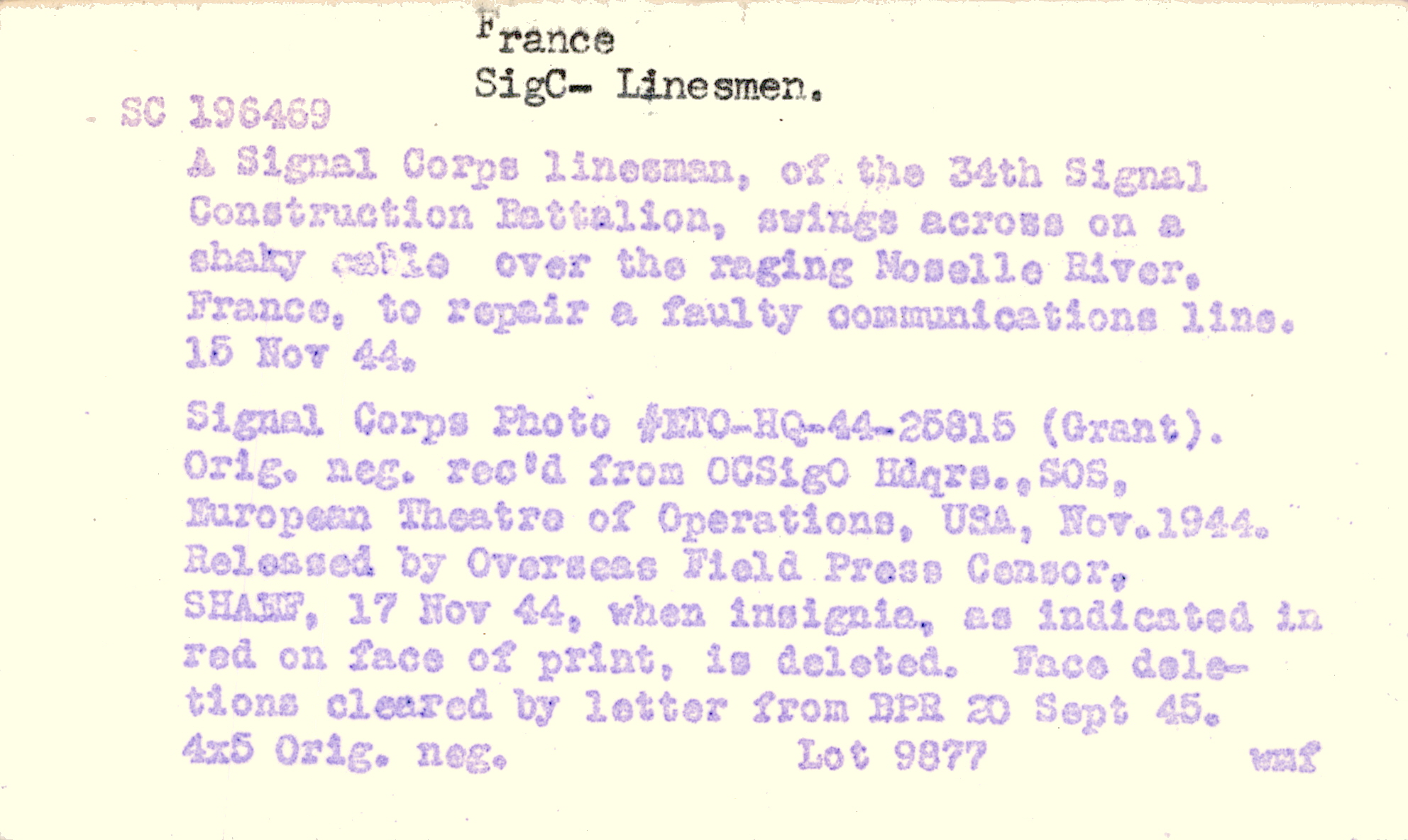
Found on 12 August 2026, and it is the nearest thing to a photograph of him this archive is ever likely to hold. A Signal Corps photographer named Grant spent three days with the 34th Signal Construction Battalion in the Moselle sector in November 1944, and the Army's own shelflist to negatives 111-SC-196000–196999 carries five consecutive caption cards for the unit — SC 196465 to SC 196469, frames 0492 to 0496. They describe, in order: linesmen stringing wire while newly placed 155 mm howitzers fire on German positions on the Third Army front; a jeep driver and machine gunner taking a break on the road to Château Salins as a snowstorm rages; men laying a submarine cable across the Moselle in strong winds, raging currents and continuous rain; a lineman tying a complicated wire junction in the rain on a heavily loaded pole; and a linesman swinging across the river on a shaky cable to repair a faulty line. Every card is stamped RESTRICTED and cleared by the Overseas Field Press Censor at SHAEF on 17 November 1944 — one of them only "when insignia, as indicated in red on face of print, is deleted." All five are 4x5 original negatives, Lot 9877. He is not named on any card, and no card names any individual. But this is his battalion, at work, at a moment when he was serving in it — and it is the answer to what he actually saw: rain, mud, a flooded river and artillery, with a wire crew going up poles anyway. The negatives survive at the National Archives Still Picture Branch and can be ordered by number. [12]
The records themselves
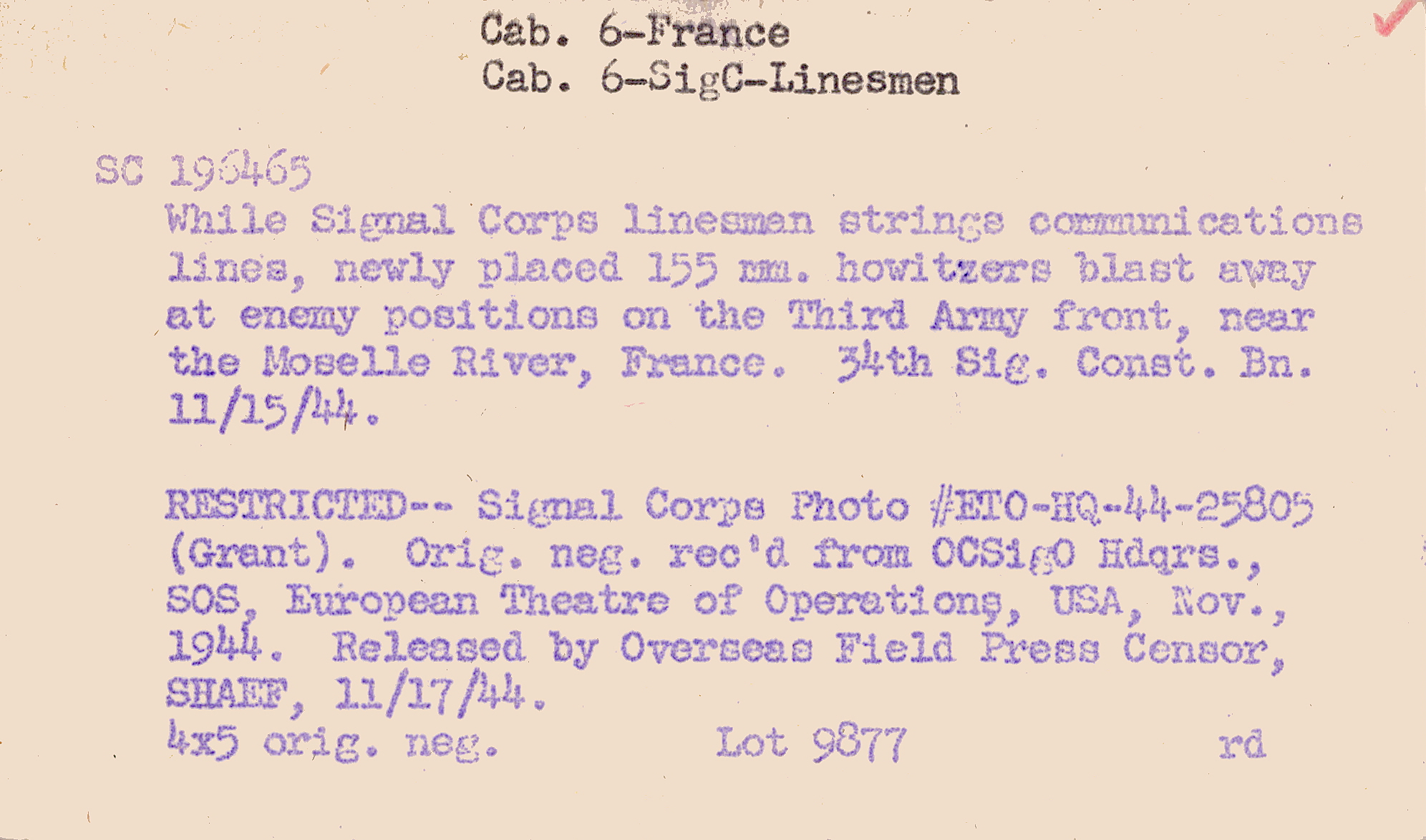 Tap to open a larger copy
Linesmen and 155 mm howitzers on the Third Army front, Moselle River
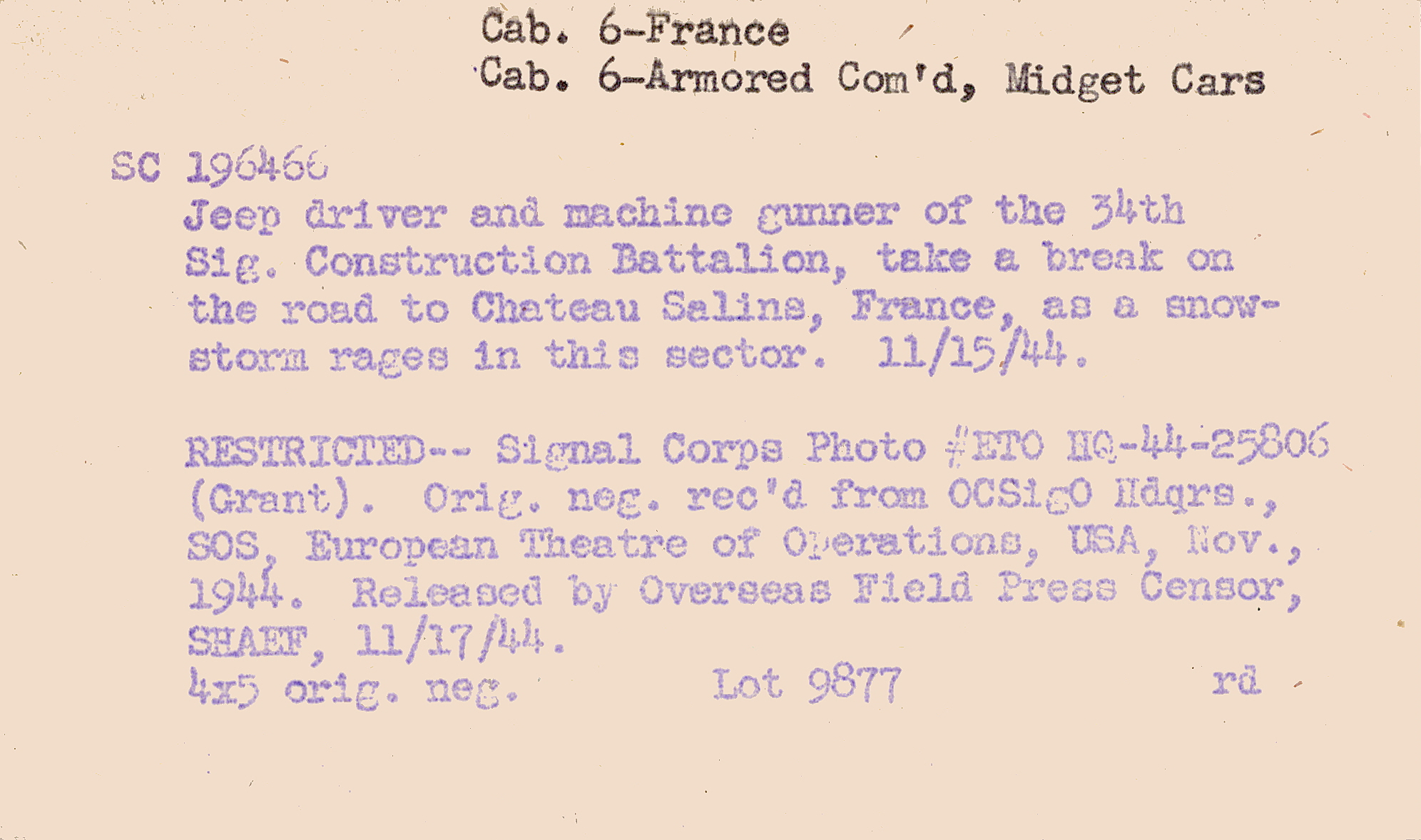 Tap to open a larger copy
Jeep driver and machine gunner on the road to Château Salins in a snowstorm
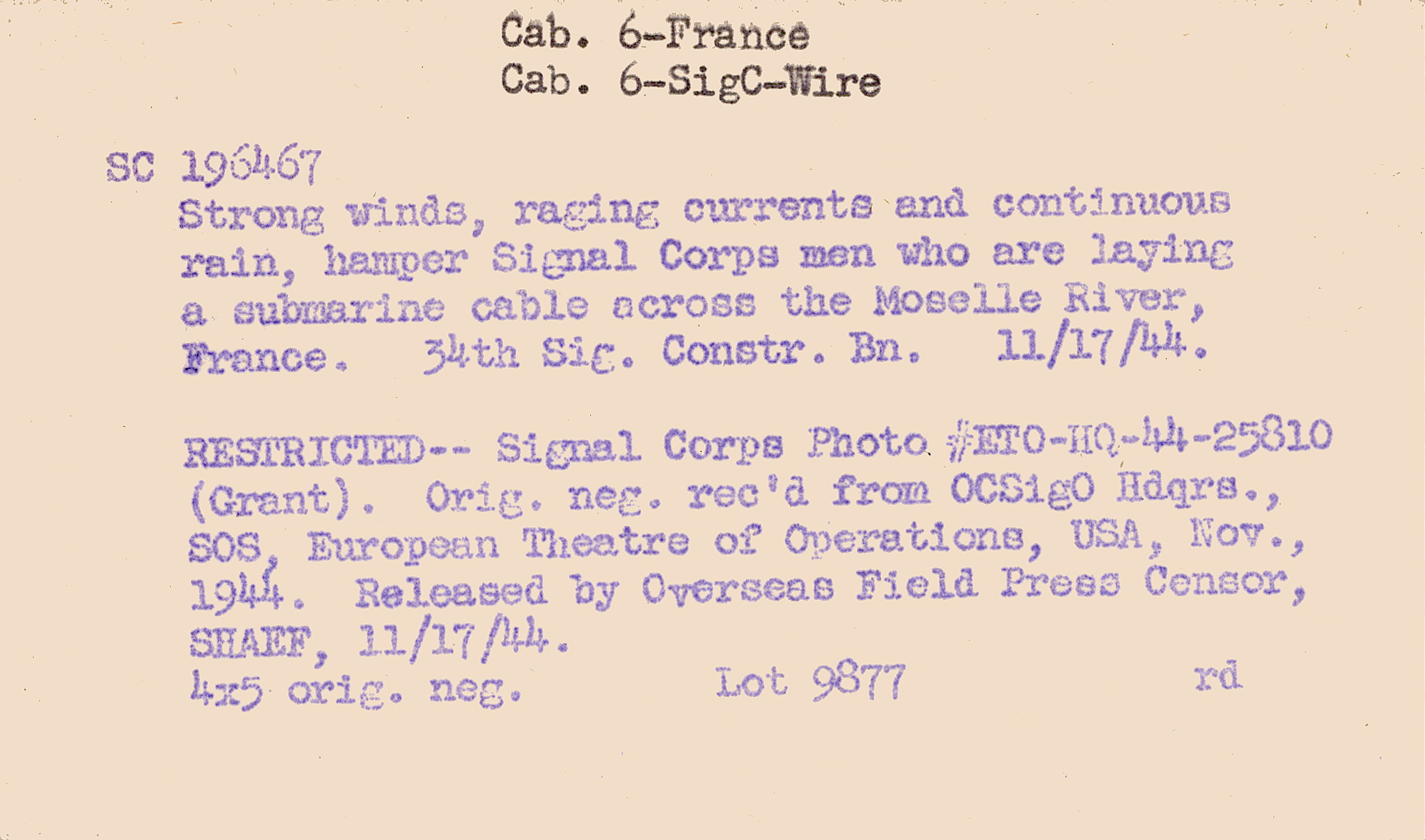 Tap to open a larger copy
Laying a submarine cable across the Moselle
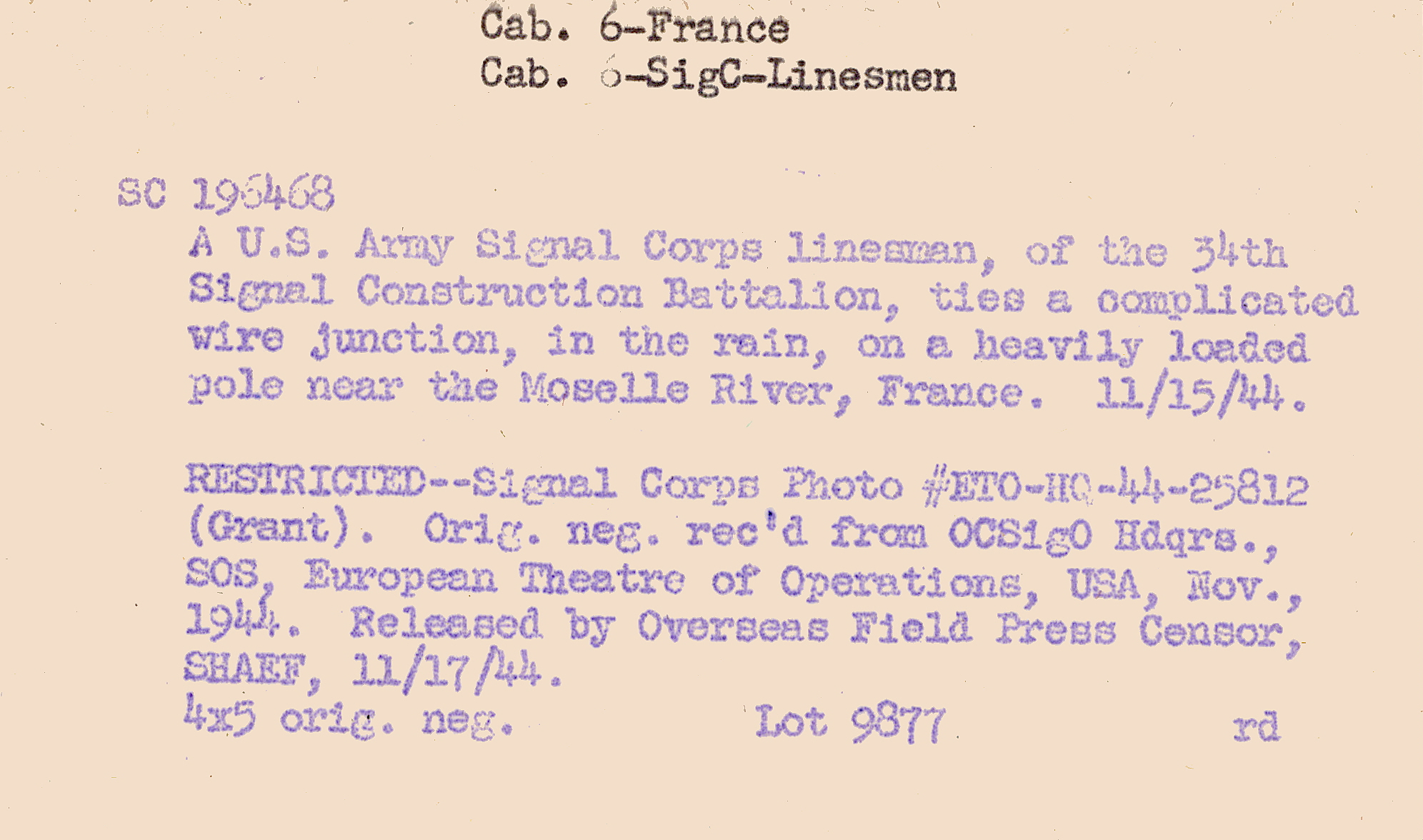 Tap to open a larger copy
Tying a wire junction in the rain on a loaded pole
 Tap to open a larger copy
Swinging across the flooded Moselle on a cable to repair a line
Proved by a record
Fifteen men — his own detachment, counted on one day in France
Found on 13 August 2026 in the National Archives at St. Louis: the daily morning reports of his own detachment, filmed on Reel 572, classified SECRET when they were made and free to read now. He was not a man in a battalion of hundreds. He was a man in a detachment of fifteen — two officers and thirteen enlisted men — commanded by Captain Fred Levy of the Medical Corps, who signed the form. Four of the thirteen were drawing rations from other organizations that day, which is to say they were out with the line companies rather than at the aid station. The entry for 26 August is one of the few in the month that is not simply No Change: departed grid N-920734 at 1000, arrived X-330725 at 2000 — a ten-hour road move, at the height of the Allied race across France. The other thirty days record the station by grid reference and nothing else. He is not named, and that is the good news. A morning report names a man only when something happens to him — sick, wounded, promoted, transferred, dead. Through the whole of August 1944 the medical detachment reported no change to any of its fifteen men. [13]
Proved by a record
How big the battalion was — 249 enlisted men in one company alone
His page carried an open question — how many men were in the battalion? — because the War Department table that fixes it, T/O & E 11-25, is not online free, and the figure of about five hundred that circulates online traces back to an uncited hobbyist page. The morning reports answer it from the other end, with the actual count rather than the authorized one. On 4 August 1944 Company B alone held five officers and 249 enlisted men, of whom 241 were present for duty. The battalion also had a Company A and a Company D — both already documented here from its own general orders — a headquarters company, and the medical detachment of fifteen. So the circulating figure is too small, not too large. This is a partial answer and is recorded as one: Companies A, C and D have not been read, and no single form states a battalion aggregate. The same page carries the only man named in Company B that day: Private Richard F. Wilson, 32829006, returned from detached service to duty. [14]
Proved by a record
The Bulge, day by day — where his detachment actually was
Thirty-one forms, one for each day of December 1944, found on 13 August 2026 on Reel 465 at the National Archives at St. Louis and stamped SECRET when they were written. They are the closest thing that exists to a diary of where he was during the Battle of the Bulge, and they are complete: no day is missing. 1 to 6 December — Jarville, an eighth of a mile south-east of Nancy. Six days, every one of them recorded as No Change. 7 December — the first move. Departed Grid Coor U-875095 at 0900. Arrived Grid Coor Q-225545 at 1200. Three hours, about sixty-five kilometres north-east. 7 to 21 December — one and a half miles north-west of the Cité de Valmont, the miners' settlement beside Saint-Avold in the Lorraine coalfield, ground the Third Army had taken at the end of November. They were here on 16 December, the morning the German offensive opened in the Ardennes eighty miles to the north — and the form for that day says No Change, as does every other day they spent there. Whatever was happening at Bastogne, nothing was yet happening to them. 22 December — the move that puts him in the battle. Departed Grid Coor Q-225545 at 1130. Arrived Grid Coor P-665057 at 1630. Five hours on the road, signed by Captain Fred Levy as before. That was the day Patton's Third Army began its counterattack north towards Bastogne, and the destination was Niederkorn, in the south-west corner of Luxembourg. 22 to 31 December — Niederkorn. They were still there when the month ended. The identifications hold together. On 25 December Company B reported from "Ditterdange, Luxembourg, P-663043" while the medical detachment was at "Niederkorn, P-665057" — a grid difference of about 1.4 kilometres, which is exactly how far Differdange is from Niederkorn. The grid is metric to a hundred metres and the places are right. The travel times agree too: three hours for sixty-five kilometres, five for eighty. This is what his Ardennes campaign star was earned doing — not fighting, but moving a battalion's communications forward behind an army that had turned ninety degrees in the snow. [15]
Proved by a record
Four of his thirteen, named — promoted at Niederkorn on 30 December
In a month of forms reading No Change, one day has names on it. On 30 December 1944, at Niederkorn, four privates of the medical detachment were promoted to private first class: Robert L. Dickson, Anthony Fiore, Mitchell Siegel and Charles W. Taylor. They are four of the thirteen enlisted men he served beside, and this is the only place in the archive where any of them is named. He is not among them. Why not is not documented. His discharge says only "Highest grade held CPL" and never dates the promotion, and Medical NCO 673 is a job code, not a rank — so "he was already an NCO" is a reasonable guess and nothing more. What can be said is that by then he had twenty-one months' service, was twenty-nine at induction and a stock clerk by trade in a detachment that ran on paperwork, and that MOS 673 is the detachment's senior enlisted billet, which somebody among those thirteen had to hold. The morning reports will settle it. They record grade changes in exactly this form — Company A's return for 3 January 1944 carries "39375647 Miller Tec 4 — Rd to Pvt" — so his promotion is on one of these reels, in a month not yet identified. One of the four ties the record together. Mitchell Siegel, 36357174, appears on the typed company roster filmed in August 1944 as a private of the line — the same man, the same battalion, four months and a country apart. [16]
Proved by a record
Fort Ord, California — five weeks before he sailed for Europe
Looked for on 13 August 2026 while trying to date his promotion, and it answered a different question instead. In January 1944 the battalion was at Fort Ord, on the coast of California — released from Fourth Army and assigned to III Corps on 15 January — and he sailed for the European Theater on 11 February. A unit training on the Pacific shore was across the continent and at sea inside a month. The returns for that month are the liveliest in any month read so far, because a battalion in garrison generates news a battalion in the field does not. Three officers went on fifteen days' leave; a fourth, 1st Lt Edward M. Forus, was posted in as company officer. Private Fehle was moved from confinement with the 125th Infantry at Gilroy to the battalion guardhouse at Fort Ord at 1800. Private First Class Way went to hospital at Camp McQuade. And Technician Fourth Grade Miller was reduced to private. No separate medical detachment reports in this month at all — the battalion files Headquarters, Company A and Company B and nothing else. Either the detachment was not yet reporting on its own, or its men were still carried on another company's rolls. That is worth knowing about him: the fifteen-man detachment he served in at Nancy and Niederkorn may not have existed as a unit when he left the United States. [17]
Proved by a record
Five campaigns: Normandy, Northern France, Rhineland, Ardennes, Central Europe
The campaign credits are listed alphabetically on the form, not in order. In sequence they run Normandy, Northern France, the Rhineland, the Ardennes and Central Europe — the invasion, the breakout, the German frontier, the Bulge and the drive into Germany. A signal construction battalion laid and maintained the telephone and telegraph lines behind an advancing army; he was its medical NCO. He was not wounded. [5]
Proved by a record
Sent to the Pacific — and arrived nine days after the war ended
With Germany beaten, he was shipped to the Central Pacific. He left on 17 July 1945 and landed on 23 August — Japan had surrendered on the 14th. It is why an infantryman's Europe record also carries the Asiatic Pacific Service Medal. He started home on 19 November and reached the United States on 2 December. [5]
Proved by a record
Honorably discharged at Fort Dix, a corporal
Released under demobilisation on an adjusted service rating of 74 points, scored at 2 September 1945 — the system that decided who went home first. He was given $300 mustering-out pay in instalments, $3.90 travel pay, and a lapel button. Total length of service: two years, eight months and twenty-nine days. [6]
Proved by a record
The President's letter
The standard message issued to every discharged serviceman, over Truman's signature. The family kept it. [7]
Proved by a record
What his medals actually were — and were not
He held no decoration for valour or achievement — no Bronze Star, no Silver Star, no Commendation Medal, and no Purple Heart: block 34 of his discharge reads Wounds received in action: NONE. Of the six entries in his decorations block, one is not an award at all — GO 33 WD 45 as amended is the War Department order that authorised his campaign credits. Three more are presence medals, given for being in a theatre rather than for anything done there: the World War II Victory Medal, the American Campaign Medal, and the Asiatic-Pacific Campaign Medal he earned on the voyage that reached the Philippines after the surrender. Two things are worth more than the rest. The European-African-Middle Eastern Campaign Medal is a presence medal too — but it is the one that carries his five campaign stars. Technically stars are credits and not decorations; in practice they are what his ribbon bar says about him, and five is a long war. The Good Conduct Medal is the only thing on the list that had to be earned and recommended. It went for exemplary behaviour, efficiency and fidelity across a qualifying period, on a commander's recommendation, and it could be withheld or forfeited for disciplinary trouble. It is not bravery. It does mean that in two years and nine months nobody had anything against him. None of this is a thin record for what he was. Decorations went overwhelmingly to the combat arms. A medical NCO in a signal construction battalion could do three years of hard and necessary work and finish with exactly this ribbon bar. [5]
Proved by a record
Fischbach, Luxembourg — his battalion shelled while building a line
This is the clearest picture the archive has of what his battalion actually did. On 11 February 1945 a wire crew of Company A was putting in communications installations near Fischbach, Luxembourg, when it came under heavy shellfire. A man was hit by shrapnel. Staff Sergeant Frank E. Yelenchic (33404030) and Technician Fourth Grade Chris Stako (33404012) left cover and carried him in, and Third Army decorated both for heroic achievement. John Fitzgerald was the battalion's medical NCO. A man wounded by shrapnel in his battalion is precisely the work he was there for. He is not named in this order and no record places him at Fischbach — but this is his unit, his war, and the kind of afternoon it involved. [11]
Proved by a record
The family story of the man's intestines — every occasion it could have been
The family remembers that he once held a man's intestines in with his jacket, and that it happened on a minefield. Nothing found so far names the incident, and this entry does not claim to. What can be done is to set out every occasion, documented in his battalion's own orders, on which one of its men was wounded — and to be plain that the story may not belong to any of them. 1 September 1944, France. "ROBERT L. WOLFE, 15078855, M Sgt, Sig C … France, 1 September 1944. Entered Service from Youngstown, Ohio." The battalion's senior sergeant, hit in the week of the pursuit east across France — the advance in which mined and booby-trapped roads were the characteristic danger to units working along them. 11 February 1945, near Fischbach, Luxembourg. A wire crew of Company A "forced to take cover from terrific enemy shelling"; a man wounded by shrapnel lying in an exposed position, his cries heard, and two comrades crawling out to carry him to safety. This is the only documented occasion when this battalion had a man down in the open who had to be brought in. If he ever worked on a casualty under fire, this is the one the paperwork knows about. But the order says shellfire, not a mine, and it does not name the wounded man. 14 March 1945, Rosport, Luxembourg. Sergeant Robert D. Schroeder of Spokane and Technician Fifth Grade Carlos L. Thompson of Harrisonburg, Louisiana, both Company D. Two men of one company, wounded the same day in the same village — the signature of a single blast. Rosport stands on the Sauer looking across at the Siegfried Line, ground the Third Army had fought over a few weeks earlier and which was heavily mined. Of the three, this is the best fit for a minefield. ### Why it may be none of them A medic treats whoever is in front of him. A signal construction battalion worked along roads, verges and field edges behind and between other units, and would come upon other outfits' casualties as a matter of course. If the man whose wound he closed belonged to an infantry or engineer company, he will never appear in the 34th's orders, and no amount of reading them will find him. ### And why it cannot be checked the way the Bulge was The day-by-day method that reconstructed December 1944 cannot reach 1945. The digitised morning reports stop dead at the end of that year: 809 reels for December 1944 and none at all for January 1945. Both Luxembourg incidents fall on the wrong side of that wall. The routes still open are the battalion's After Action Reports in Record Group 407, and the individual records of Wolfe, Schroeder and Thompson. [18]
Proved by a record
Japan — his battalion under I Corps, and marked for the voyage home
The emptiest line on his discharge was the Pacific. It says only that he departed 17 JUL 45 to CPTO, arrived 23 AUG 45 — nine days after Japan surrendered — and came home on 19 November. Nothing said what he did in between, or even which country he was in. Found on 13 August 2026 in I Corps's own Signal Section report for the occupation of Japan: his battalion was there, and under I Corps. The report lists the corps signal units in the Osaka–Kyoto–Wakayama area at the start of October 1945 and then records a decision about his: > "It had been decided that the 34th Signal Light Construction Battalion (turnabout shipping) would revert from I Corps control to KOBE Base." "Turnabout shipping" is the phrase that matters. It means the unit was not staying for an occupation tour — it was to be turned round and sent home. The decision is recorded by 1 October 1945, and he sailed for the United States on 19 November. The paperwork and the voyage agree. The designation is worth noting too. The battalion is called the 34th Signal Light Construction Battalion here — the title the War Department's table of organization, T/O & E 11-25, took on in February 1944. It is the same unit under its later name, and this is independent confirmation of the retitling found while trying to establish how many men it held. [19]
Proved by a record
Four hundred and forty-four men — the battalion counted, at last
The strength question, asked on 12 August 2026, is answered. I Corps's troop list for the occupation of Japan gives every unit its strength and the island it staged from, and under Signal it reads: 34th Sig L Cons Bn — 444 — Luzon. So the battalion was 444 men, and the figure of "about five hundred" that circulates on uncited reenactment pages turns out to be close after all — for 1945. It does not agree with Europe, and the disagreement is the point. In August 1944 Company B alone returned 249 enlisted men. A battalion of four line companies at that size, plus a headquarters company and a medical detachment, cannot have been 444. The unit that reached Japan was a good deal smaller than the one that crossed France — which is what a year of casualties, transfers and point-score demobilisation does to a battalion. And it places him. The list says the battalion staged from Luzon. His discharge has him arriving in the Pacific on 23 August 1945 and Japan is not mentioned; the month between was spent in the Philippines. [20]
Proved by a record
Sailing for a landing that might have been opposed
The occupation of Japan had a codename — Operation BLACKLIST — and his battalion is named in its signal annex, tasked alongside the 293d Joint Assault Signal Company to establish communications facilities. What surrounds that tasking on the same page is the striking part. The annex allots shore fire control frequencies with their code names — Green River for Navy gun control, then Whiskey, Bourbon, Tequila, Mabel, Sourpuss, Coca Cola, Mary Boss, Vodka, Joe Blow — and instructs that "frequencies for shore fire control will be assigned to beaches, red, white, etc" and that "assault battalion will report in to their respective nets." Japan had surrendered on 15 August. The plan he sailed under still provided for naval gunfire onto coloured beaches and for assault battalions reporting in. Nobody knew whether the surrender would hold, and the paperwork was written for both outcomes. [21]
Proved by a record
Released from I Corps — and the machinery of going home starts
I Corps's signal narrative dates it exactly: on 1 October 1945 the battalion was released from I Corps and reassigned to Headquarters, ASCOM O. A separate passage records that it had been decided the battalion — marked "turnabout shipping" — would revert to Kobe Base. The reason is given plainly in the same report: by the end of the first week of October the corps units moving through Wakayama had cleared on to their occupation zones, and I Corps no longer needed to run a signal centre there. There was also, it notes, "extensive employment of existing Japanese wire lines throughout the Corps area of occupation" — the country's own telephone network was intact enough to use, so a construction battalion was surplus to requirements. He sailed for the United States on 19 November 1945. [22]
Proved by a record
Died
St. Francis Hospital
From our family tree - no record found yet
His discharge recorded at Hudson County, two days after he died
The certificate carries a Jersey City stamp of 16 March 1981. He had died on the 14th. Someone took his discharge to the Register's office within two days — the ordinary business of a veteran's funeral, and a small measure of how these papers were kept. [6]
Proved by a record
Original records
5 further records are shown in the timeline, beside the event each one documents.
 Tap to open a larger copy
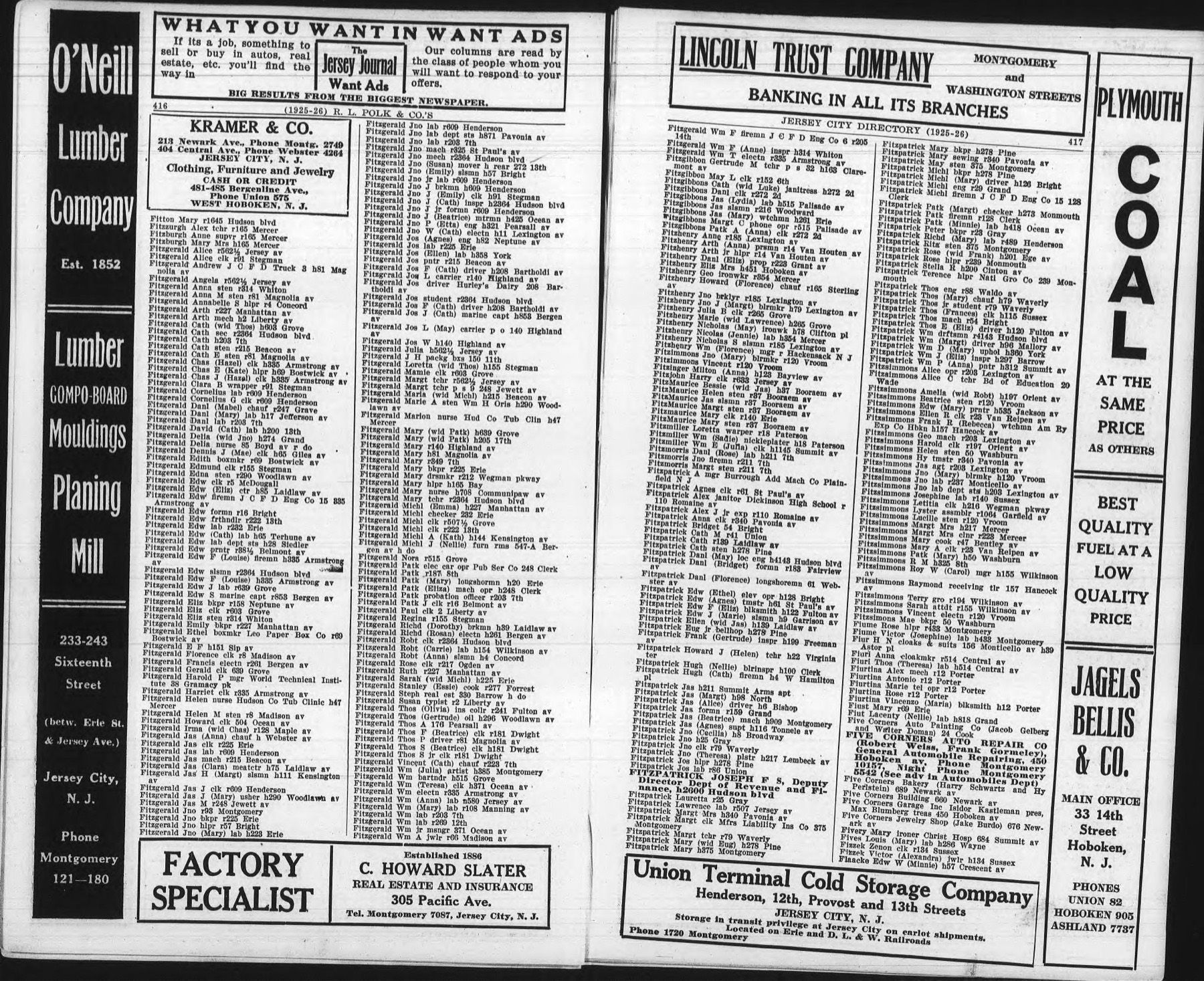
Jersey City directory, 1925–1926, David and Cath Fitzgerald entry
A city directory is an old address book that often lists a person's home and job.
What the records say
11 records transcribed.
Record exhibit
1920 United States census: David and Catherine Fitzgerald household
A census is a government list of the people who were living in a home.
Partly proved
Verbatim transcription currently held in this archive — reproduced in full.
Jersey City, Hudson County, New Jersey: John Fitzgerald, born about 1914 in New Jersey, with parents David Fitzgerald and Catherine Fitzgerald and siblings Mary and Margaret.
Record exhibit
1930 United States census: David and Cathrine Fitzgerald household
A census is a government list of the people who were living in a home.
Partly proved
Verbatim transcription currently held in this archive — reproduced in full.
Jersey City Ward 15, Hudson County, New Jersey: John J. Fitzgerald, born about 1914 in New Jersey, with parents David and Cathrine Fitzgerald and siblings Margaret M. and Mary A.
Record exhibit
U.S., World War II Draft Cards Young Men, 1940–1947: John Joseph Fitzgerald
This old record gives information about the person or family named here.
Partly proved
Verbatim transcription currently held in this archive — reproduced in full.
John Joseph Fitzgerald; birth date 2 September 1913; birthplace Jersey City, New Jersey; registration date 16 October 1940; residence Jersey City, Hudson County, New Jersey. Ancestry record ID 301750207; image ID 44025_03_00023-01417.
Record exhibit
Jersey City directory — David and Cath Fitzgerald at 200 18th Street, 1925–1926
A city directory is an old address book that often lists a person's home and job.
Partly proved
Verbatim transcription currently held in this archive — reproduced in full.
[COMPILED] “Fitzgerald David (Cath) lab h200 18th.” [INFERENCE] “David (Cath)” is a strong match to the archive’s David–Catherine couple, but the row supplies no age or birthplace and is not joined to the 775 Newark Avenue row.
Record exhibit
Enlisted Record and Report of Separation (Honorable Discharge), John J. Fitzgerald, 14 December 1945
This old record gives information about the person or family named here.
Proved by a record
Full verbatim transcription — reproduced in full.
WD AGO Form 53-55, 1 November 1944. Transcribed from photographs of the original.
Record exhibit
Honorable Discharge certificate, John J. Fitzgerald, Fort Dix, 14 December 1945
This old record gives information about the person or family named here.
Proved by a record
Verbatim transcription currently held in this archive — reproduced in full.
Honorable Discharge. This is to certify that JOHN J FITZGERALD 32 775 493 CORPORAL 34TH SIGNAL CONSTRUCTION BN Army of the United States is hereby Honorably Discharged from the military service of the United States of America. This certificate is awarded as a testimonial of Honest and Faithful Service to this country. Given at SEPARATION CENTER FORT DIX N J. Date 14 DECEMBER 1945. EMIL SIOVITZ, MAJOR, QMC. | LIBER 30 PAGE 340 | Register of Hudson County | Jersey City stamp MAR 16 1981
Record exhibit
Presidential message of thanks to John J. Fitzgerald, signed Harry Truman
This old record gives information about the person or family named here.
Proved by a record
Verbatim transcription currently held in this archive — reproduced in full.
JOHN J FITZGERALD — To you who answered the call of your country and served in its Armed Forces to bring about the total defeat of the enemy, I extend the heartfelt thanks of a grateful Nation. As one of the Nation's finest, you undertook the most severe task one can be called upon to perform. Because you demonstrated the fortitude, resourcefulness and calm judgment necessary to carry out that task, we now look to you for leadership and example in further exalting our country in peace. [signed] Harry Truman — THE WHITE HOUSE
Record exhibit
War Department General Orders No. 114, 7 December 1945 — Units Entitled to Battle Credits: Ardennes
This old record gives information about the person or family named here.
Proved by a record
Verbatim transcription currently held in this archive — reproduced in full.
GENERAL ORDERS No. 114, WASHINGTON 25, D. C., 7 December 1945. UNITS ENTITLED TO BATTLE CREDITS. ARDENNES … a. Combat Zone. — The area forward of the line: Euskirchen-Eupen (inclusive)-Liege (exclusive), east bank of Meuse River to its intersection with the Franco-Belgian border, thence south and east along this border and the southern border of Luxembourg. b. Time limitation. — 16 December 1944 to 25 January 1945. … present for duty as a member of or attached to a unit listed … 34th Signal Construction Battalion.
Record exhibit
Controvich, Checklist of Signal Corps Unit Histories and Personal Memoirs, 1917 to the Present (February 2021) — no history of the 34th Signal Construction Battalion
This old record gives information about the person or family named here.
Partly proved
Full verbatim transcription — reproduced in full.
The checklist's convention is to print the wartime designation in square brackets beneath the modern battalion number, followed by its published histories. The 31st, 35th, 38th and 41st Signal Construction Battalions all appear that way with wartime publications. Under the 34th there is no bracket and no wartime title — only a 1955 booklet from Möhringen about the postwar corps signal battalion, a different unit.
Record exhibit
General Orders of the 34th Signal Construction Battalion, APO 403, 1944–1945 (declassified 2023)
This old record gives information about the person or family named here.
Proved by a record
Full verbatim transcription — reproduced in full.
Read by Apple Vision OCR from the digitised fiche and checked by eye. The fiche sequence runs 27th, 50th, 33d, 34th (frames 116–120), 35th, 38th Signal Construction Battalions. Stamped DECLASSIFIED by E.O. 10501, 6/1/2023.
Record exhibit
General Orders 139, Headquarters Third United States Army, 14 June 1945 — heroic achievement awards and Meritorious Service Unit Plaque, 34th Signal Construction Battalion
This old record gives information about the person or family named here.
Proved by a record
Verbatim transcription currently held in this archive — reproduced in full.
GO 139, Hq Third US Army, 14 Jun 45, cont'd — Staff Sergeant FRANK E. YELENCHIC, 33404030, Company A, 34th Signal Construction Battalion, United States Army. For heroic achievement in connection with military operations against an enemy of the United States on 11 February 1945. During construction of communications installations near FISCHBACH, LUXEMBOURG, the crew was forced to take cover from terrific enemy shelling.Show the full recordHide the full recordFull record, about 200 words
Hearing the cries of a man wounded by shrapnel, Sergeant YELENCHIC left the shelter of a ditch in which he had taken refuge, crawled to the exposed position where the injured man lay and, with the aid of a comrade, carried him to safety. … Technician Fourth Grade CHRIS STAKO, 33404012, Company A, 34th Signal Construction Battalion … same action. … AWARD OF MERITORIOUS SERVICE UNIT PLAQUE — By Direction of the President and under the provisions of Sec I, Cir 32 [and] Sec I, Cir 56, Hq ETO US Army, 27 May 1944, the Meritorious Service Unit Plaque is awarded to the 34th Signal Construction Battalion for service from 20 October 1944 to 26 December 1944.
Historical context
These background articles explain the places, work, and events in this entry.
Bayonne and the Industrial Waterfront, 1870–1920
The Bayonne in these family records was a new city built around water, rails and heavy industry. Bayonne Township was formed only in 1861, uniting older settlements on Bergen Neck; it became a city in 1869. The…
Sgt. Peter Cooney and the Fighting 69th
The Peter Cooney buried in France was a sergeant in Company M, 165th Infantry—the wartime number of New York’s celebrated 69th Regiment. His unit belonged to the 42nd “Rainbow” Division, assembled from National…
Reading Irish Civil Registration
The year 1864 is the dividing line in this family’s Irish paper trail. Civil registration began in 1845 for non-Catholic and civil marriages, but from 1 January 1864 the law required registration of all births,…
The Irish Road to Ipswich, Queensland
Most branches on this site point toward New York or New Jersey. The Hickey–McGreevy–McGuire cluster points in the opposite direction, to Ipswich, Queensland. The Australian evidence is uneven: cemetery records …
A Train Operator in Bayonne, 1914
James D. Leahey’s funeral entry records a compact working life: married, American-born, age twenty-eight, living at 83 West 12th Street in Bayonne, occupation “train operator.” He died on 1 June 1914, twelve da…
What we still don't know
- The draft registration index records a 2 September 1913 birth, while the 1920 and 1930 census indexes estimate about 1914; the exact draft-card date is preferred, but the minor conflict remains recorded.
- [CORRECTED — THE UNIT AWARD IS REAL] This page previously said a Meritorious Unit Commendation for his battalion was "probably a conflation" with the 34th Signal Company, which served in Italy. That was wrong, and the correction comes from a primary document: General Orders 139, Headquarters Third United States Army, 14 June 1945, awards the Meritorious Service Unit Plaque to the 34th Signal Construction Battalion for 20 October to 26 December 1944. The caution was reasonable — the two units really are confused online — but the doubt is now settled in the battalion's favour.
- Did he serve in the Second World War, and if so in which branch? Draft registration does not establish service. Research routes: NARA World War II Army Enlistment Records, 1938–1946 at aad.archives.gov, filtered to New Jersey, Hudson County, and birth year 1913; Hudson County Second World War discharge records held by the County Clerk; and the VA gravesite locator, which gives branch, rank, and war when a veteran has a marker.
- Obtain the draft card image for his street address, employer and place of employment, next of kin, physical description, and signature. It is available through Ancestry, Ancestry Library Edition at a public library, or NARA.
- Find his 1940 and 1950 United States census entries.
- Find his marriage record to Margaret Mary Farley.
- Find his 1981 obituary and establish his burial place.
- Identify which St. Francis Hospital was meant and obtain a record of his reported death there.
- Do not assign John to 200 18th Street from the 1925–1926 directory: that row names only David and Cath, not their children.
- [THE ORIGINALS ARE IN THE FAMILY AND SHOULD BE SCANNED] Four documents were photographed on 12 August 2026: the Enlisted Record and Report of Separation (WD AGO Form 53-55), the Honorable Discharge certificate, the Separation Qualification Record (WD AGO Form 100) and the presidential letter over Truman's signature. Everything here is transcribed from those photographs. The Separation Qualification Record has not been read — the photograph is too blurred — and it is the one that describes what he actually did day to day, in his own summary of duties. It is worth a flat, well-lit scan.
- [HIS SERVICE RECORD ITSELF] The 1973 fire at the National Personnel Records Center destroyed most Army records for men discharged before 1960, so his file may not survive — but the discharge in the family's hands is the reconstruction document the NPRC asks for, and a morning report search for the 34th Signal Construction Battalion would place him by date.
- [AN ODDITY WORTH NOTING] He is recorded single with one dependent at discharge in December 1945. He married Margaret Mary Farley afterwards. The dependent was most likely a parent — his mother Catherine Condon lived until 1961.
- [WHICH COMPANY? THE DISCHARGE DOES NOT SAY] It gives the battalion — 34th Signal Construction Battalion — not the lettered company within it. Two things would name it: the Separation Qualification Record in the family's folder, too blurred to read in the 12 August 2026 photograph, and the battalion's morning reports at the National Personnel Records Center, which list men by company day by day and are a separate series from the personnel files burned in 1973.
- [NOT IN THE NARA ENLISTMENT DATABASE — WHICH IS EXPECTED] Searched 12 August 2026: his serial 32775493 returns nothing in NARA's Electronic Army Serial Number Merged File, and neither John J. Fitzgerald it holds for Hudson County carries that number. NARA states the series "does not contain records of all World War II Army enlistees" — many punch cards were damaged and never recovered. A gap, not a puzzle.
- [THERE IS NO PUBLISHED HISTORY OF HIS BATTALION — DO NOT GO LOOKING FOR ONE] Checked 12 August 2026 against Controvich's Checklist of Signal Corps Unit Histories and Personal Memoirs (February 2021), the standard bibliography of the subject. Its sister battalions all published one — the 31st (an organisational history from Memphis in 1942 and a 188-page unit history), the 35th (a Newsfoto yearbook, c. 1946), the 38th and the 41st. The 34th Signal Construction Battalion has none. The only 34th entry is a 1955 booklet from Möhringen about the postwar corps signal battalion, a different unit entirely. The negative is controlled: the same search finds five other Signal Construction Battalions in the same list, in the same numeric sequence, formatted the same way. There is simply no book.
- [THE ROUTE TO HIS COMPANY: MORNING REPORTS, AND NARA HAS BEEN DIGITISING THEM] A search of the National Archives Catalog for "34th Signal Construction Battalion" on 12 August 2026 returned 27 results, most of them rolls of WWII morning reports — and those rolls carry a thousand digitised images each, free to view. Morning reports list a unit's men by company, day by day, and they are a different record series from the personnel files that burned at St Louis in 1973, so they survive. That is the document that would name his company, and probably place him on particular days. The rolls are titled by date and roll number rather than by unit, so the work is to find which roll covers the battalion and then read forward from March 1943.
- [TWO REFERENCE WORKS CHECKED AND SET ASIDE] The Order of Battle of the United States Army, World War II, European Theater of Operations on the Internet Archive is the Divisions volume and covers divisional signal companies only — it contains no signal construction battalion at all, so his absence from it means nothing. A second ETO order-of-battle scan has unusable OCR (gibberish throughout), so nothing can be concluded from searching it either. Neither is a negative about him.
- [THE FAMILY STORY TO GUARD AGAINST] Five campaign stars beginning with Normandy invite the conclusion that he landed on D-Day. He did not — see the timeline entry. The absence of a Bronze Service Arrowhead on his discharge is the specific evidence, and the campaign window (6 June – 24 July 1944) is what makes the star compatible with arriving weeks afterwards. What is genuinely unusual about his war is the other end of it — the redeployment that landed him in the Pacific nine days after Japan surrendered.
- [HOW TO FIND HIM BY NAME — THE FICHE ARE FREE AND ONLY PARTLY READ] His battalion's General Orders sit at frames 116–120 of FICHE_1446, RG 64, National Archives at St. Louis (catalog.archives.gov/id/483370102), and the whole fiche is 199 frames, digitised, free. Only a sample was read on 12 August 2026 and no Fitzgerald was found — but the frames read were Purple Heart orders, and he was not wounded. Good Conduct Medal orders are what would name him, and he certainly had one. Two more fiche matched the same search and were never opened: FICHE_87 (id 356267050) and FICHE_89 (id 356267450), 199 frames each. The image URLs follow the pattern `catalog.archives.gov/medialz/st-louis/rg-064/333187305/…_NNNN.jpg` with four-digit frame numbers, and Apple Vision OCR reads this typescript adequately.
- [HIS NAME IS IN NONE OF THE 594 FRAMES — A CONTROLLED NEGATIVE] Every frame of FICHE_1446, FICHE_87 and FICHE_89 — 198 real images each, 594 in all — was downloaded and read by OCR on 12 August 2026, twice over: Apple Vision here and three Tesseract segmentation modes in a parallel pass. No John J. Fitzgerald and no serial 32775493 appears in any of them. The one Fitzgerald in the whole set is First Lieutenant Donald Fitzgerald, 01045791, Coast Artillery Corps, given the Soldier's Medal for fighting an oil fire aboard a mined ship in the English Channel — a different man in every particular. The negative is controlled: the same sweep correctly finds the 34th Signal Construction Battalion at FICHE_1446 frames 0116–0120 and FICHE_89 frame 0034, and finds Good Conduct orders for three other battalions. So the reading works; he simply is not in these three fiche. Other fiche in the series remain unopened — the catalogue search returned 27 results.
- {'question': 'How many men were in the 34th Signal Construction Battalion?', 'detail': "Asked on 12 August 2026 and not answered, which is worth recording because the answer looked easy and is not.\n\nWhat the archive's own documents prove is the shape of the unit, not its size. Two companies are named in primary records: Company A, in General Orders 139 of Third Army for the Fischbach action of 11 February 1945, and Company D, in the battalion's own Purple Heart orders for Rosport. A battalion lettered as far as D had four line companies, and John Fitzgerald's own specialty — medical NCO — belongs to the headquarters and medical detachment that served all of them.\n\nThe War Department table that fixes the number is identifiable: T/O & E 11-25, titled Signal Construction Battalion in the April 1942 edition he was raised under, and retitled Signal Light Construction Battalion on 25 February 1944, with Changes 1 on 7 July 1944. The table itself is not online free. Figures of about five hundred men circulate on hobbyist reenactment sites with no citation, and are not recorded here as fact.\n\nTwo routes would settle it properly: the T/O & E 11-25 photocopy, which the Military Research Service sells, or the battalion's own morning reports at the National Archives at St. Louis, which state present-for-duty strength directly and of which nineteen were located unexamined on 12 August 2026.\n\nPartly answered, 13 August 2026. The morning reports were found and read. Company B on 4 August 1944 held five officers and 249 enlisted men; the medical detachment held fifteen. What remains is Companies A, C and D.\n\nAnswered, 13 August 2026: 444. I Corps's troop list for the occupation of Japan gives the battalion's strength outright. See the timeline — and note that it disagrees with the European figures, because the battalion shrank."}
References
- [1] 1920 United States census: David and Catherine Fitzgerald householdBack to citation 1a Back to citation 1b
- [2] 1930 United States census: David and Cathrine Fitzgerald householdBack to citation 2a Back to citation 2b
- [3] U.S., World War II Draft Cards Young Men, 1940–1947: John Joseph FitzgeraldBack to citation 3a Back to citation 3b Back to citation 3c
- [4] Jersey City directory — David and Cath Fitzgerald at 200 18th Street, 1925–1926Back to citation 4
- [5] Enlisted Record and Report of Separation (Honorable Discharge), John J. Fitzgerald, 14 December 1945Back to citation 5a Back to citation 5b Back to citation 5c Back to citation 5d Back to citation 5e Back to citation 5f Back to citation 5g Back to citation 5h Back to citation 5i
- [6] Honorable Discharge certificate, John J. Fitzgerald, Fort Dix, 14 December 1945Back to citation 6a Back to citation 6b Back to citation 6c
- [7] Presidential message of thanks to John J. Fitzgerald, signed Harry TrumanBack to citation 7a Back to citation 7b
- [8] War Department General Orders No. 114, 7 December 1945 — Units Entitled to Battle Credits: ArdennesBack to citation 8a Back to citation 8b
- [9] Controvich, Checklist of Signal Corps Unit Histories and Personal Memoirs, 1917 to the Present (February 2021) — no history of the 34th Signal Construction BattalionBack to citation 9
- [10] General Orders of the 34th Signal Construction Battalion, APO 403, 1944–1945 (declassified 2023)Back to citation 10a Back to citation 10b
- [11] General Orders 139, Headquarters Third United States Army, 14 June 1945 — heroic achievement awards and Meritorious Service Unit Plaque, 34th Signal Construction BattalionBack to citation 11a Back to citation 11b Back to citation 11c
- [12] Shelflist to U.S. Army Signal Corps Black-and-White Photographs, 111-SC-196000 to 196999 — five caption cards for the 34th Signal Construction Battalion, Moselle sector, November 1944Back to citation 12
- [13] Morning report, Medical Detachment, 34th Signal Construction Battalion, 26 August 1944Back to citation 13
- [14] Morning report, Company B, 34th Signal Construction Battalion, 4 August 1944Back to citation 14
- [15] Morning reports, Medical Detachment, 34th Signal Construction Battalion, 1–31 December 1944Back to citation 15
- [16] Morning report, Medical Detachment, 34th Signal Construction Battalion, 30 December 1944 — four promotionsBack to citation 16
- [17] Morning reports, 34th Signal Construction Battalion, Fort Ord, California, January 1944Back to citation 17
- [18] General Orders 2, Headquarters 34th Signal Construction Battalion, 17 October 1944 — Purple Heart, M/Sgt Robert L. WolfeBack to citation 18
- [19] I Corps, Signal Section report, occupation of Japan, October 1945 — the 34th Signal Light Construction BattalionBack to citation 19
- [20] I Corps troop list for the occupation of Japan — strength of the 34th Signal Light Construction BattalionBack to citation 20
- [21] I Corps signal annex, Operation BLACKLIST — communications to be established by the 293d JASCO and the 34th Signal Construction BattalionBack to citation 21
- [22] I Corps Signal Section — release of the 34th Signal Light Construction Battalion, 1 October 1945Back to citation 22