Your engine bay,
from photographs.
A sparse 3D reference recovered from overlapping owner photographs. Rotate the points, or choose a source view and compare their projections with its photo. Engine and body observations now share a relative coordinate frame.
This reconstruction has arbitrary units. A measured length between identifiable reconstructed points is needed for physical scale; corresponding body datums are also needed for chassis alignment. The optional native overlay below uses provisional CAD stud spacing for a conditional display scale; it does not supply that missing measurement. These dots are observations, not closed surfaces or a 1:1 collision model.
Loading the photographic reference…
Drag to orbit; scroll or pinch to zoom. Showing a source photo limits the dots to features observed in that image. Orbiting returns to the full point set. Photographs are displayed unchanged.
Engine and body, against the same photographs
Turn on Native engine to compare the current block, head, rocker cover, intake, carburetor, cleaner and major accessories with any of the 14 recovered source cameras. Current body surroundings adds the heater, front rails/crossmember and battery case envelope at their existing whole-car relationship to that engine. You can change opacity, hide the photo points or orbit the combined reference.
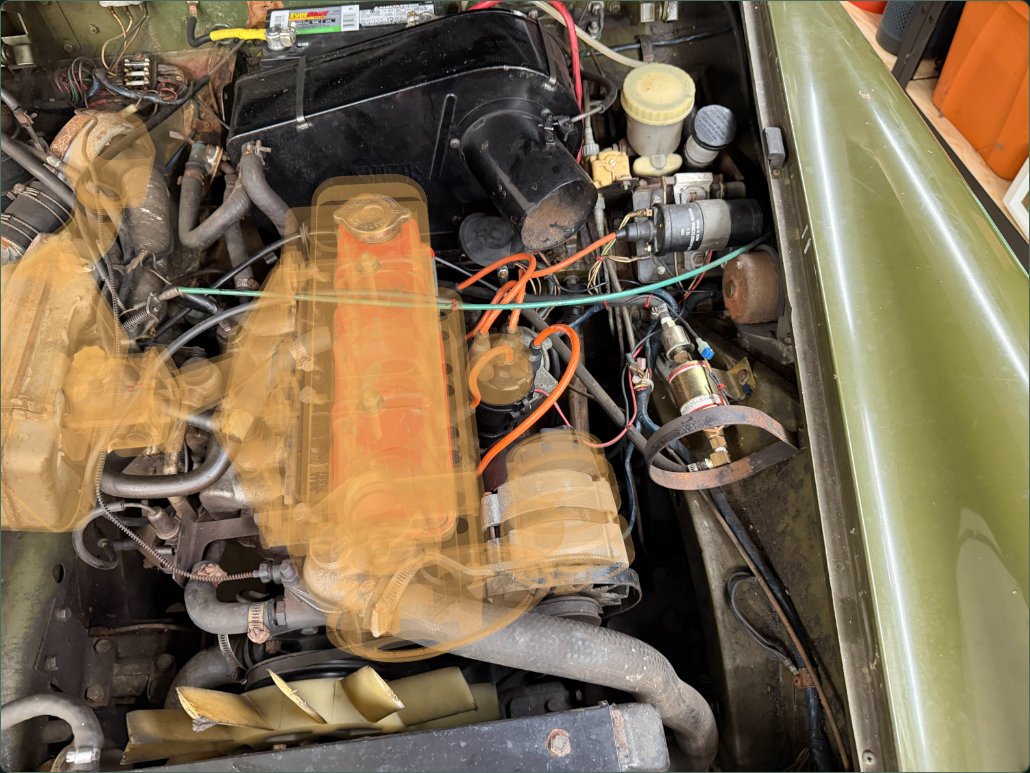
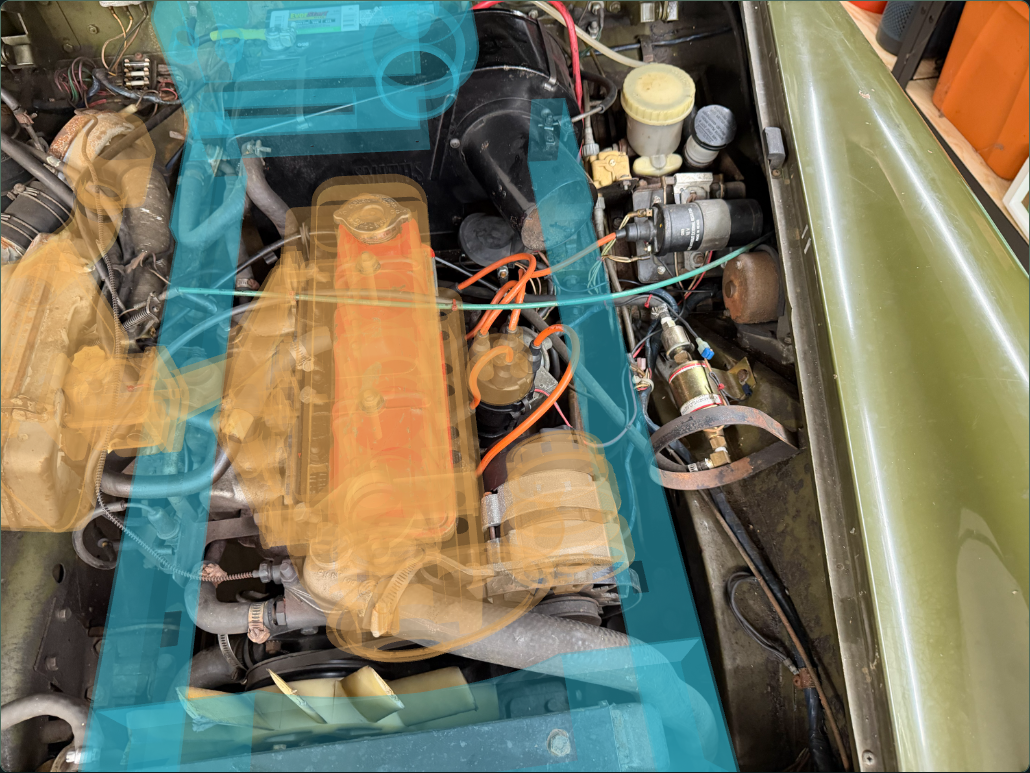
The engine is aligned using two interpreted cover-stud tips and an estimated cap-face normal. Its existing provisional 152 mm stud spacing supplies a conditional display scale. It is not an owner measurement or factory specification. Body parts receive no independent fit: visible mismatches expose the current registration problem. This comparison does not move the engine, gearbox, mounts or body in the primary whole-car model.
The reconstructed cap-to-rear-stud distance is about 0.352 of the stud span; the previous CAD ratio was about 0.581. That difference survives any physical scale choice. The linked filler neck, opening and cap move from source Z −128 to −93 mm, conditional on the retained stud spacing and estimated 7 mm cap/stud height difference. The remaining cap-center proxy discrepancy is about 6.9 mm at that provisional scale; it is not a fitted accuracy claim. The cap envelope now follows the silver four-lobed warning-cap form visible in these photos, retaining the old estimated 58 mm maximum footprint and 14 mm height. Its central recess is blind; no vent is inferred. Actual dimensions, mechanical center, neck attachment, locking/sealing and suitability as an oil cap remain unverified.
Workshop limit: amber/blue overlap or separation is a discrepancy between reference models. It is not evidence of contact, fitted clearance, tool access or an engine-removal route on your car. Battery catalog dimensions, interpreted photo points and unmeasured installed positions remain separate evidence classes.

The current intake overlay includes the photo-estimated carburetor pose and connected neck revision. The current cleaner shell has a separately documented photo-envelope revision. Dimensions remain conditional estimates, and the independent filter comparator conflicts with the new case.
The attempted exterior-photo bridge did not produce an accepted body camera. Read the bounded registration probe. The original 14-camera reconstruction stays unchanged; this result does not prove manual registration is impossible.
The alternator now uses a separate photo-estimated rigid pose. Its original dimensions remain, with unresolved belt/support boundaries recorded. The new asymmetric upper outlet and visible hose now replace the old hose/case conflict; radiator/pump/cowl registration remains unresolved.
The new formed cover, bounded radiator/frame placement and shorter landing tongue are included as blue surroundings. Open engine and surroundings together ↗. A close visible-cover match does not register the hidden radiator, full body or complete circuit.

What this adds
Fourteen existing photos now connect in one reconstructed bay fragment, including engine, front-body and rear-bay surroundings. The solve uses visible image features and estimated cameras, rather than assigning positions from an exploded drawing. Six other supplied images did not register into this main fragment; disconnected reconstructions are kept separate.
Original camera metadata distinguishes the main lens from two other-lens close-ups, and records two capture sessions. Shared visible features across those sessions do not establish unchanged hidden components or the car’s current state. This relative frame supports explicitly conditional reference construction; an independent installed datum chain is still needed for fitted clearances and replacement claims.
How to use it
Use the source views to inspect the observed surroundings and the CAD reference to explore component relationships. Missing points do not prove empty space. This data does not establish fitted clearances, tool access, working movement, replacement compatibility or a verified removal sequence.
Reconstruction evidence and limits
The main reconstruction registers 14 of 20 supplied images and contains 2,805 sparse points. The displayed subset has 2,305 points observed in at least three distinct images, with a maximum triangulation angle of at least five degrees and mean image error no greater than two analysis pixels. This filter removes weak tracks; it does not certify dimensional accuracy.
A separate per-image camera solve shares five front-bay images. Comparing corresponding tracks between the two pipelines gives a median difference of about 0.36% of their arbitrary reference span, and a 95th-percentile difference of about 1.66%. Both solves use the same photos and differ in feature extraction; this is sensitivity evidence, not independent survey validation. It does not establish millimetre accuracy.
Shared camera groups, a centered principal point, one radial distortion term and unchanged full-frame JPEG correspondence remain assumptions. Rounded original EXIF focal lengths are initial priors. The data uses PyCOLMAP’s sparse reconstruction; processing options, input fingerprints, camera poses and observation tracks are retained below.