Behind the
front bumper.
An open front shell and diamond-mesh intake replace the solid nose and earlier-style chrome grille/backing. The rubber moulding now has a rear cavity; a separate armature, paired mounting beams and inner support references show the connection toward the frame.
The parts plates distinguish GAN6 intake and bumper hardware. All contours, thicknesses, holes, mesh pitch, fixing positions and stations remain estimates. Existing owner photos show the locking-platform/cooling context and rubber bumper, but do not calibrate the front-end section or identify the hidden support variants.
A continuous front moulding
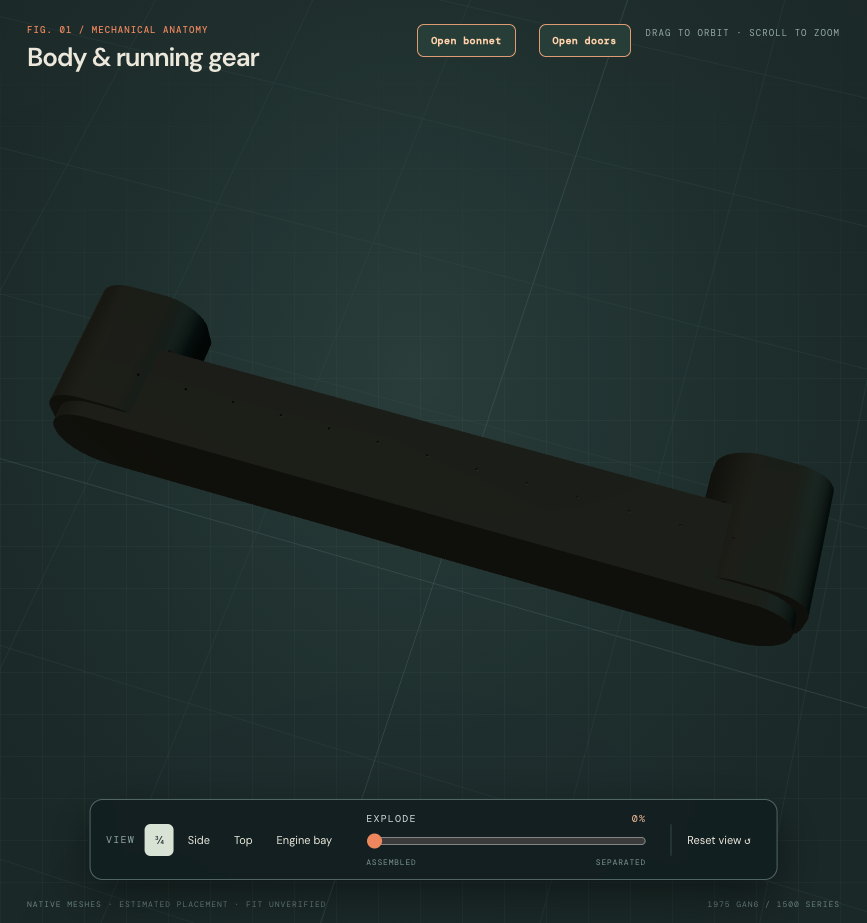
The long flat front face is replaced by a bowed shell and matching inner boundary. The full outer bounding envelope,corner-return rear ends,front-module position and26moulding rivet axes remain. Armature,clamps,tube,springs,beams and fixing references retain their native geometry.
Before · flat central face
After · continuous bow
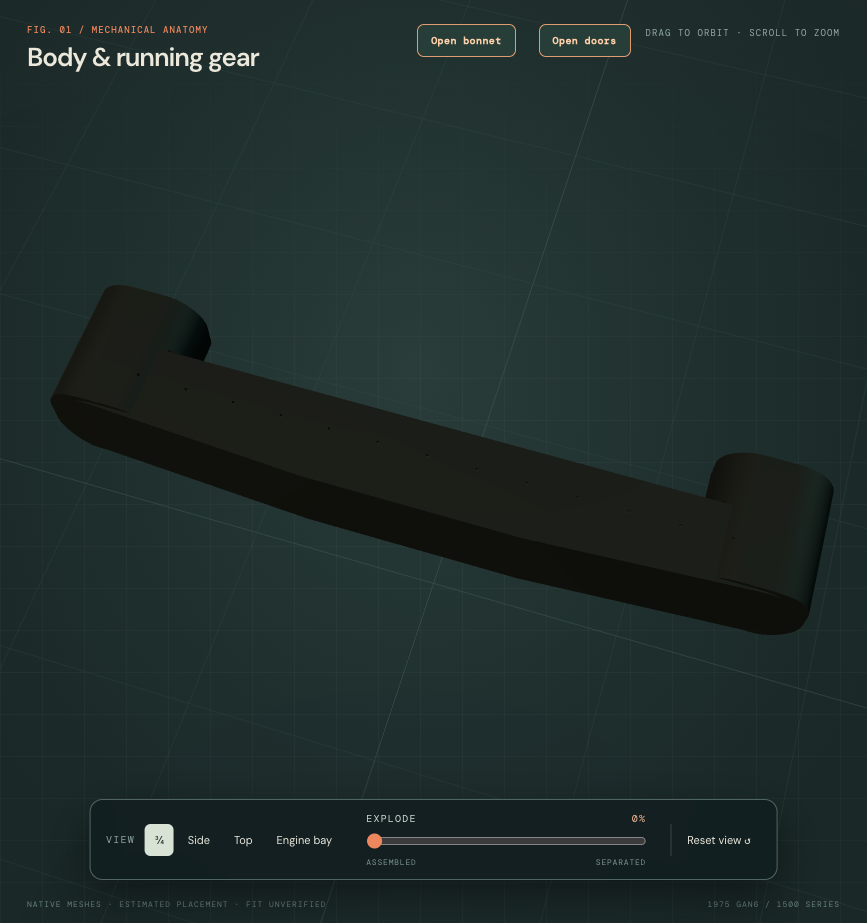
Factory ML0078/PDF269 supports the broad bowed moulding form. The35mm edge-relative bow,quadratic interpolation and inherited8mm projected-Z wall are construction estimates,not fitted dimensions or normal rubber gauge. Existing owner side/bay views do not recover front plan curvature. The apparent long opening in the exploded drawing is the rear armature cavity;that cavity and the separate nose intake already exist. No extra frontal opening is inferred or cut.
Native checks hold all eleven other mesh records/native volumes,outer bounds and joint/source contact figures. Existing rivet-group overlap of approximately41.01mm³ and towing/fixing-group overlap2432mm³ remain model discrepancies,not fitted interference findings;the shell is not moved to erase them. Existing wheelhouse contacts and beam-to-frame construction distances remain unchanged. None of these checks verifies actual clearance,compressed fit,impact function or a removal path.
Inspect the boundaries
Preserve the configuration differences
| Factory evidence | Comparison represented | Unresolved fitted detail |
|---|---|---|
| Plate 263 | CHA478 air-intake grille and four grille-to-locking-platform screws for GAN6, distinct from the preceding chrome radiator grille. | Actual grille identity, mesh construction, dimensions, orientation and fixing locations. |
| Plate 234 | CZJ565 front end and North American CZJ638/639 mounting-beam pair. Except-North-America CZJ586/587 is retained as a different catalog configuration. | Fitted cast/stamped identity, beam profile, section, attachments, repair history and body registration. |
| Plate 269 | Rubber bumper, separate armature and handed inner support references. Armature changes at GAN6-158716; earlier outer-spring hardware is a separate branch. | Fitted early/late arrangement, outer-spring branch, clamping/rivet map, loaded shape and fastening values. The outer-spring alternative remains unmodeled. |
Owner-photo reconciliation
Existing IMG_6853 was re-viewed for the painted locking platform, central circular latch region, access opening and adjacent cowl. IMG_6856 supplies wider bay context; IMG_6329 shows the rubber bumper in side view. The revised platform span and second access opening are estimates; the latter repeats an unverified symmetry assumption. Separate estimated lock, safety-catch and cable comparisons are now linked below; fitted geometry and operation remain unresolved.
How the model differs from the old blocks
The nose now has a real aperture rather than a solid volume hidden by a dark grille panel. The mesh contains open cells. A fixed upper return approaches the existing closed-bonnet leading profile to close an inherited drawing gap; its small separation is a display choice, not a measured panel gap or verified bonnet sweep.
The estimated 1.5 mm projected steel offset and 8 mm rubber shell offset provide visible sections, not manufacturing gauge. The armature is a generic open channel, and mounting beams are generic open longitudinal channels. Their drawing relationships do not establish bolted or welded ownership, fit, support strength, impact performance or towing/jacking function. The intake remains a browser reference. Native bumper/support and headlamp/body-interface exports now supply the nose and attachment comparisons; none is a fitted scan.
Relationship to the cooling stack
The new bonnet-hardware study ↗ adds separate lock, safety-catch, hinge and support boundaries. The retained opening animation remains illustrative.
The maintained radiator/cowl meshes, frame and native engine placement are unchanged. An open front aperture does not prove a connected air duct, cooling performance, radiator fit or removal space. Existing cowl/fan reference conflicts and the estimated common registration remain in force. Inspect the cooling-structure study before interpreting the front view as an installed fit.
Cover and armature share a display offset; beams stay fixed and inner support references separate independently. Select or isolate each to inspect its boundary. Those choices are not a verified assembly split, loosening order, lifting/support arrangement or radiator/bumper extraction path.
Native support chain and shared joints
The moulding, armature, mounting beams and inner springs now have native STEP geometry, with separate clamping plates, a hollow support tube/end tabs and fixing roles. The existing nose, intake, radiator/cowl and front body rails stay at their source stations. This exposes the major connections ahead of the cooling stack without claiming a bumper or radiator removal route.
Factory p.269 supplies two CHA254 clamping plates, 26 CHA307 moulding rivets, CHA321 support tube/four CHA365 rivets, handed CHA298/299 inner springs, four inner-spring-to-body nuts and two AHA6498 towing-eye roles. Rivet head stations follow the estimated outer profile with a 0.5 mm display gap; they are not fitted shank lengths or set-rivet geometry. Paired spring/beam shapes use an unverified mirror assumption. Shared estimated bores now pass through the cover/clamps/armature and tube tabs/web; spring and body-beam faces share their own estimated fixing axes. The four armature-side fixing sets are construction comparisons, not a verified fitted count.
CHA238 and CHA534 remain alternative armatures, with the change at GAN6-158716. Early CHA250 outer springs end at GAN6-158715 and remain unselected and unmodeled. The factory’s twelve spring plain/lock washers are not forced onto this partial branch. The silver/gold motif alternatives are not selected. Existing owner IMG_6329/6341/6853/6856 supports exterior and platform context, not the hidden hardware map.
Declared construction changes
The 8 mm cover offset is retained; native corner rounds approximate the prior silhouette. Armature/clamping/beam sections use 3 mm estimates and inner springs use unloaded 5 mm strips. The armature height follows the moulding’s estimated inner faces. Beam front ends shorten from 2.02 to 1.94 body units (67.7333 mm), meeting a shared rear-spring comparison plane. Base undersides lower 4.2333 mm to the retained rail-top plane. Neither change is an owner measurement, selected shim, weld specification or verified load path. Body rails are unchanged; no frame holes are invented.
The new sources intersect retained wheelhouse/rail references; see the geometry metadata for separate pair volumes. These are reconstruction discrepancies, not actual-car interference. Each beam has zero minimum source distance to its retained rail. Zero distance only describes the constructed drawing plane; it does not verify fitted seating, support, impact response or welding.
The cover, armature, clamps and tube share a display translation; beams remain fixed and spring/fixing comparisons separate illustratively. Threads, loaded washers, rivet setting, spring response, towing-eye capacity, safe support, tightening and verified replacement/removal paths remain unresolved. Isolating a body beam does not make it a detachable part, and modeled eye geometry does not approve its use for towing or recovery.
The headlamp housing/body study now adds open nose notches, hollow wing nacelles, backing bowls and shared retaining/body/trimmer passages. Lamp axes align to the old bulge centers by an explicit construction correction; fitted identity, beam/aim, wiring and removal paths remain unresolved.
Current shorter-front construction
The coordinated shorter-front reference supersedes the former nose, platform and bumper stations. Bonnet/wing contours, detailed lamp and bumper poses, landing/catch openings, support-beam lengths and wheelhouse front ends now follow a selected nominal overall-length comparison. The rear body, axles, engine/cowl and aft bonnet mounting stations stay. The front-only allocation remains estimated; current source contacts, fitted body joints, loaded support and replacement/removal paths remain unresolved.
Optional factory horn obstacles
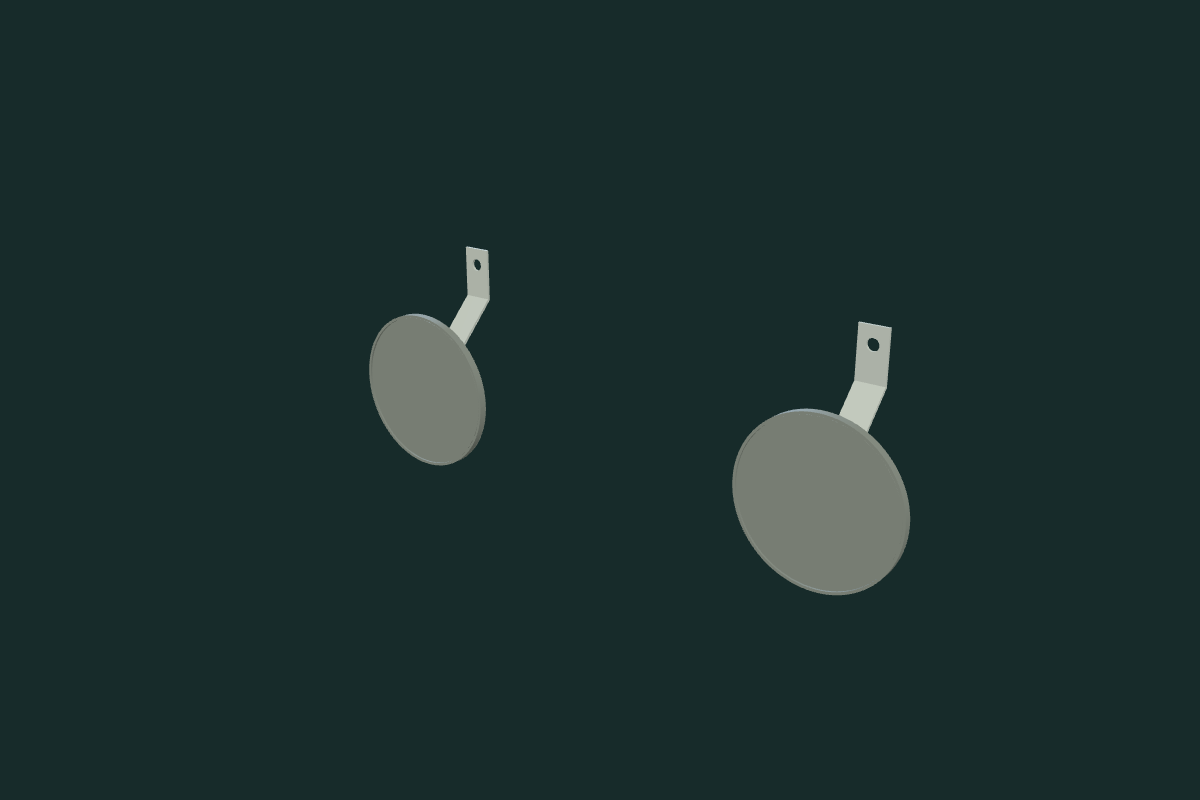
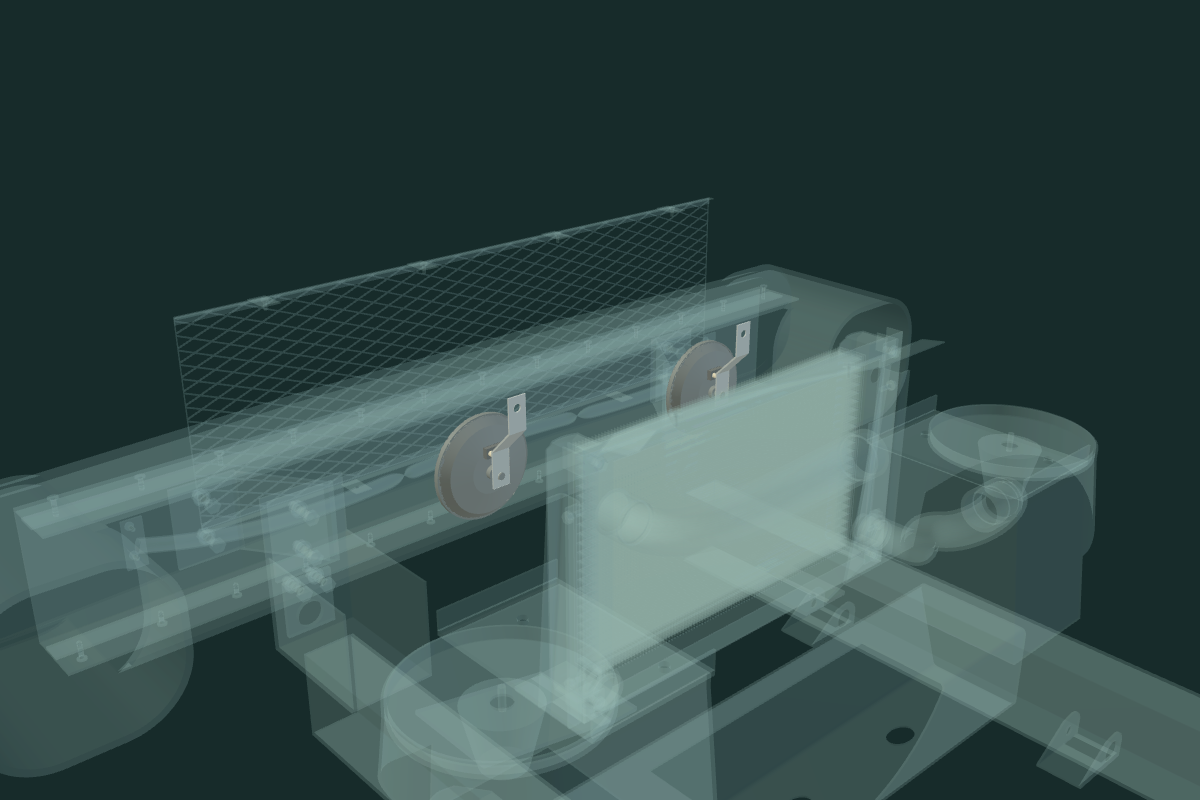
The factory parts book lists high- and low-note horns, but the whole-car reference had no horn assemblies. This select-only comparison adds the exterior family and folded bracket roles between the retained radiator and bumper drawings. Both comparisons stay hidden until selected. Owner photographs do not establish fitted horn presence, count, identity, condition or mounting position.
Select a complete assembly from the parts list, then use Isolate selected part to inspect its five native role groups. Clear the selection to hide the optional comparison and restore the surrounding references.
Catalog roles and alternatives
Factory plate MH0174A, PDF203 /107-H53/H54 lists BHA5367 high and BHA5368 low from GAN6-154101, and AHA6657 RH / AHA6658 LH brackets for twin horns. Earlier BHA4515/4514 and 37H7542/7543 horns and the flat 57H5309 bracket remain separate references. The plate's shared exterior illustration has two terminal cues; it does not prove the later unit's shape or terminal count.
The MGOC mixed-family replacement page distinguishes GGE101/102 one-terminal and GGE103Z/104Z two-terminal labels. Its application text does not resolve this car's fitted configuration. No polarity, earth path or wiring is assigned.
Independent construction, without a fit solution
The two bodies use an estimated 120 mm cover envelope, 18 mm body depth, 2–3 mm shell sections and a separate 1.5 mm front face/6 mm rim projection. The folded strips use a 100 mm rise, 30 mm offset, 22 mm width, 2 mm section and 9 mm bores. All boss, smooth-stem and terminal dimensions are estimates. High is displayed at body [170,550,1320] mm and low at [-170,550,1320] mm, both facing +Z. Those stations and the assignment of note to side are independent drawing choices, not recovered mounting geometry.
The closed front face is an exterior boundary, not a working or verified replaceable diaphragm. There is no coil, contact mechanism, acoustic model, frequency, current, ground circuit, relay or harness. Bracket bores and smooth stems do not establish threads, clamping, elasticity or loaded support. No body receiver or backing is fabricated, and no original bumper, body, cooling or engine part moves to make these comparisons fit.
The complete export has 22 groups and 89 valid positive solids. Twelve original bumper mesh records and their native volumes are preserved; ten new horn role groups contain twelve solids. The body-cavity, front-cover and bracket-bore witnesses pass. Forty-five new internal pairs and 2,190 pairs against 219 retained source groups have no positive material intersections in this bounded sample. Zero source overlap does not establish attachment, fitted clearance, cooling performance or a removal path.
Use the parked electrical inspection guide to record actual horn function. This geometry supplies no live testing, tightening, support, release order or verified removal/refit procedure.
A native open-web grille comparison
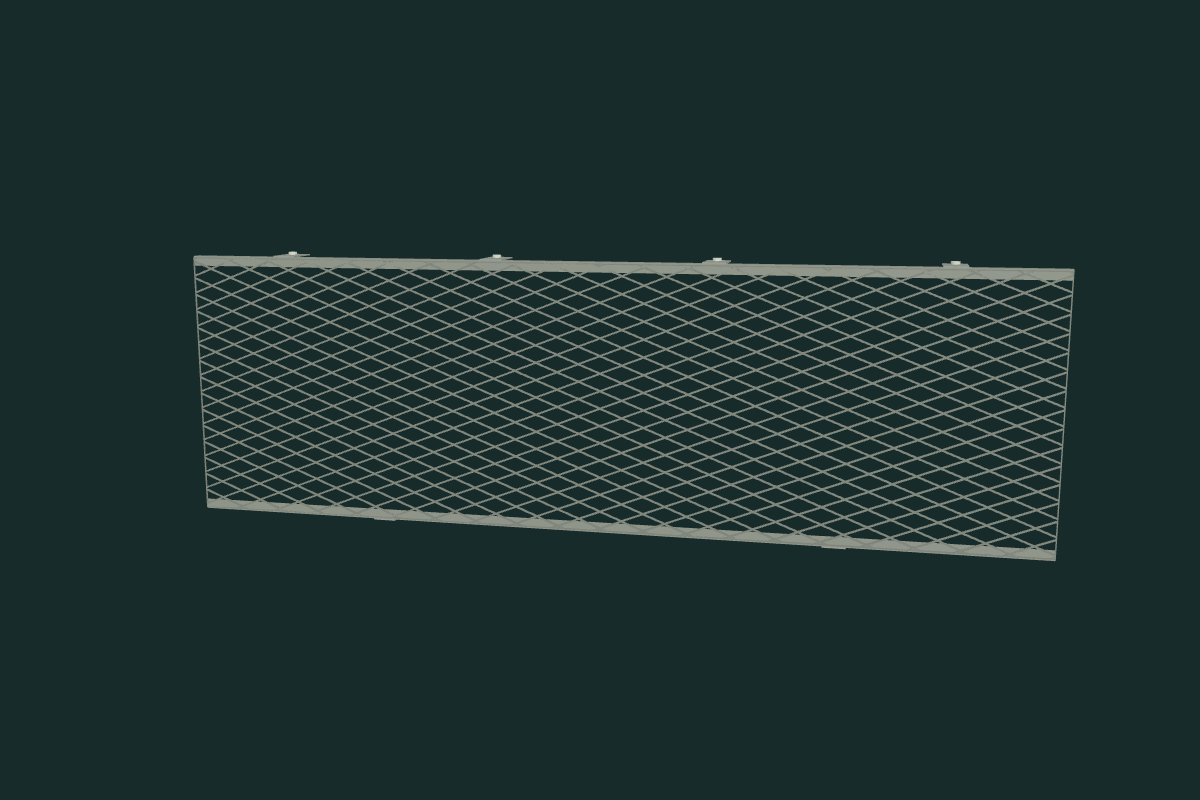
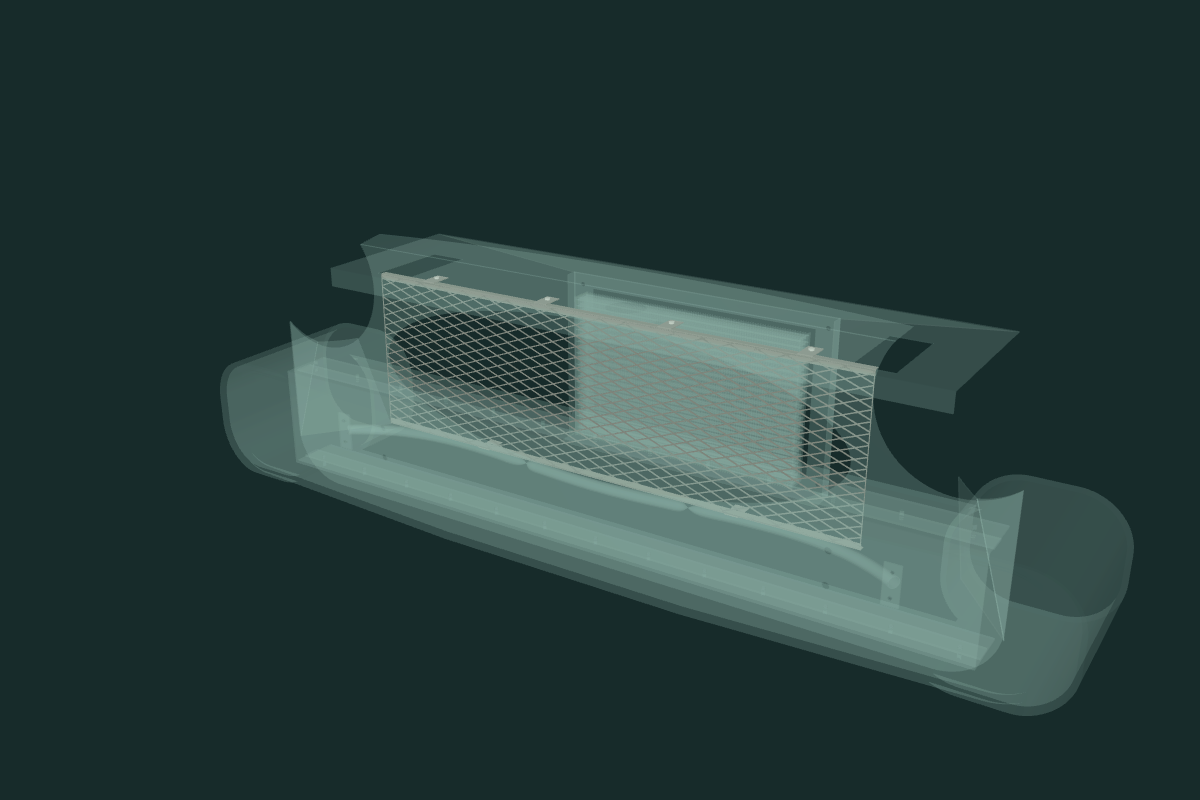
The intake grille now has a STEP/mesh reference instead of browser-only round crossing rods. A planar diamond-aperture web, two formed edge rails, four upper and two lower tab roles, and four upper screw cues remain one selectable assembly. Its panel reference rectangle and four upper lateral stations stay; the new sections, foot heights, bore offset and lower tab positions are estimates. Neighbors stay in their source poses.
Keep the source branches distinct
Factory plate ML0020B, PDF263 separates CHA478 and four AB608041 screws to the bonnet-locking platform. Its illustration includes lower tab roles, without a calibrated mounting map. The Rimmer CHA478 photograph supports flat diamond strands and formed edge strips/tongues. It does not measure this car.
MGOC labels its current replacement hex mesh; its catalog lists six GHF423 screws to landing panel and valance. That scope is broader than the factory's four platform screws. The model displays four upper cues and leaves the two lower bores without invented fixings or body receivers. Neither source establishes the fitted grille, mesh pattern, complete fixing count or drill map.
Held reference dimensions, estimated material
The browser panel reference rectangle is 795.8667 × 245.5333 mm at body Y592.6667 / Z1532.4667 mm. The former round wires/frame extended beyond that rectangle by their radii; it is a held construction rectangle, not an unchanged full-material envelope. The flat web uses a 1.2 mm section, 36 × 14 mm diamond holes on estimated 40 mm horizontal / 8 mm staggered-row pitches and a 1 mm perimeter web. The 8 mm rail faces, 9.4 mm returns, tab sections, 5 mm bores, smooth shanks and heads are estimates. No expanded-strand twist, forming/welding process, thread, loaded clamp or verified detachable-part boundary is reconstructed.
The complete export has 26 groups and 102 valid positive solids, retaining all 22 preceding mesh records/native volumes. The web has 673 apertures; 537 complete aperture centers and neighboring web material were checked. All six tab bores and adjacent material pass. Six new internal pairs have no positive material overlap. Across 916 pairs with 229 retained source groups, eight positive contacts remain, including about 1,649.42 mm³ web/bumper moulding and 1,432.56 mm³ edge-rail/landing-panel overlaps. They are unresolved reconstruction conflicts, not findings on the fitted car. No neighboring part moves to hide them; no airflow, cooling, strength or removal path is verified.