People, places and memory
Hampton Gate Tavern: testing the deed against the maps
Documented tavern; exact site unresolved
The tavern is real. The 1875 deed locates one Cavileer estate parcel near the bridge, but does not say the hotel stood on it. That distinction is the starting point for finding the building.
A widow and a ward in the record
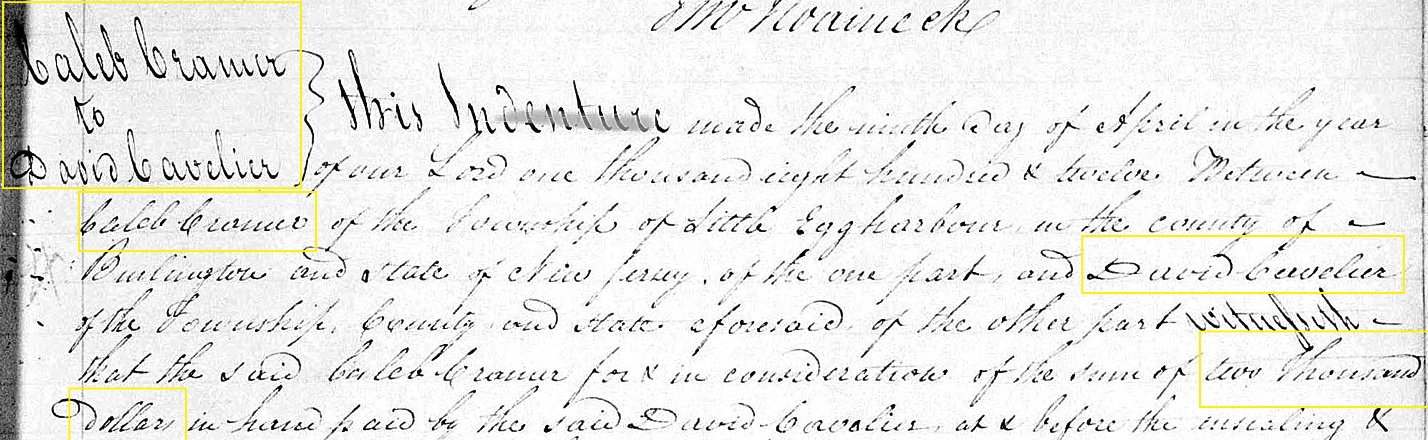
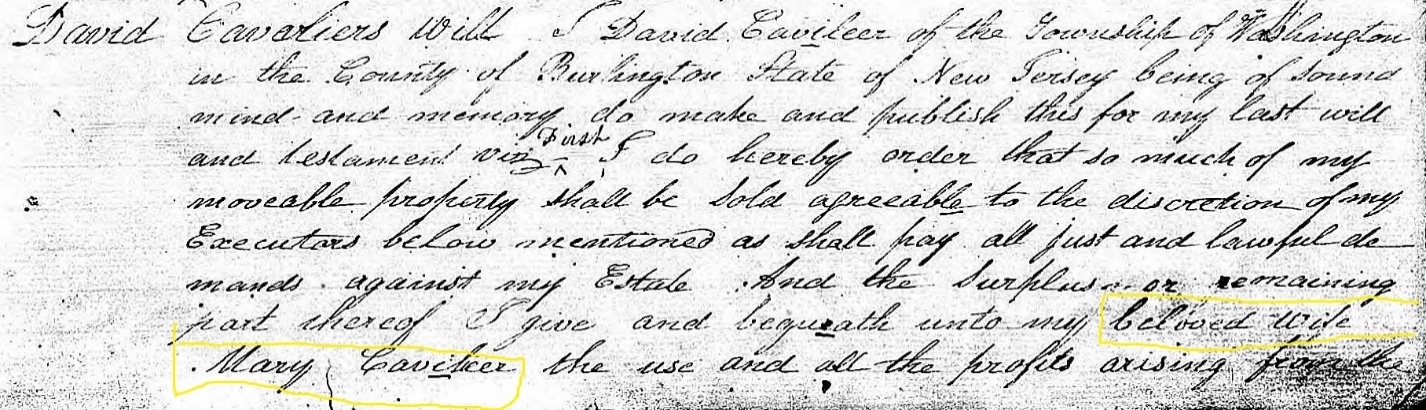
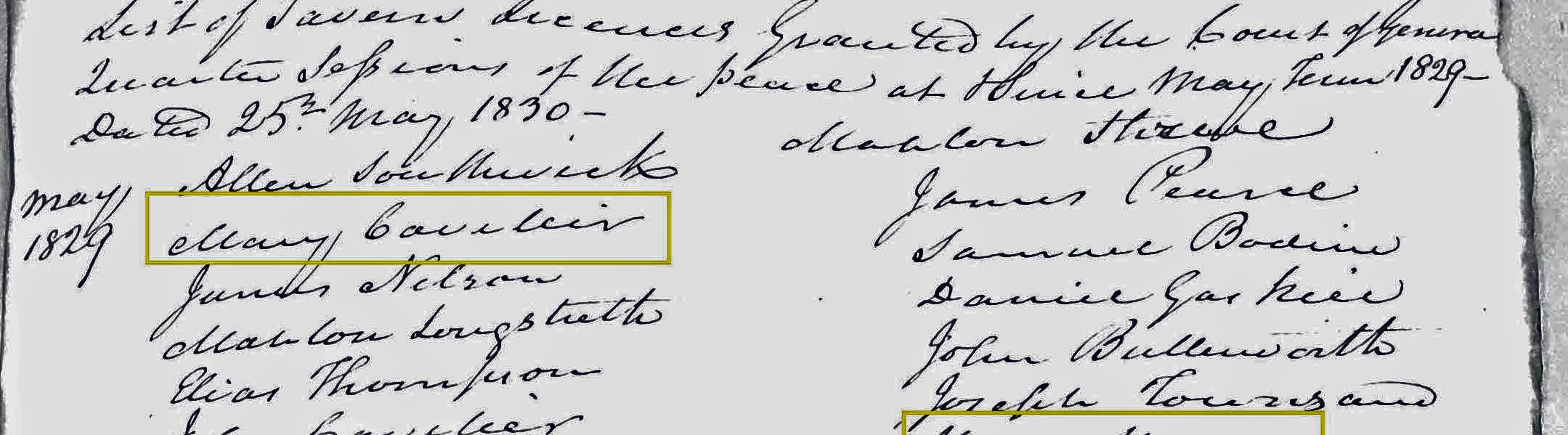
The 1812 deed excerpt identifies Caleb Cramer’s $2,000 sale to David Cavileer. The excerpt does not itself describe a tavern building. David’s will excerpt gives Mary use and profits of remaining property after debts, and a license list for the May 1829 term includes Mary Cavileer. Those records place Mary in the property and tavern story without supplying a building footprint.
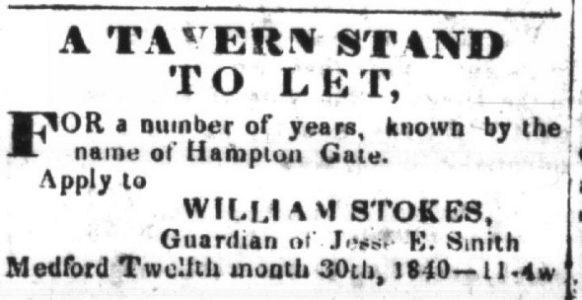
The December 30, 1840 notice expressly offers a “tavern stand” called Hampton Gate for rent and directs applicants to William Stokes, guardian of Jesse E. Smith. It does not say how Jesse acquired an interest, who then operated the tavern, or whether Mary had died.
What the 1875 deed actually proves
We inspected the complete January 1875 commissioners’ deed in the Burlington County guest deed viewer, Book A9, pages 426–430. It follows an Orphans Court division and sale of part of David Cavileer’s estate to Mahlon Prickett. It calls the parcel “Number One” on a survey map prepared for the sale. Its starting landmark is a pine stump on the south side of a large stone hill, said to be about fifteen chains west of Hampton Gate Bridge. The described courses then reach a smaller stone hill, neighboring lots and old roads.
Those are useful survey clues, but the deed never calls Lot No. 1 the tavern, hotel or inn. Its standard phrase granting “buildings [and] improvements” does not identify a particular structure. The $82.41 sale price belongs to this lot and should not be compared directly with the $2,000 paid for the earlier purchase. A later deed quoted in a NJPB property-stone discussion repeats the stump-and-bridge boundary. The forum’s identification of present terrain is a lead to test, not proof of the tavern location.
The maps disagree
The complete 1849 Otley map (with a THS detail) labels “J. Smith’s Hotel” near Hampton Gate. The complete 1859 Parry–Sykes–Earl map (and THS detail) places a “Hotel” symbol on the opposite side of a road from a nearby household name. The 1860 topographical map again has a hotel symbol, and the 1876 atlas shows a building without a hotel label. Road alignments, symbol placement and map scales differ. The Library of Congress notes that the 1849 sheet is oriented with north toward the upper left, making a simple left/right comparison of crops especially misleading. A map symbol is not a present-day surveyed coordinate.
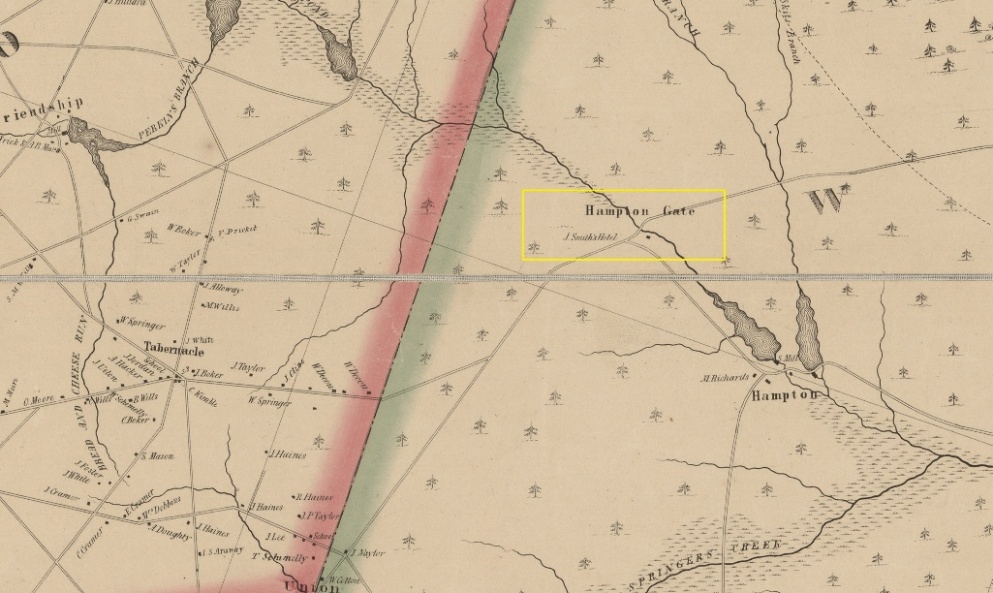
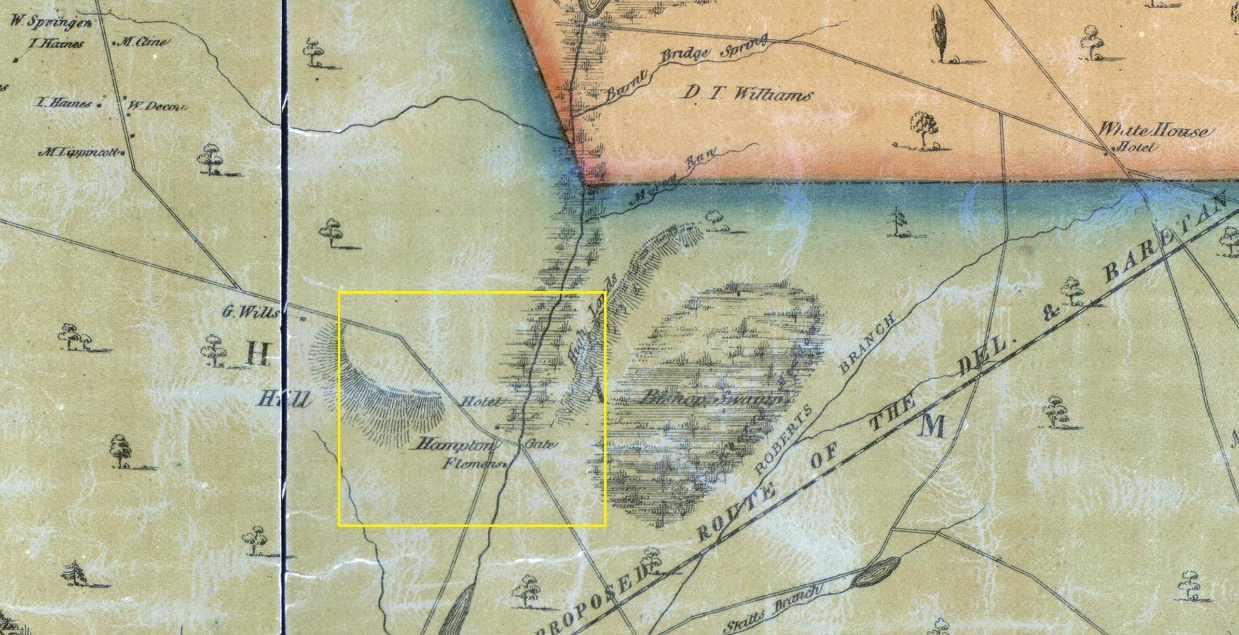
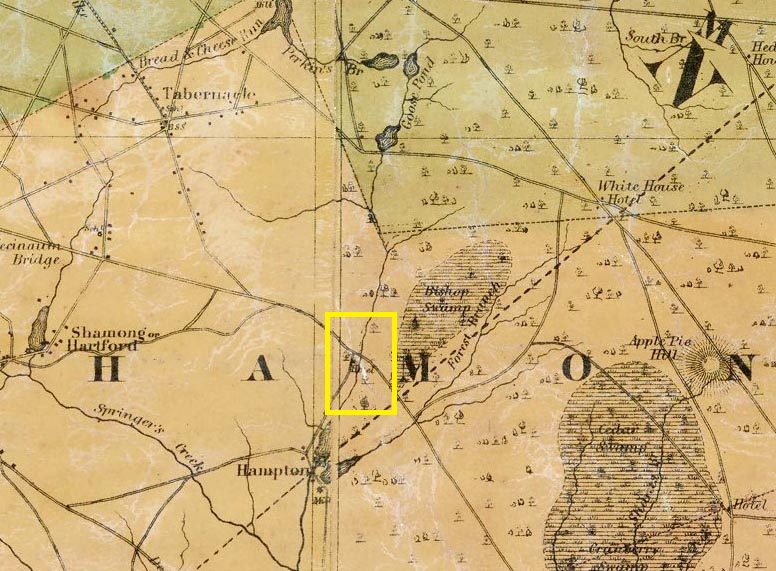
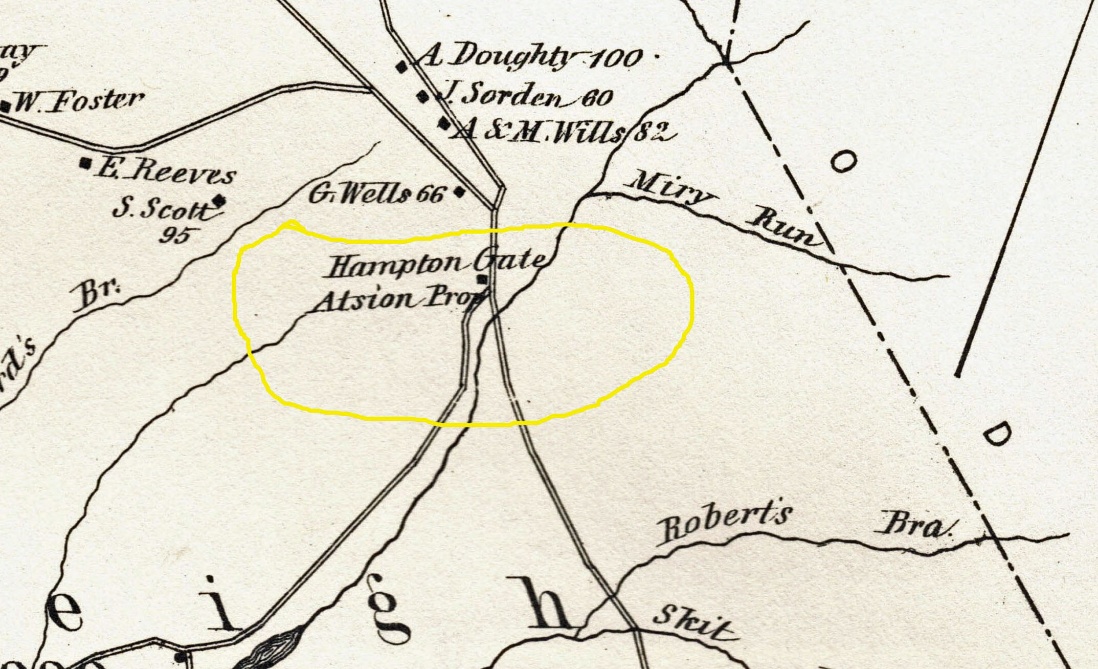
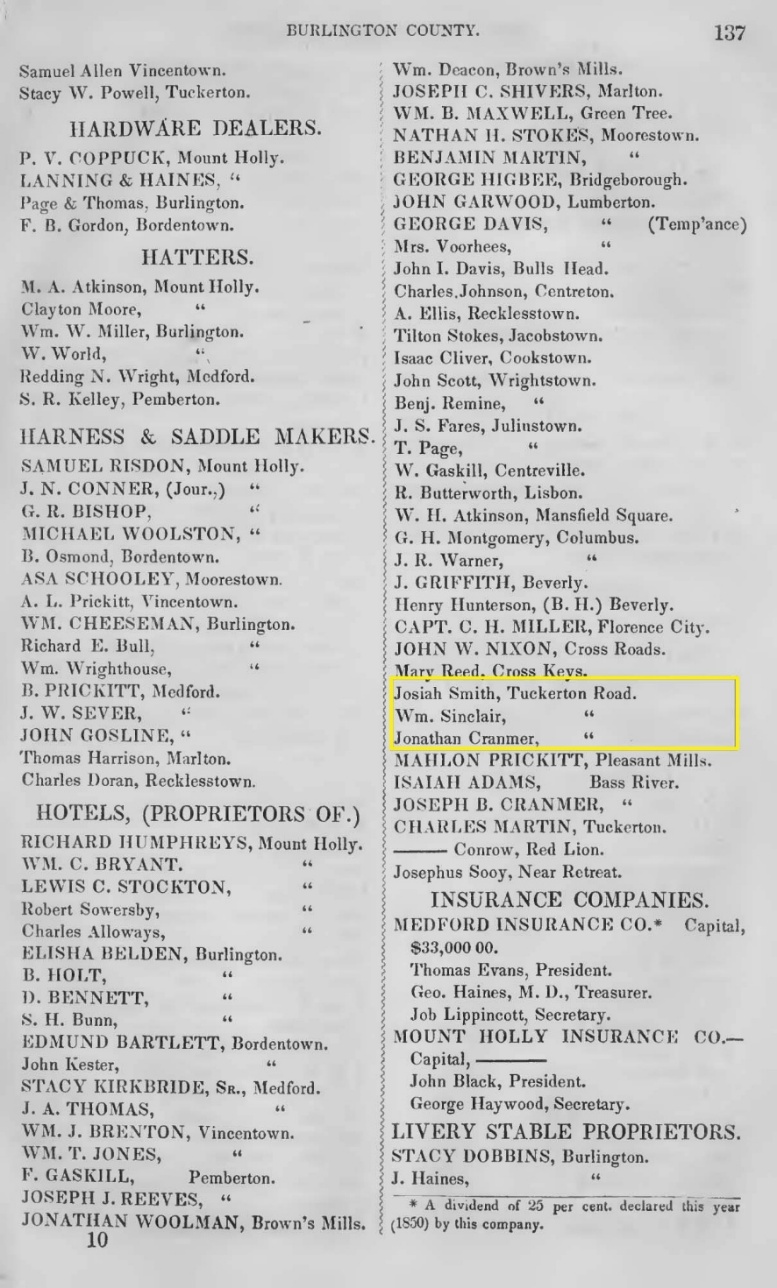
The “J. Smith” label also needs a name check. Jesse E. Smith is in the 1840 Hampton Gate notice. Separate Buck Tavern licenses place Josiah Smith at another inn near Atsion and Red Lion Roads. The 1850 directory lists Josiah as a hotel proprietor on Tuckerton Road, but that entry alone does not transfer him to Hampton Gate. We cannot yet expand the initial on the 1849 map.
Three tests that could settle it
- Find the commissioners’ survey. The deed says Lot No. 1 was numbered on a map made for the sale. The Orphans Court division papers may preserve that map, showing the other lots, roads and perhaps buildings. The county clerk partition guide identifies a box covering 1864–1884 and a divisions volume on reel 1-243. The Orphans Court minutes guide places 1870–1883 minutes on reel 2-345; a separate divisions guide identifies reel 2-386, which the FamilySearch catalog also lists as digital image group 5670045. These are collection leads; the survey has not yet been found.
- Trace the tavern interest separately. A guardianship file for Jesse E. Smith and intervening conveyances between the 1840 notice and 1849 map could show whether the ward and mapped “J. Smith” are connected.
- Register full historic maps. Compare the bridge, river, roads and stone hills on full 1839, 1849, 1859, 1860 and 1876 sheets. Reject any candidate that fails the deed boundary or maps repeatedly to the wrong side of the old road. A hotel symbol alone remains approximate.
View the Hampton Gate area on our map. The marker identifies the historical locality, not a tavern foundation or a parking place.
Sources and limits
Rick Franzen’s Tabernacle Historical Society study assembled the deed excerpt, notice and maps. We checked the full 1875 deed in the county’s older-image system; its image address is session-specific, so use Deeds A9, pages 426–430. The State Archives deed guide confirms the earlier Book Y survives on reel 1-46 / GSU 842213, though we have not inspected its full page 31. The stone-building tradition and exact site remain unproved. The nearby 1860 peddler accusation is a separate story.