Folded behind
the seats.
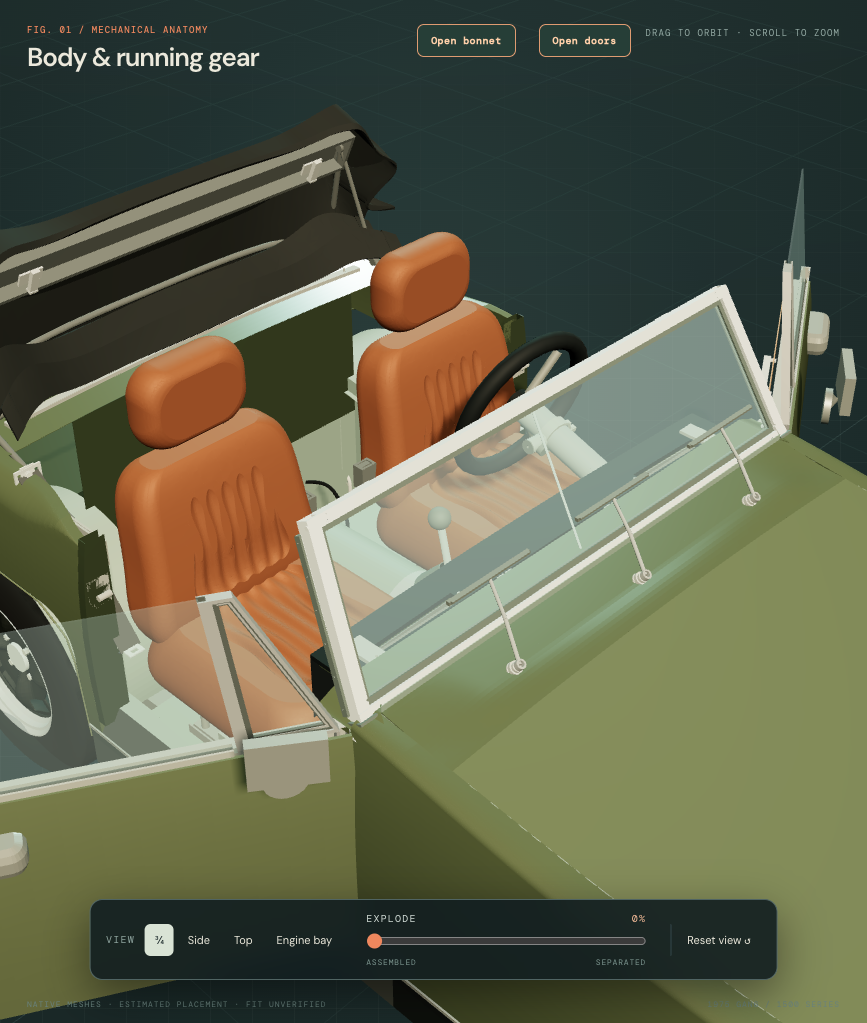
The previously absent hood stack now has folded fabric and header-rail context, side links, transverse bows, body bases/packing, catches, seal and rear retainer references. This is a static parked assembly; no folding or raised state is simulated.
Lower the cabin stack to the existing exterior view
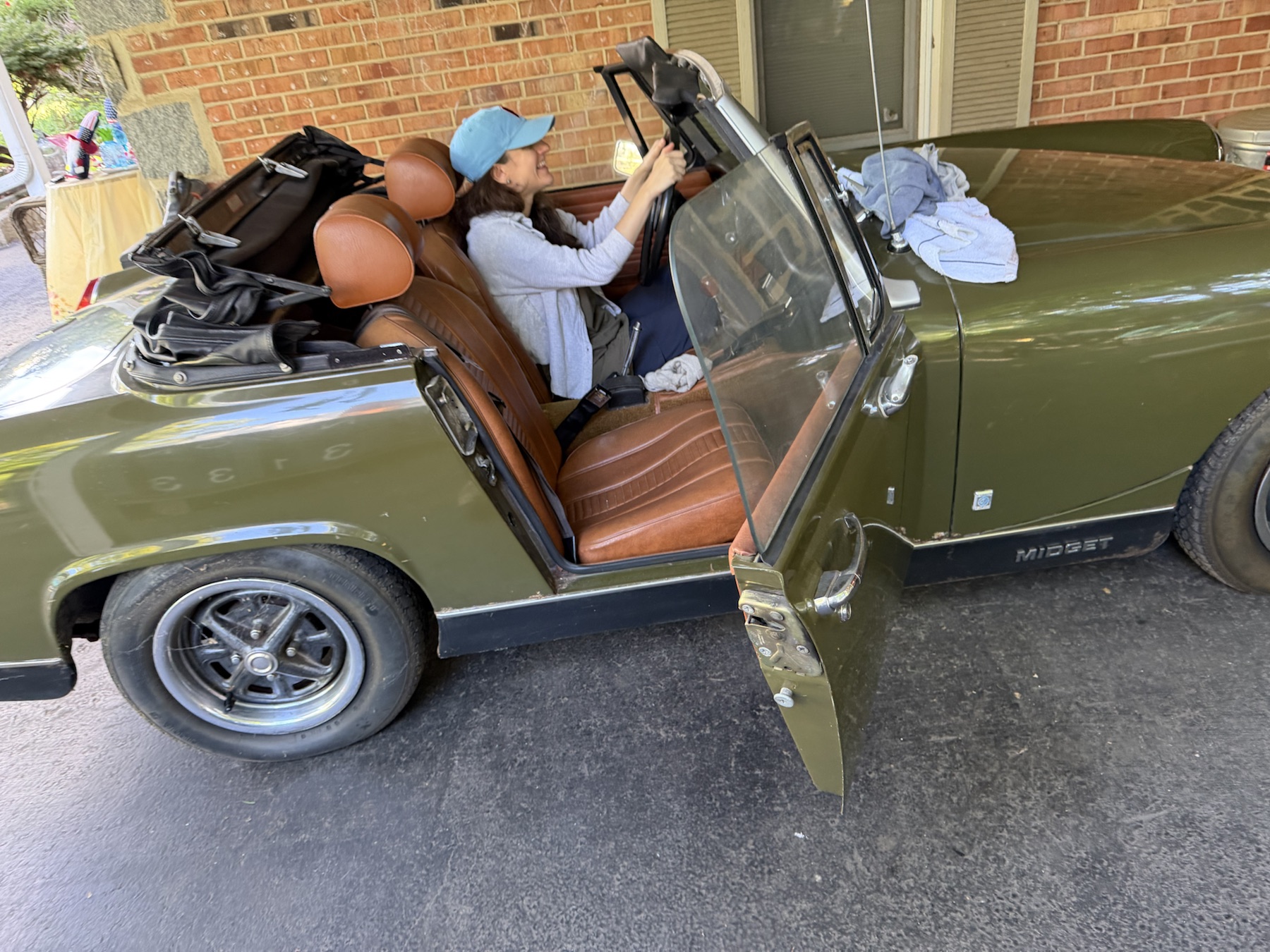
The earlier model placed the headrests and parked hood too high in the held IMG_6329 comparison. Both complete upholstery assemblies now sit 75 mm lower, with shorter estimated frame posts connecting them to the retained upper slides. The floor runners, fixing references, floor-hole stations and seat fore/aft positions stay. The hood header moves about 178 mm down and 119 mm forward in the model; its dimensions and estimated rake stay. Static upper links and fabric follow that construction.
Inspect the current cabin in the whole-car model ↗ · Inspect the shorter support chain ↗ · Inspect the header reference ↗
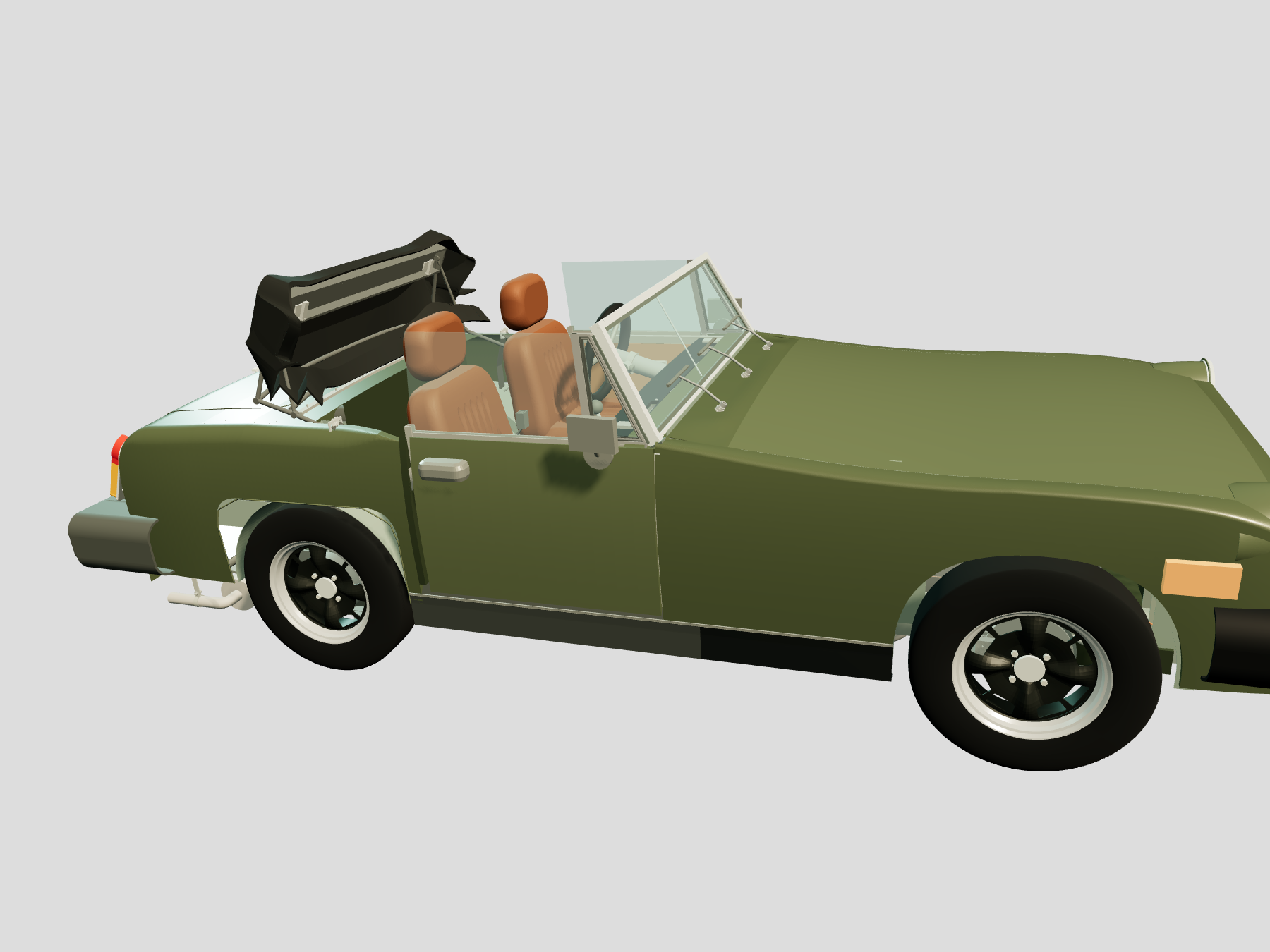
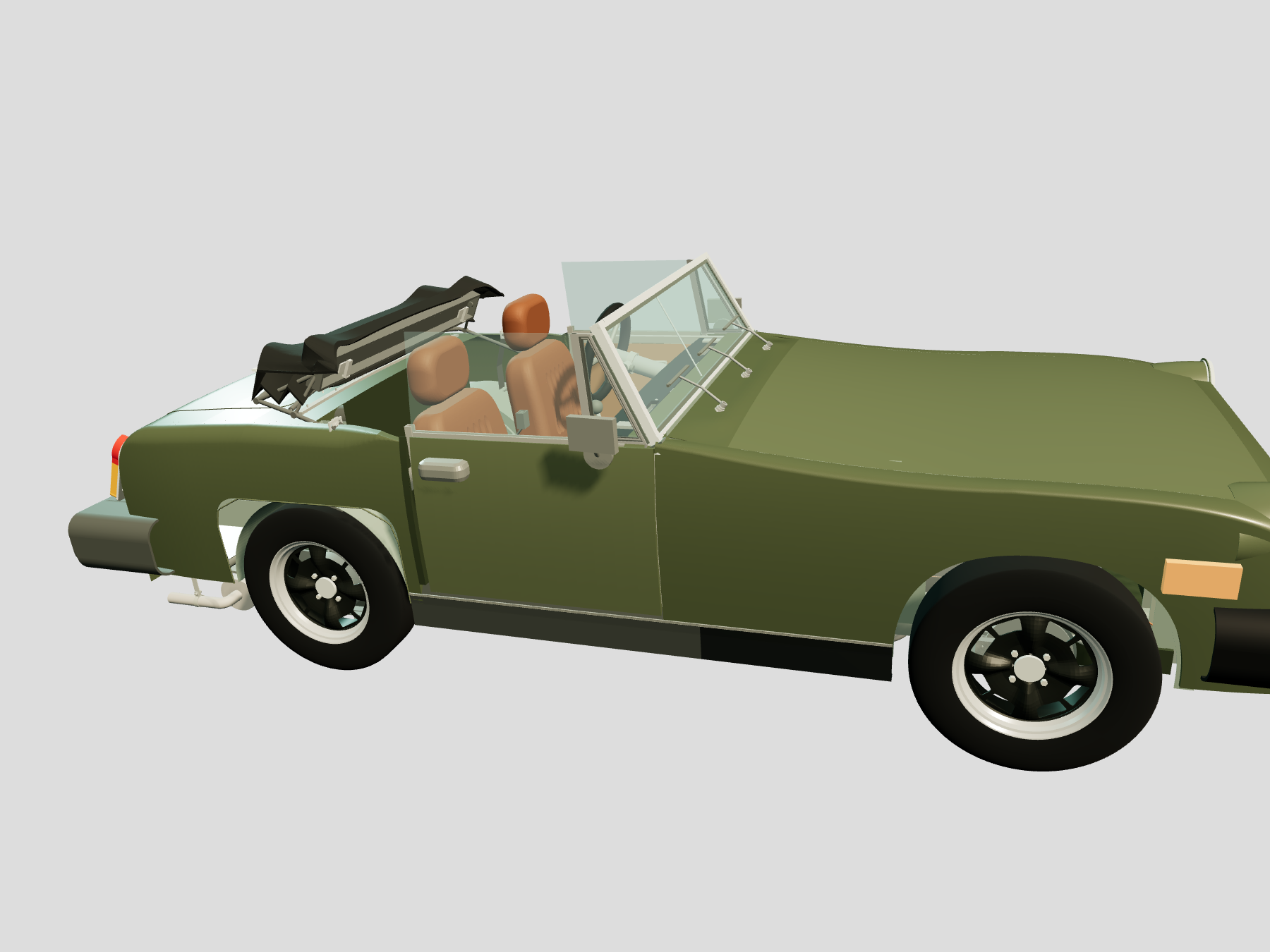
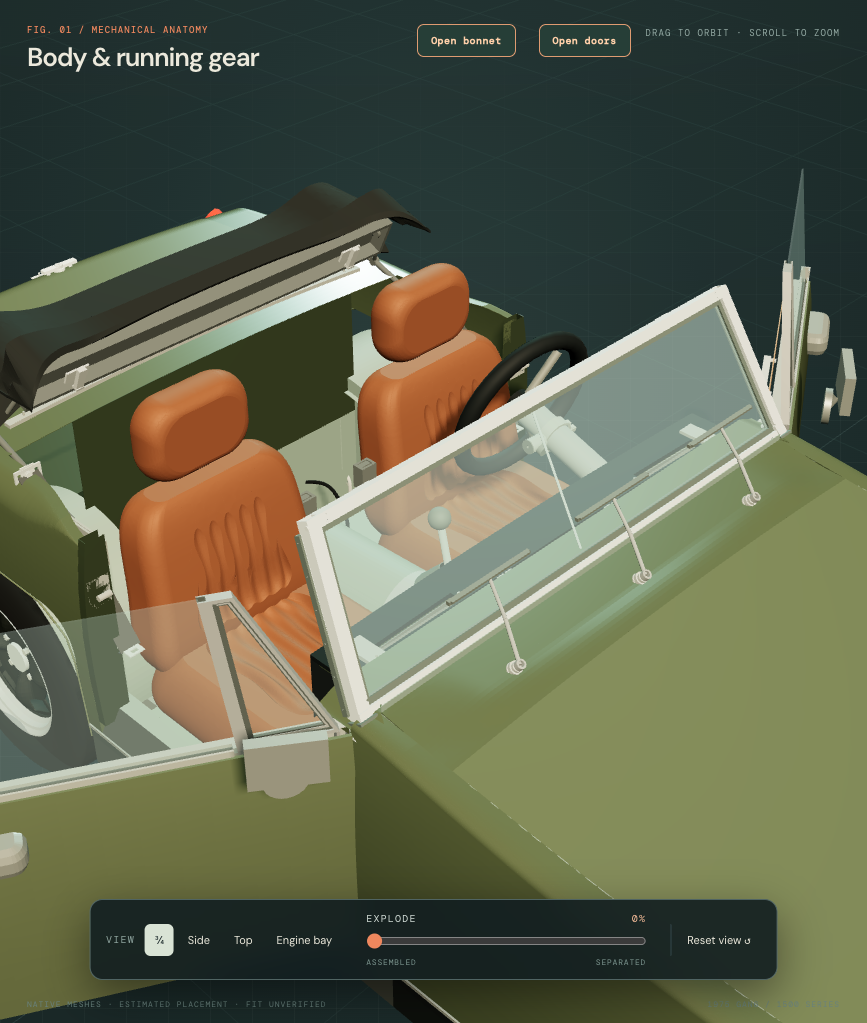
Evidence and assumptions: the visible far/driver headrest crown supplies a vertical image reference under the existing nominal-wheel camera. Upholstery shape, X/Z and the camera are held; the selected 75 mm translation is rounded. The interpreted far upper header corner guides its Y/Z position while its unmeasured width, section and −65-degree reference rake stay. These are conditional photo constructions, not direct owner dimensions. The near/passenger seat repeats the height assumption because it is obscured. The photographs do not prove a particular seat adjustment or hood movement between IMG_6329 and IMG_6341.
The selected driver crown is about four pixels from the picked image point. This is the same image used to choose the height, not an independent dimensional validation. A partially obscured far headrest outline still differs by about 19 pixels; width, depth and fore/aft position are retained without forcing that edge to fit. Catch placement, hidden seat/frame identity and actual folded-fabric geometry also remain unverified.
The earlier upholstery, support and higher qualitative hood construction remain available as separate references. The earlier factory reclining-seat drawings and hood drawing support component roles. They do not identify the fitted seats, establish this height or make CHA23/24 an identified GAN6 frame. The 1500 supplier listing likewise supplies comparison parts rather than a fitted assembly survey.
Workshop use: inspect the floor runners, upper slides, frame, diaphragm, fixings and upholstery separately. Local CAD probes confirm the held runner/post planes and front cushion support reference. The 75 mm figure is a CAD correction, not a spacer dimension or a specification for modifying the actual mounts. Fitted hardware, loaded support, restraint compatibility, release order and doorway removal remain unverified. The hood is a static construction; no compatible folding linkage, fabric deformation, textile gauge or verified removal path is established.
Current upholstery STEP ↗ · Current support STEP ↗ · Current parked-hood STEP ↗ · Evidence and assumptions ↗ · Native checks ↗
Gather the fabric around the parked frame
The former fabric was a constant-width extrusion with straight transverse folds ending below the standing header. It now has a curved transverse envelope, gathered side returns and an upper drape around that header. Owner IMG_6341, above, supplies the visible exposed fabric and side-pile context. IMG_6329 shows a more obscured, lower-looking parked state; the two photographs do not establish one identical fabric pose.
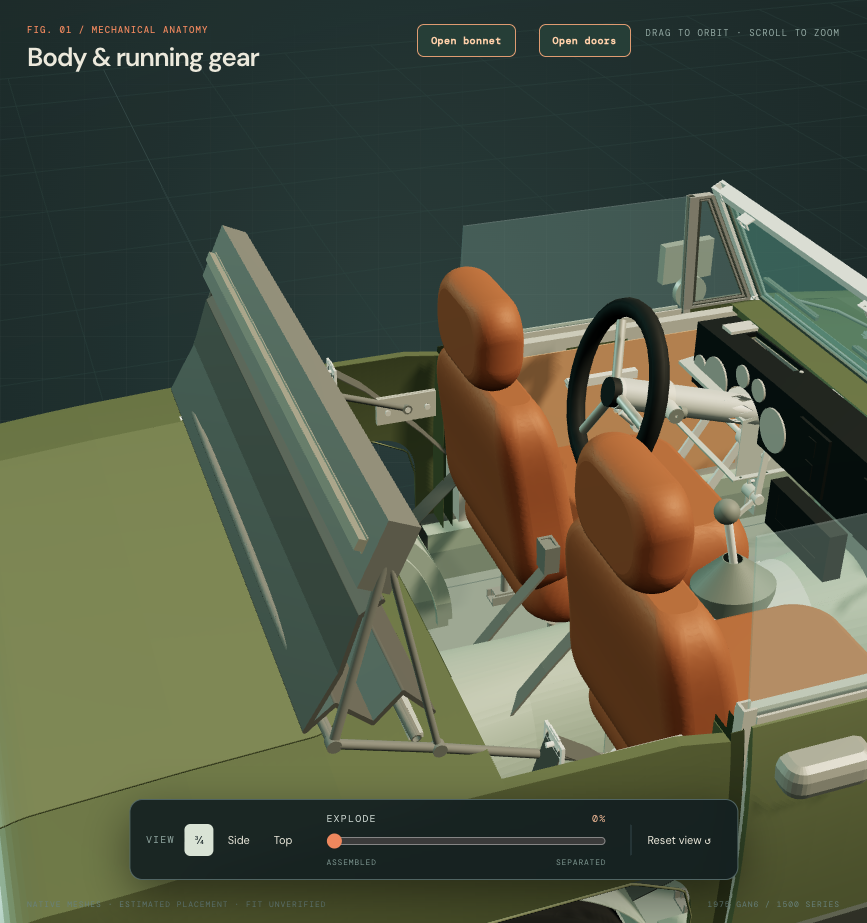
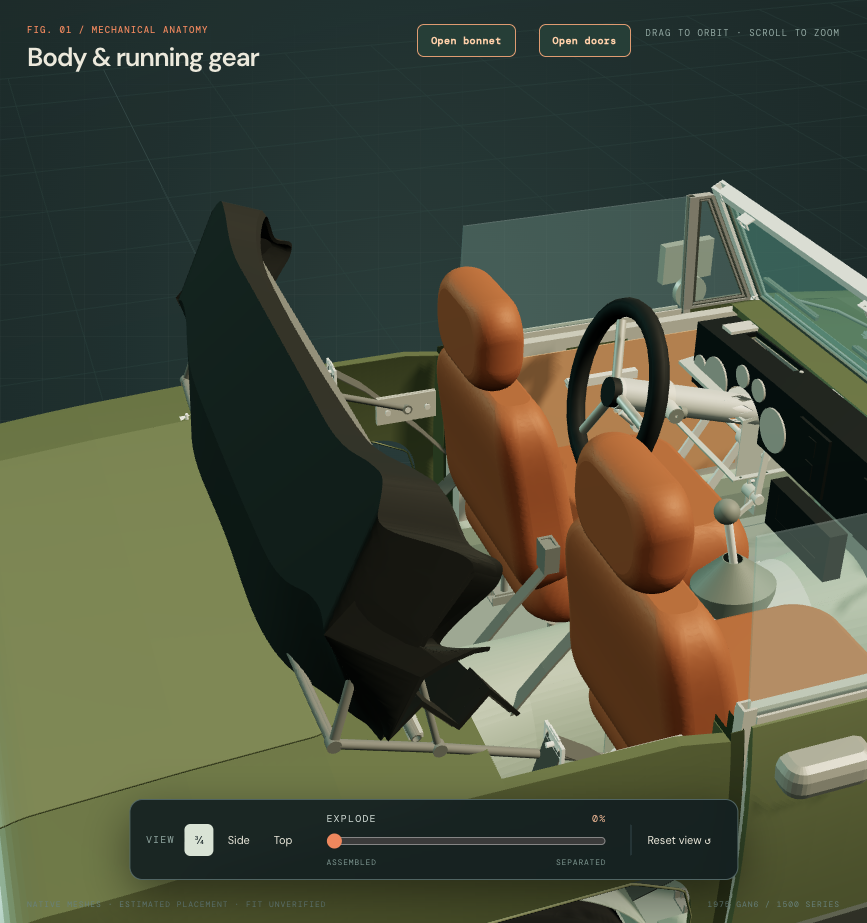
The first five centerline points of the lower stack stay. The transverse width, side piles, forward-turning ends and upper wrap are new unmeasured construction estimates. Twelve frame/header/retainer mesh groups remain byte-identical. No fabric/window cutting pattern, seam placement, headlining, stowage cover or hidden attachment is inferred.
A finite section of approximately 6.77 mm makes the folded envelope inspectable; it is not textile thickness or a measured number of layers. The upper centerline uses a roughly 7.20 mm construction stand-off outside the retained header/seal back envelope and header upper face. That allowance only defines the drawing. It does not establish fitted sealing, loaded support or actual-car clearance.
The final fabric has no positive source intersection with the retained header, its seal, catches, boot lid or sampled seat envelopes. The rear/forward bows still cross the fabric reference by approximately 8,589/2,389 mm³; each side-link group crosses it by about 573 mm³. These estimated cloth/frame stations remain unregistered. No frame, seat or body is shifted to hide those contacts, and the result is not a working folding assembly.
Use the revised envelope to inspect the space occupied by the parked fabric beside the seats and above the fixed rear retainer. The separated view does not establish cloth release points, safe support, fastener access, a folding sweep or a verified replacement/removal sequence. The older parked-pose study below retains its historical geometry and checks; this section supersedes its constant-width fabric reference.
Standing header and the fixed rear shroud
IMG_6341 shows the exposed folded stack with header/catch-like hardware standing above the headrests. The prior model laid that rail flat below them. The revised reference rotates the existing header, seal/retainer and catches together, extends the estimated upper side-link points, and adds a standing fabric drape above the retained lower-fold centerline. The five base/packing, bow and frame/body-fixing source groups are unchanged.
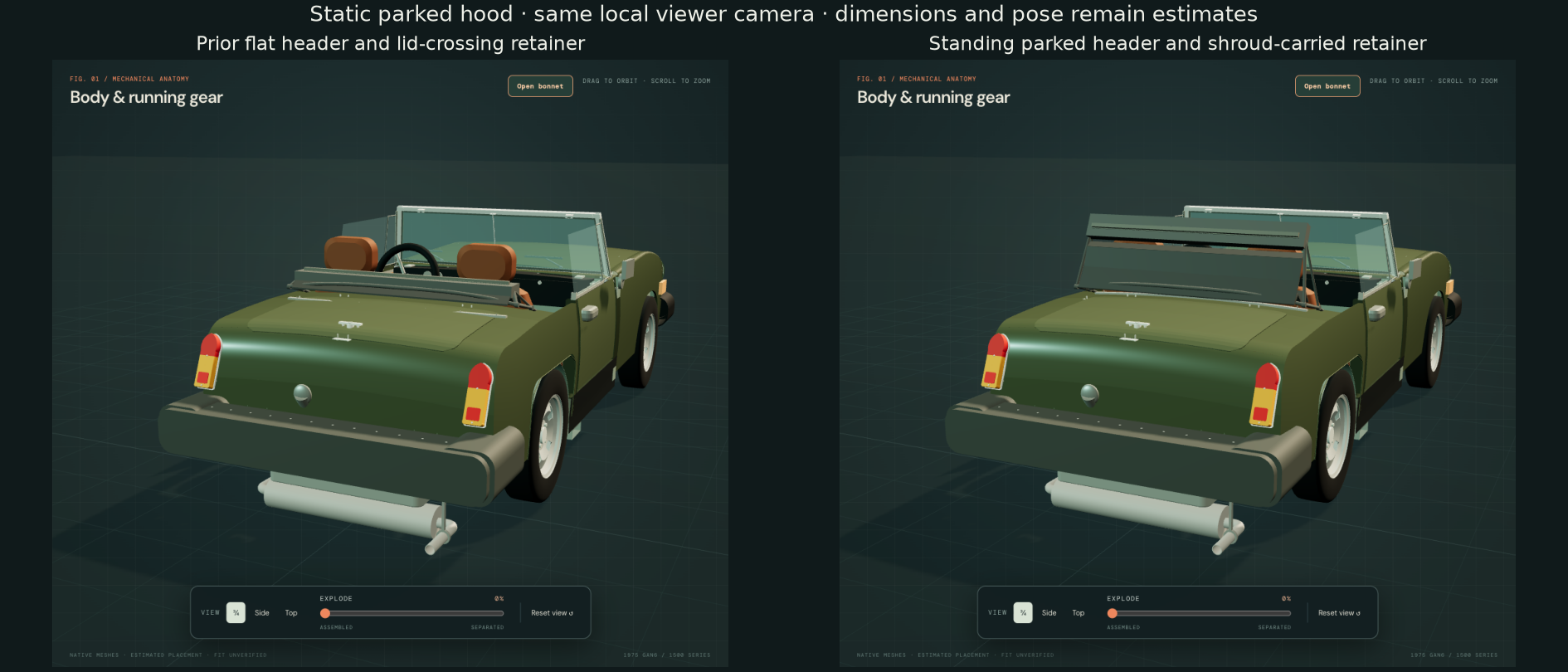
The separate factory AHA8185 rear retainer and seven ZCT605 body-screw roles are body-carried. Its old reference crossed the moving boot lid. It now follows the shared estimated crown of the fixed shroud ahead of the lid. Its station is the unmeasured midpoint of the existing front-shroud band, with a 0.5 mm unloaded display gap; section and fixing map remain construction choices. No body holes or receiver seats have been invented.
The previous retainer/lid source overlaps (approximately 8,974 mm³ at the skin and 45 mm³ at the frame) are absent after this topology correction. The limited native lid/seat sample also has no positive contact with the revised hood. This establishes model separation only: the shroud, parked pose, seat geometry and body mounts are still unregistered estimates, so it does not establish actual-car fit, loaded seating or operating clearance.
Link lengths, hinge compatibility, cloth/window deformation, catches, tension, raised position and supported folding remain unverified. Inspection offsets do not establish a release sequence, safe support, tightening instruction or removal path. Exact hidden attachments remain the evidence gap.
Current geometry and contact checks · Source geometry and construction pose · Inspect the retainer and surroundings
Seat-belt reference assemblies now add separate stowed webbing, buckle/stalk and attachment boundaries beside the seats; fitted identity and hidden body anchors remain unresolved.
Inspect the parked relationships
The header and folded sheet envelope occupy a provisional stack behind the existing seats. Two base/packing references face the rear cockpit sides; their holes and body contact are unregistered. Side links and bows are inspection subdivisions of a frame comparison, not identified separately replaceable factory pieces. Pivot cues do not establish a mechanically compatible linkage.
Factory architecture and distinct covers
Factory PDF p. 252 lists the GAN6-applicable cover/header, seal/retainer and catch architecture. PDF p. 253 separates AHA9051 frame, two AHA8295 packing pieces and six frame-to-body screws. The model’s three-per-side pattern is an estimate, not a fitted hole map. Its screws, link sections, header orientation and bow shapes are not measured dimensions.
PDF p. 254 separates the AHA8185 rear retainer and seven body screws from the CHA93 hood-stowage cover and its storage bag. The owner image shows an exposed folded stack, so no stowage cover or tonneau is added over it. The MGOC frame/header comparison corroborates these component distinctions but does not identify the fitted material, seal or zip/window variant.
Use the obstacles without inferring motion
Compare the parked stack with seat backs/headrests, cockpit sides, rear bulkhead, deck and boot lid. Existing seat/body datums are unchanged. The frame/body mount and rear-retainer contacts remain unresolved; apparent overlap or separation is a model result rather than fitted clearance. Window panels, fabric patterns, stretch, tension and folding creases are not reconstructed from hidden views.
The general separation view offsets fabric and header/catch references to expose their shapes. This does not raise the hood, unlatch it, deform its fabric, release body fixings or establish a service sequence. No pivot travel, bow interference, catch engagement, seal compression, loaded support, safe stowage or boot/seat clearance is verified. All added dimensions and positions are estimates.
Separate parked CAD assembly
Construction checks cover valid positive-volume shapes, STEP round-trip and native metric placement. They do not validate operating linkage or fitted attachment. The other native exports and existing body geometry are unchanged.