People, places and memory
The old White Horse Tavern beyond Chatsworth
Documented tavern property; exact footprint unresolved
Deeds and a forest-fire report document an older White Horse property in the Tabernacle area, distinct from the hotel carrying the name in Chatsworth.
A named house in a land transaction
A deed excerpt identified by THS as Burlington County Book W2, page 498, from 1828 explicitly describes a tavern house and other buildings on land commonly called the White Horse. It places the tract in Northampton Township and identifies prior ownership by Abraham Matson. This is stronger evidence for an operating-place name than a later story assigning the inn a picturesque colonial origin. 1828 deed excerpt.

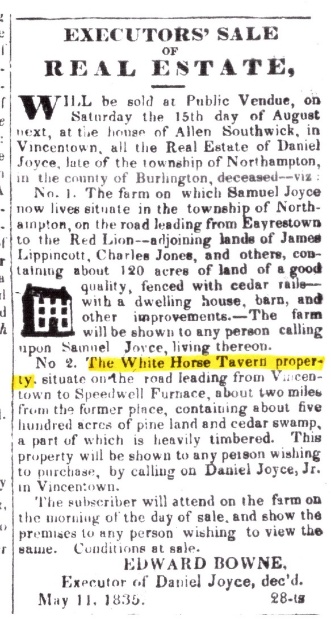
An executor’s advertisement dated May 11, 1835 offered Daniel Joyce’s White Horse Tavern property among his real estate. It located the property on the road from Vincentown to Speedwell Furnace and advertised roughly 500 acres of pine land and cedar swamp, much of it heavily timbered. The inn belonged to a larger working landscape whose land and timber were saleable assets. 1835 executor’s advertisement.
The fire report, read precisely
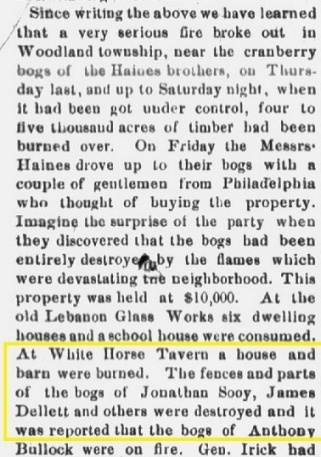
The New Jersey Mirror clipping captioned May 27, 1875 describes a serious regional woodland fire. At White Horse Tavern it reports that a house and barn burned. It also records losses at cranberry properties and the old Lebanon Glass Works. The wording ties destruction to the White Horse site, but does not establish that every tavern building disappeared or that the name ceased to be used that day. 1875 fire report.
Two White Horses, and a missing footprint
Franzen’s THS history separates this property from the Chatsworth hotel and compares conflicting fire dates and ownership traditions. The precise footprint remains uncertain. A later hotel with the same name is not, by itself, proof that a destroyed building was moved or rebuilt there.
Sources and research limits
The deed, sale advertisement and fire clipping were inspected as separate documents. Their dates come from the documents where visible and otherwise from THS captions. Unverified early proprietor traditions and an exact construction year are omitted. The relevant next records are full deeds, original newspaper pages and estate inventories that distinguish a business name from an individual structure.