Places and miscellany
The ghost story of Mary Ann Forge
Paraphrased folklore and site history
Henry C. Beck used an imagined golf-playing ghost to frame the ruins of an iron settlement and an abandoned country-club venture near Mount Misery.
Forge, ruins, and failed developments
Beck said the identity of the Mary Ann for whom the settlement was named was unknown. His industrial description associated the site with Hanover Furnace and local traditions of work crews carrying iron outward and returning with brick. The later preservation study distinguishes their roles: Hanover supplied pig iron, which Mary Ann worked into finished iron products. He found a large forge ruin, an earthen dam with a broken gate, ornamental plants marking former homes, and dark water flowing toward Mount Misery. The article admits that little contemporary documentation of the village had been located.
New York promoter William R. Hunt later bought the site, cleared part of it, and abandoned an unspecified plan. Another group purchased the Quigley dwelling for a clubhouse and imagined the Mount Pleasant Country Club, but never finished it. The building reportedly had fireplaces in every room but no glass in its windows. A sign still directed travelers toward Mount Misery Country Club.
The ghost
The supernatural passages are literary invention or local folklore, not eyewitness documentation. Beck pictures a figure moving through the abandoned clubhouse at midnight, carrying clubs and seeking a nonexistent first tee. The joke binds two vanished ambitions—the forge town and country club—into a single “golfing ghost.”
The documented works behind the ghost
The Fenwick Manor preservation plan traces the Mary Ann tract to Benjamin Jones’s purchase from John Black in May 1827. Jones built the forge afterward; it made bar iron, wagon tires and axles from Hanover pig iron. Richard and Samuel Jones acquired the two works in 1846, and the plan places their closure in the 1860s. This supplies an ownership and production history where Beck’s feature emphasized ruins. Fenwick Manor Historic Preservation Plan, developmental history, p. 16 (PDF p. 47).
The Historical Society of Pennsylvania’s finding aid identifies seventeen volumes associated with Hanover Furnace and Mary Ann Forge in the Jones and Taylor family papers, Collection 2037. Its list includes correspondence, daybooks, ledgers and cashbooks spanning the operating period. These surviving business records offer a concrete route toward identifying workers, customers and the forge’s last transactions. The finding aid has been located; the manuscript volumes have not yet been examined. HSP, Forges and Furnaces collection guide, pp. 54–55.
The remaining mysteries
The material reviewed does not establish who Mary Ann was, when Beck’s country-club promoters acquired the property, or how far their development proceeded. Deeds and business records could settle those questions without treating the golfing ghost as an eyewitness account.
Mary Ann before it became a ghost town
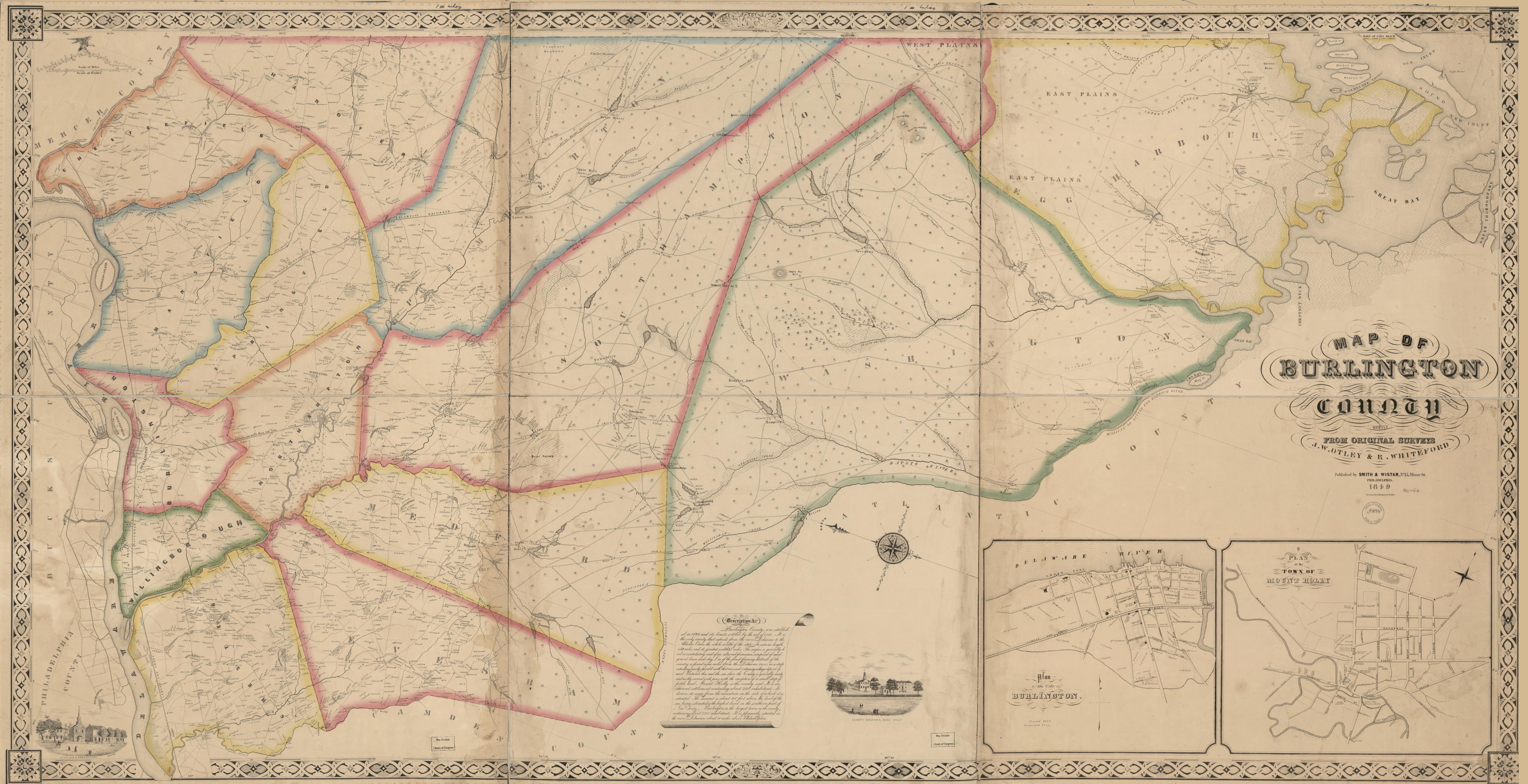
J. W. Otley and R. Whiteford’s 1849 Map of Burlington County records the working landscape that Beck later visited in ruins. “Mary Ann” appears beside a long narrow pond. At its southern end the map separately labels a forge and saw mill, with “R. Jones” beside a nearby building symbol. The saw mill is a useful addition to the site's ironmaking history: this was a settlement with more than one water-powered operation.
The map also places Mary Ann between Browns Mills and the Upper and Lower mills, connected by roads through the Mount Misery drainage. It provides contemporary evidence of the settlement’s layout and Jones association, but does not identify the woman behind its name or document the later country-club venture. The small building symbols alone cannot identify particular workers’ homes. Otley and Whiteford, Map of Burlington County, 1849.
A published guidebook, independent of the newspaper feature
Beck’s 1937 book More Forgotten Towns of Southern New Jersey has no chapter on Mary Ann Forge, but mentions it four times in passing, in contexts unconnected to the undated newspaper feature that is this entry’s primary source, and those mentions add detail beyond it. An 1834 New Jersey map, Beck writes, showed the principal road to Barnegat running through Bordentown, Recklesstown, Fooltown (or Georgetown), Penny Hill, Mary Ann Forge, Mount Misery and Old Half Way to Cedar Bridge — placing the settlement on a real, dated colonial-to-antebellum stage route rather than only in local memory. By 1937 he found “Mary Ann is remembered only in a broken water gate,” matching this entry’s own description of a broken dam gate above. He also records that slag with charcoal still embedded in it could be found at “Weymouth, Speedwell, Mary Ann, and other furnace sites” — physical industrial debris independent of the newspaper feature’s account of forge ruins. A later chapter describes returning to the area and finding the trail to Mary Ann Forge, Upper Mill and Lower Mill newly marked with directional signs, which Beck credits to public interest raised by his own earlier writing. None of this identifies Mary Ann or documents the country-club venture; it corroborates the site’s location and physical remains from a second, independently written source.
Source
Henry C. Beck, “The Ghost of Mary Ann Forge,” an undated newspaper feature in the source collection. The masthead and page are absent and portions of the surviving text are damaged. Also Henry Charlton Beck, More Forgotten Towns of Southern New Jersey (New Brunswick: Rutgers University Press, 1937), read in full via the Internet Archive text (archive.org/details/moreforgottentow00beck); the four passages used above are at pp. 35, 83, 237 and 287, the pages given for “Mary Ann Forge” in the book’s own index.