Treasure stories · Paisley
The search for General Clinton’s treasure
Dated newspaper account; treasure unverified
An 1892 report said New York searchers followed a rough map to Paisley, or South Park, looking for treasure supposedly buried during the Revolution.
The excavation
The party brought surveyors to a plot near the New Jersey Southern Railroad. Their map placed the cache between two landmark pines mentioned in old deeds. The trees, about twenty feet apart, aligned with a colonial stone monument attributed to the original Council of Proprietors and stood on land associated in the damaged source text with Constant LeDuc, described as a French colonist.
A trench dug between the trees produced a few silver and copper coins and two or three rusted flintlock pistols. The newspaper presented the story as rumor and explicitly left its credibility to the reader. It attributed the supposed burial to British General Clinton but gave no documentary evidence.
The town was real; the treasure remains a rumor
A matching clipping has been located in the Tabernacle Historical Society’s chronology under September 8, 1892, New Jersey Courier. Its heading, “Buried Treasure (?) Again,” signals the newspaper’s skepticism. The image resolves the damaged name as Constant LeDuc and identifies copper among the reported coins. The society’s supplied date is traceable; a full issue and page number remain to be checked. 1892 clipping, inspected for this update.
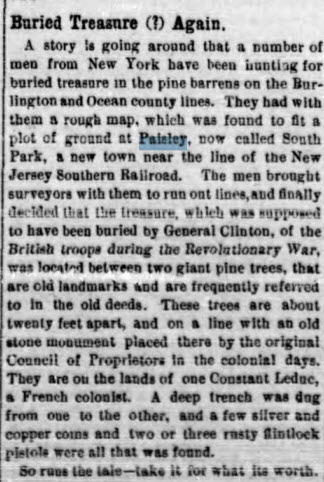
The surrounding records explain the two place names. A March 1892 notice records the post office’s change from Paisley to South Park, while LeDuc was advertising land there. The treasure report appeared amid a troubled speculative settlement, rather than at an unidentified wilderness site. That context does not prove the story was an advertisement or a fraud: no link between its anonymous searchers and the land promoters has been established. Society chronology and reproduced records.
The LeDuc name at South Park, 45 years later
Henry Charlton Beck’s 1937 book More Forgotten Towns of Southern New Jersey independently places a LeDuc at South Park, decades after the 1892 land promotion. Visiting the settlement, Beck met “hard-working Albert B. LeDuc,” the state fire warden responsible for patrolling roughly 80,000 acres of surrounding pine country, describing him as fifty-seven years old, a World War artillery veteran, and thoroughly familiar with the back trails around South Park and nearby Apple Pie Hill. No source examined this session establishes Albert B. LeDuc’s relationship, if any, to Constant LeDuc of the 1892 report; the surname could reflect a father, other relative, or coincidence. What the passage does establish is that “LeDuc” was a real, lasting family name attached to this specific, obscure Burlington County place, independently of the 1892 clipping and the promotional notices around it — evidence against the possibility that the clipping’s central name was invented or badly garbled.
Beck also supplies unrelated background on the historical figure the legend borrows its name from. His 1939 book Fare to Midlands: Forgotten Towns of Central New Jersey recounts the June 1778 council of war at the Hunt House in Hopewell, where Washington and his generals discussed attacking the British column under General Clinton as it marched slowly toward Sandy Hook by way of Monmouth Court House, burdened with a large baggage train and harried by New Jersey militia tearing up bridges. That march passed well north of Paisley/South Park, so it offers no direct evidence that Clinton buried anything there; it does show that a real, well-known British general moved through New Jersey in 1778 encumbered with baggage and pursued by irregulars, a documented episode plausible enough to explain why local treasure rumors elsewhere in the state would attach his name to a supposed cache, whether or not his actual route ever came near this one.
Source note
The notebook crop lacks a masthead and page number. A matching clipping in the Tabernacle Historical Society collection is dated September 8, 1892, and attributed to the New Jersey Courier; that supplied attribution and the recovered name are discussed below. Henry Charlton Beck, More Forgotten Towns of Southern New Jersey (New Brunswick: Rutgers University Press, 1937), pp. 136–142, read in full via the Internet Archive text (archive.org/details/moreforgottentow00beck); and Beck, Fare to Midlands: Forgotten Towns of Central New Jersey (New Brunswick: Rutgers University Press, 1939), pp. 244–245, also read in full via the Internet Archive text (archive.org/details/faretomidlandsfo00beck). Both are plain-text OCR transcriptions of scanned public-domain-eligible copies; page numbers are taken from the running heads embedded in that OCR text.