LATER NORTH-AMERICAN LAMP / UNREGISTERED BODY POSE
Rear lights with
separate service boundaries.
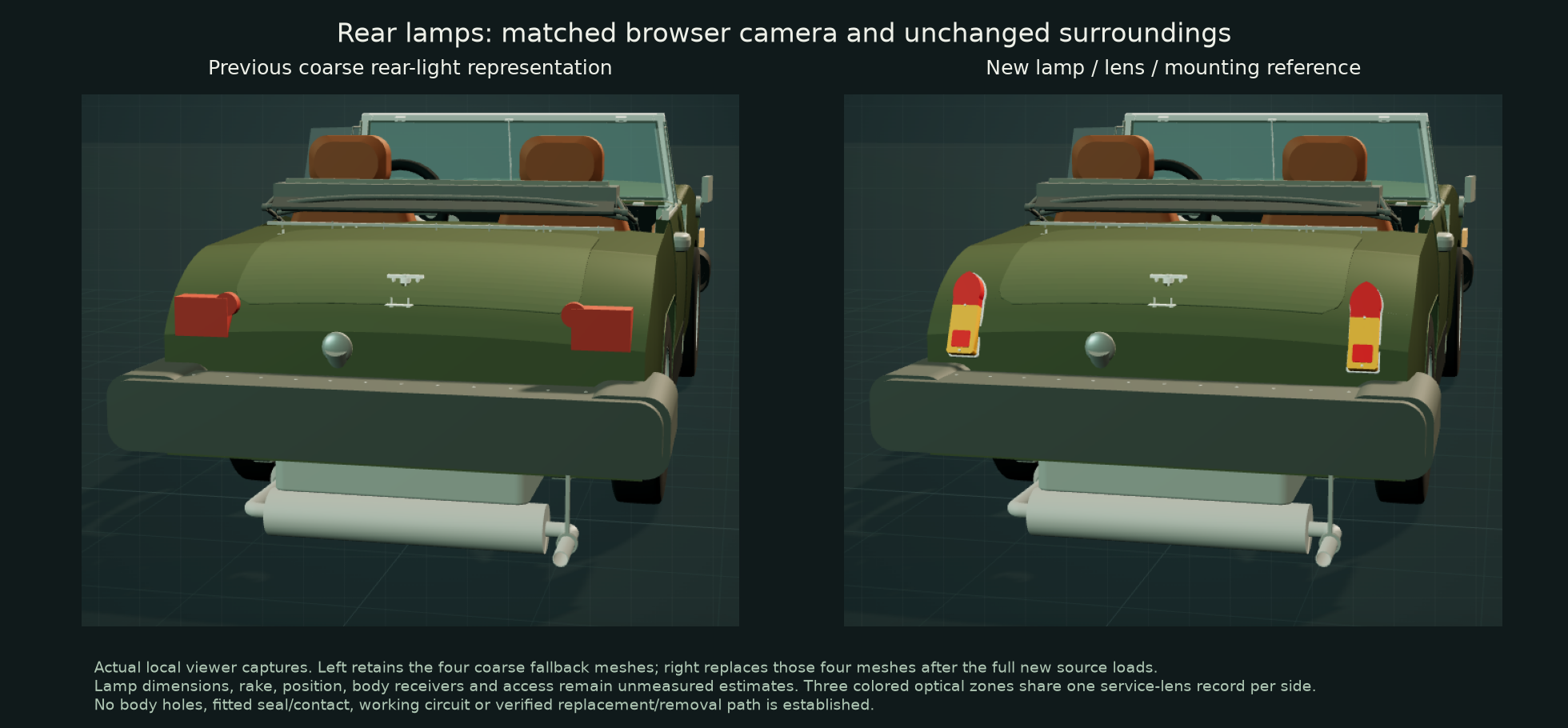
Tall lamp-body and lens references replace the broad red blocks and separate circles embedded in the old body shell. Rear studs, seals, bulb chambers, hollow holders and short local lead bundles now expose the mounting and access relationships. The fitted lamp identity and body registration remain unverified.
Rear side markers and number-plate lamps
These previously omitted assemblies now have separate catalog comparisons. Each side marker separates its open base, rim, smooth red lamp window, smooth reflex zone, holder, unidentified bulb envelope, three fixing roles and local tails. Each chrome plate lamp separates its shell/foot, lens, festoon envelope, backing/contact roles, unloaded base grommet, mounting hardware, front screws and local tails. All forty earlier rear-lighting groups retain their meshes, native volumes and positions.
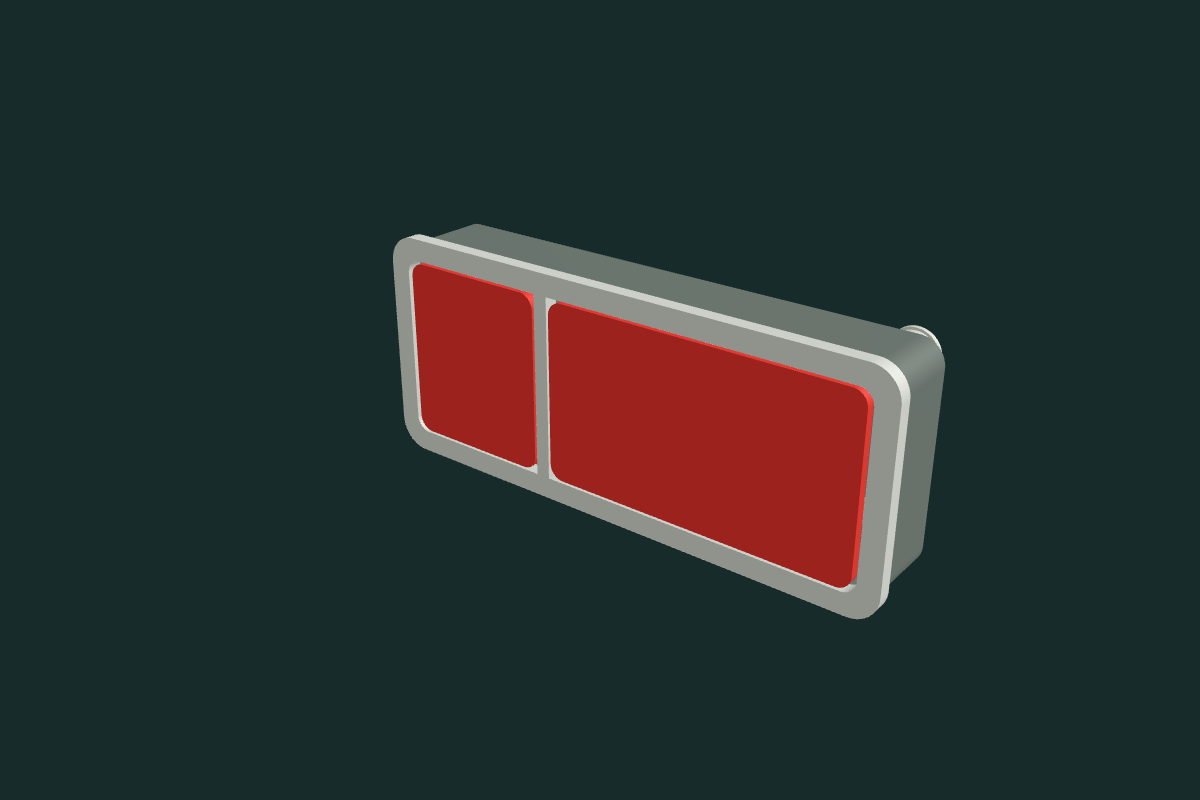

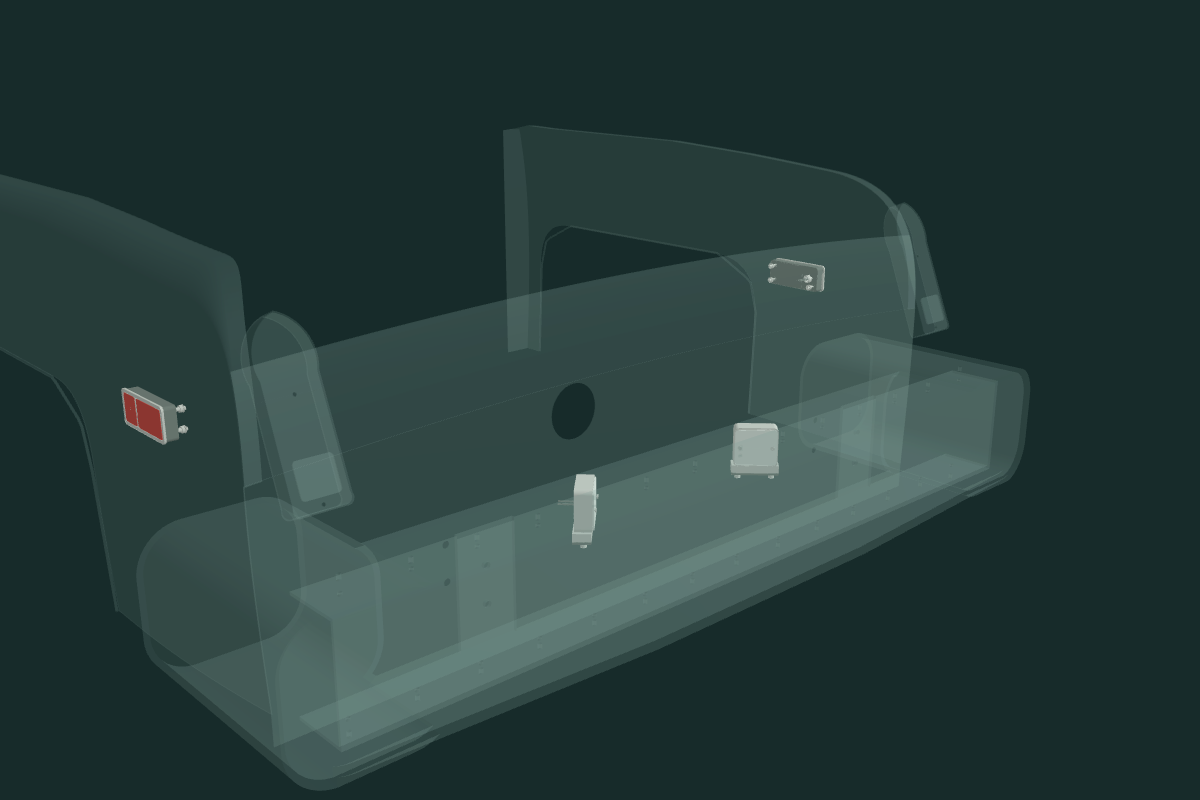
Factory PDF215 distinguishes the BHA4972 rear marker, 608224 red lens, 519364 rim, 47H5279 reflex, 244700 holder and GLB989 bulb. Six CNZ102 nuts and LWZ202 washers support three fixing roles per lamp; their coordinates and sections are not dimensioned. BP Northwest’s own offered assembly shows adjacent lamp/reflex zones and lists the same assembly for either side. This does not establish the installed orientation or fitted part.
Factory PDF216 lists BHA5303 with 13H5991 lens/bulb support, GLB254 bulb and 13H9016 base grommet for USA/Canada GAN5-143355–154100 and GAN6-154101–179462. AAU2143 with AAU5113 lens starts at GAN6-179463. The plate image was read directly; a generic “rubber bumper” supplier description does not merge these branches. MGOC’s BHA5303 photograph supplies chrome shell, lens, base/stud and local-tail context. No branch is identified as fitted here.
All dimensions and poses are construction estimates: 110 × 44 × 16 mm marker body, 65 × 60 × 24 mm plate shell, every wall/bore/fixing map, bulb shape, tail and base section. Marker centers at ±620, 630, −1460 mm and plate-lamp centers at ±170, 480, −1750 mm are independent body-frame choices. Their clocking is illustrative. GLB989 and GLB254 identify factory roles only; no fitted bulb, dimension, wattage or interchangeability is assigned.
The native check finds no positive intersections in 448 pairs against the quarter panels, rear panel and bumper. That does not prove support contact, registration or clearance. Eight positive internal source pairs remain: per marker, base/holder 58.904862 mm³, base/fixing envelopes 176.714587 mm³ and lens/bulb 42.750793 mm³; each plate shell/local-tail overlap is 9.047787 mm³. These are unregistered reconstruction relationships, not actual-car interference or validated mounting/sealing. No opening, reinforcement or receiver is cut to make them fit. Smooth red zones do not reproduce reflex prisms; smooth clear lenses do not establish light distribution. Tails and contact envelopes do not assign conductor count, polarity, earth, continuity or a functional circuit. No plate illumination, operating clearance, access, safe release order or verified replacement procedure is claimed.
Current complete rear-lighting STEP ↗ · Geometry, sources and estimates ↗ · Native retained-source and contact checks ↗ · Whole-car viewer checks ↗
A separate reversing-lamp comparison
The whole-car reference previously omitted the reversing lamps. Paired unregistered comparisons now separate the hollow housing, smooth lens, unloaded seating frame, unidentified festoon, backing/contact clips, two front screws and local tail/grommet envelopes. The original twenty-six stop/tail/indicator source groups retain their meshes, native volumes and placement.
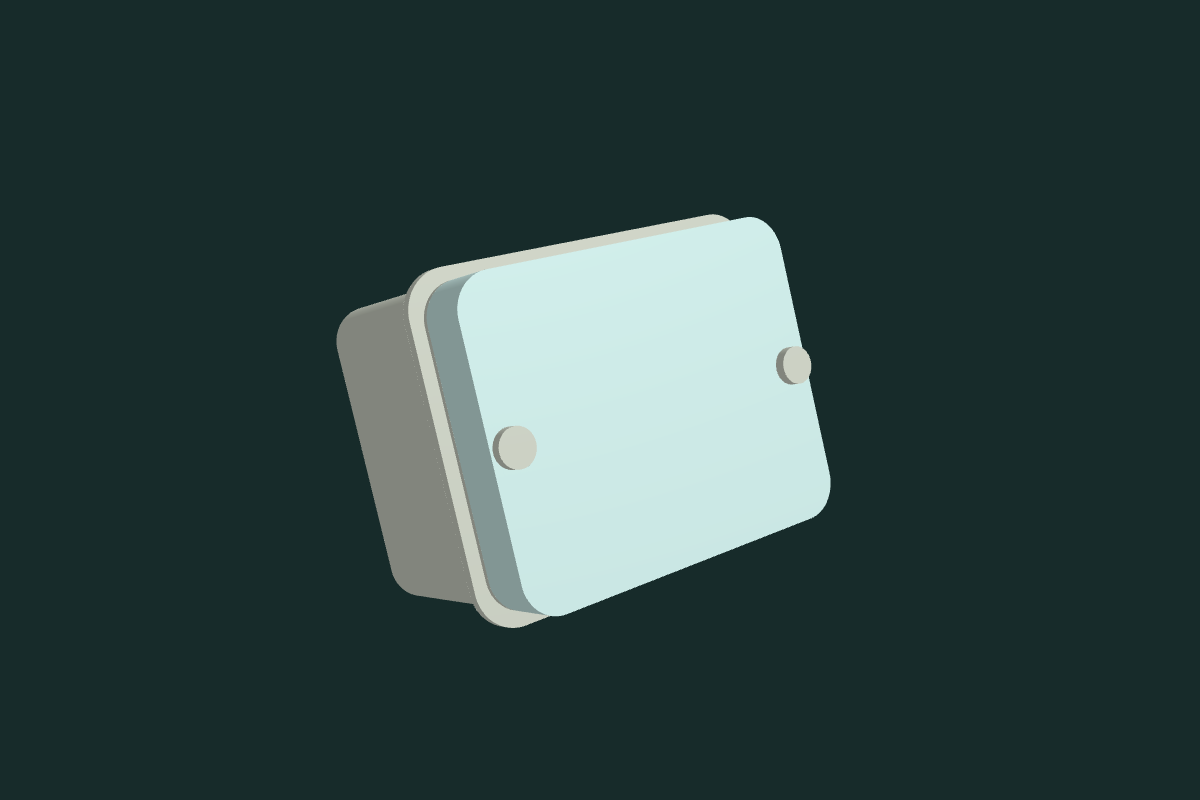
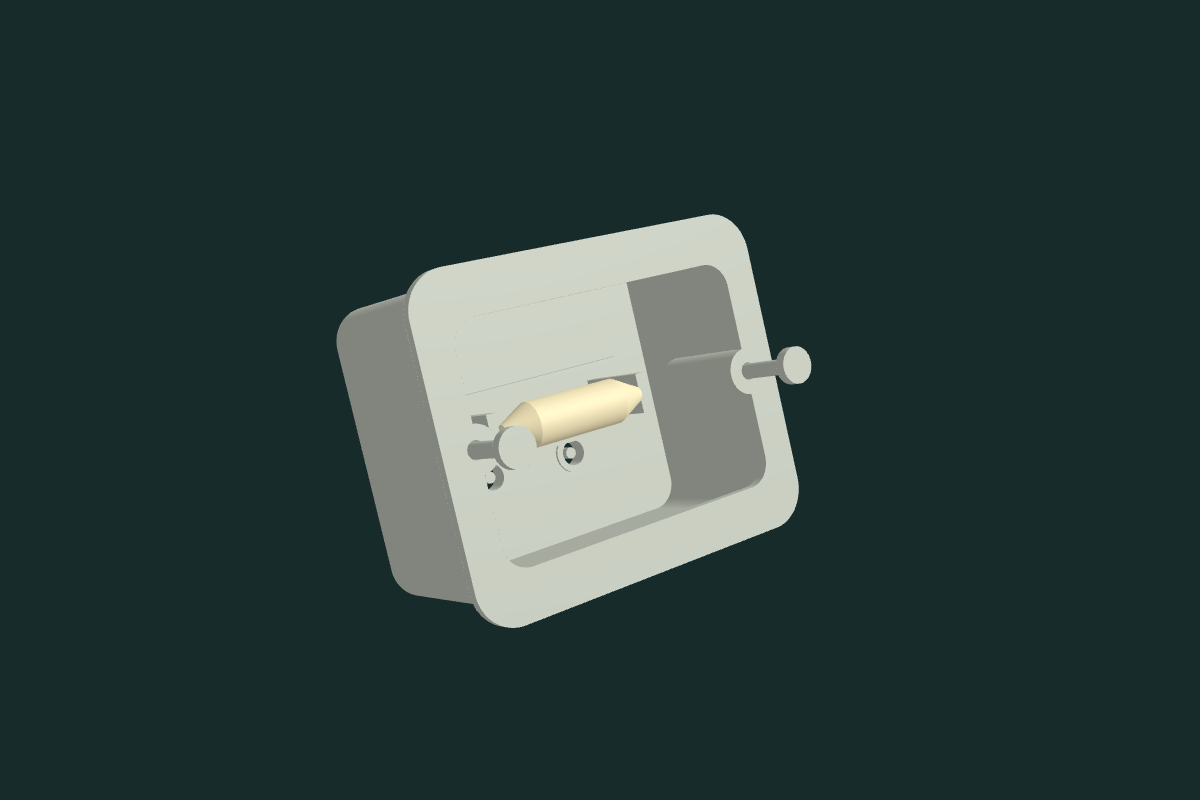
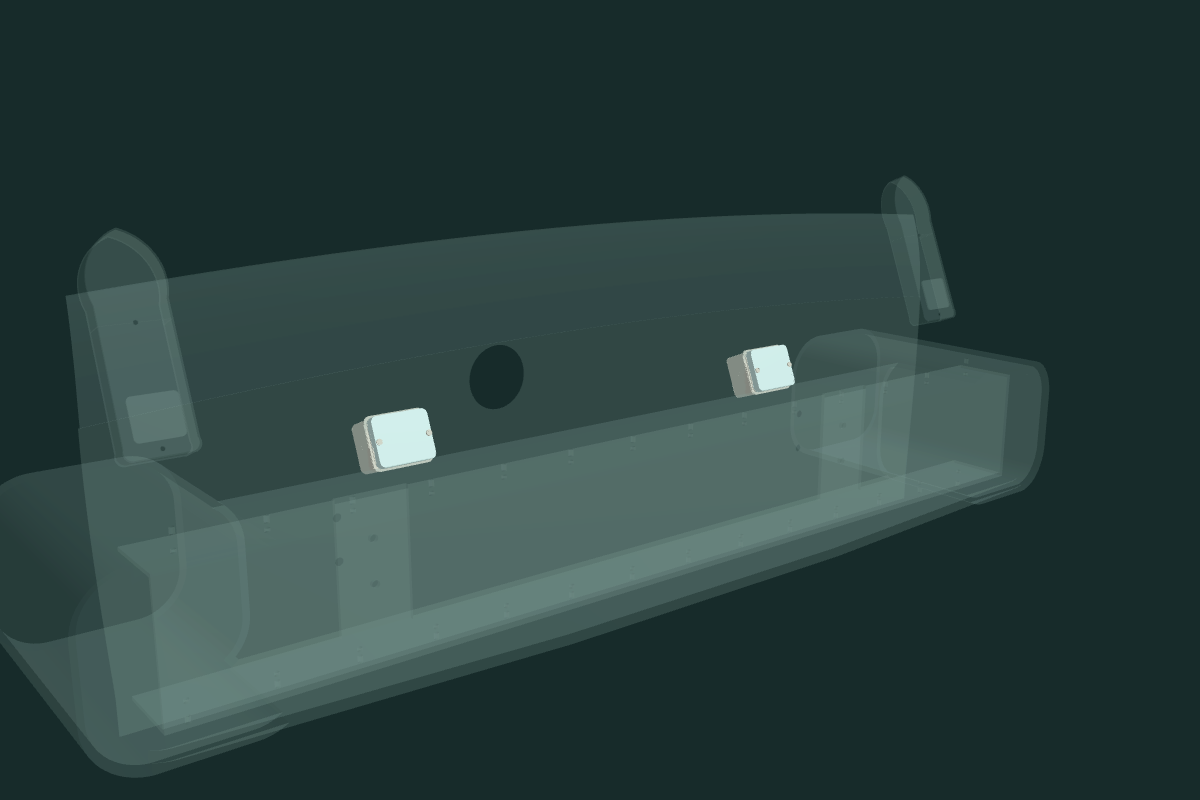
Factory PDF214 lists the later USA/Canada BHA5262 lamp, 37H7512 lens, 37H1759 seating gasket and GLB270 festoon. The page image was read directly: OCR incorrectly reads BHA5282. Classic Bits’ L798 photograph supports a rounded lens, two front screws, backing/contact roles and separate gasket. Its AAU5510 lamp is a replacement comparison.
The factory names GLB270; Classic Bits offers LLB239 separately, while MGOC lists GLB273 with its offered lamp. None identifies the fitted bulb. The model’s 32 × 9 mm festoon is an unmeasured recognition envelope. No wattage, filament, electrical operation or interchangeability is assigned.
Emberton’s L798 exterior is described approximately as 75 / 62.5 / 50 mm, with “wide” repeated for two dimensions. Using these as width, height and lamp-body depth is a construction interpretation, not a dimensioned manufacturer drawing. Every wall, bore, screw map, smooth lens and contact/lead shape remains estimated. Centers at ±288, 542, −1715 mm in the body frame and a 22-degree rake are independent drawing choices, not owner-photo measurements.
The rear panel and bumper stay. Per lamp, the proposed pose intersects the closing panel by about 495.262 mm³ at the housing, 194.190 mm³ at the lens, 56.719 mm³ at the seal and 18.297 mm³ at the screws. Tail/grommet envelopes overlap the housing by 87.085 mm³ and the backing/contact group by 6.429 mm³. These source conflicts do not establish fitted interference, loaded sealing or electrical continuity. No body aperture, receiver, hidden reinforcement or relief cut is added.
No fitted lamp, polarity, conductor count, earth path, gearbox-switch connection, optics, approved light pattern, operating clearance, access or verified replacement procedure is established. Rear side-marker and number-plate comparisons are now documented above; their fitted identities and service paths remain unverified.
Earlier reversing-lamp stage STEP ↗ · Geometry, estimates and sources ↗ · Retained geometry and static contacts ↗ · Whole-car viewer checks ↗
Keep the market and lamp family explicit
Factory parts plate 213 lists the later USA/Canada BHA5260 assembly and 37H7119 lens, distinct from BHA4973/37H4737. The modeled reference has red above amber and an integral red reflex zone, as shown by the supplier's front, open-base and rear photographs. Those photographs show an offered reproduction. IMG_6329/6341 give owner rear-quarter context without identifying the fitted complete rear lamp.
The three colored optical volumes share one selectable lens record per side. Their colors do not make them three removable service pieces. The supplier pictures support two bulb chambers, two front lens screws and two rear stud roles, without calibrating their dimensions or the car's hole map.
| Reference boundary | What is supported; what remains unknown |
|---|---|
| Cast base / rear-quarter body | Separate base, unloaded body gasket, two stud/nut/washer roles and rear bulb-access windows. All sections, gauge, maps, seal compression, body receivers and mounting coordinates remain estimates. No body openings are cut to manufacture agreement. |
| One lens / base | One lens record with red, amber and integral reflex zones; separate unloaded seating frame and two front screw envelopes. Actual screw identity, optical construction, sealing and fitted lens type remain unknown. |
| Stop/tail and indicator bulbs | Factory GLB380/GLB382 roles; the separately attributed OSRAM 7528 P21/5W and 7506 P21W comparisons provide nominal 26.5 mm diameter and 52.5 mm length. Globe/neck/base breakdown is estimated; fitted manufacturer, bayonet keys, contact engagement and filaments are not reconstructed. |
| Rear holder / local wiring | Two hollow holder envelopes, separate boot comparisons and two short open lead-bundle envelopes. These are not an asserted conductor count, circuit, color/polarity map, earth path or complete rear harness. |
Use the boot surroundings without inventing an access path
The lamp center stations now use the conditional IMG_6329 pose documented in the shared rear-body reconstruction. Shape and 22-degree rake are held; only Y/Z were fitted under an explicit unmeasured lateral prior. Opposite-side symmetry is assumed. The 80 mm width, local height, 22-degree rake and all lamp/body sections remain unmeasured construction estimates. Rear-quarter curvature, receiving surfaces, body apertures, retention and the common installed pose still need reconciliation. The boot lid follows the revised shared profile. Rear bumper and rear wheelhouse/shackle sources stay unchanged. Lamp-body seats and apertures remain unresolved.
Use isolation to inspect a lens, base, holder, bulb or fixing role, then return to the whole car for the surrounding body and boot. These offsets do not establish release order, supported access, bulb twist/withdrawal travel, wiring disconnection, tightening or a verified lamp replacement path. Do not drill, cut or choose parts from this drawing. Reverse lamps, rear side markers and number-plate lighting remain separate incomplete assemblies.
Validation covers valid connected bases, native STEP round-trip, positive mesh volumes, open bulb passages, selected lens/base/seal nonintersections and rear-bumper source comparison. These checks establish reference geometry; fitted identity, circuit, body sealing and removal clearance remain unresolved. The four old red meshes remain if the new source cannot load.