Inside the
rear bumper.
The former solid bumper blocks are replaced by a forward-open moulding, open steel armature, upper/lower clamping strips, rivet-layout comparison and four body-fixing references. The rear panel, tank and suspension retain their existing datums.
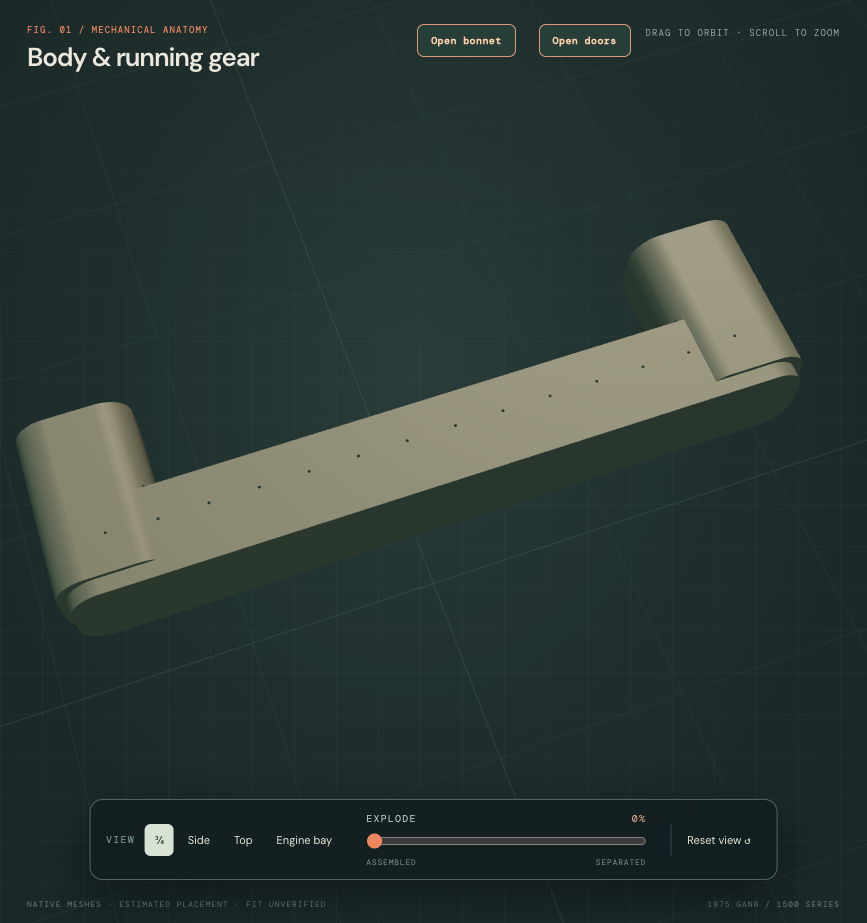
A continuous rear shell
The long flat rear face now follows a continuous quadratic bow,while the corner returns,outer bounding envelope and mounting chain retain their previous stations. The inner boundary follows the same curve with the inherited8mm projected-Z wall allowance. The shell remains one connected native solid.
Before · flat central face
After · continuous bow
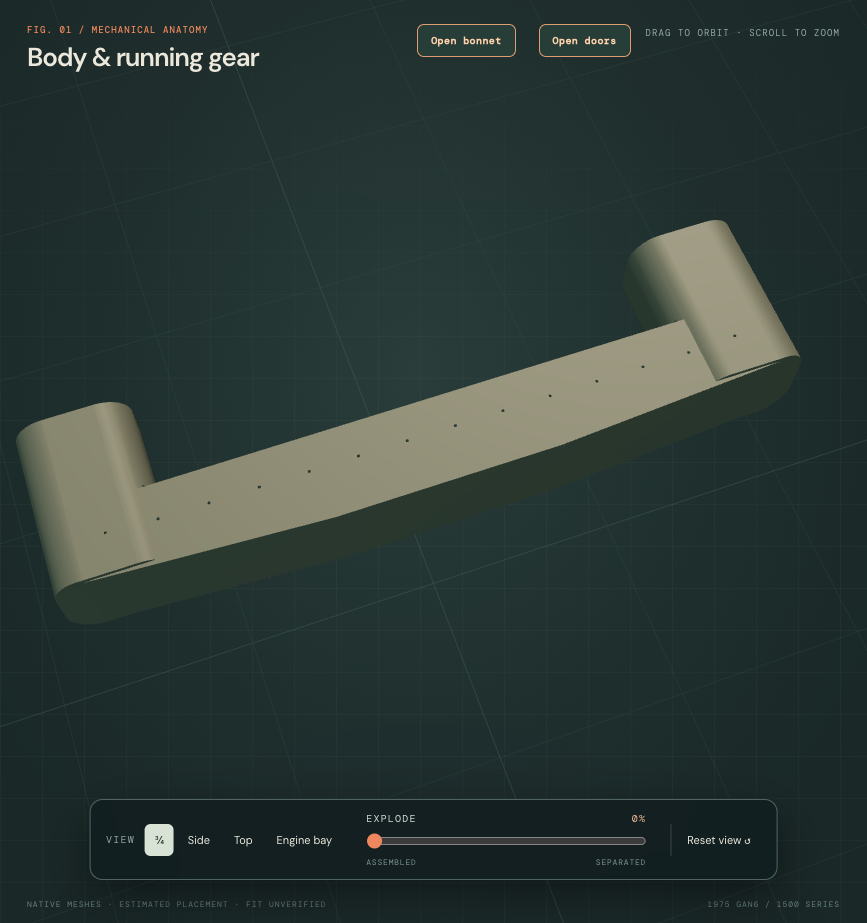
Factory ML0078/PDF269 supports the bowed rear-moulding architecture. OwnerIMG_6329 supports fitted rubber-bumper presence and corner context,but its side view does not measure the plan curve. The selected35mm edge-relative bow and symmetric quadratic interpolation are estimates. The8mm wall allowance is projected along Z,not a measured normal rubber gauge. Neither armature variant is selected as fitted.
All six other source mesh records/native volumes remain unchanged:armature,two strips,rivets and left/right body fixings. Full outer bounds,body station,all28rivet axes and passages are held. This is a reference shape improvement;it does not establish rubber compression,clamping,impact response,body clearance or a replacement path.
Inspect the mounting relationships
The moulding wraps around an open channel and its estimated mounting faces. Four drawing studs extend toward the rear closing panel, through four separately estimated panel apertures to washer/nut envelopes. That common pattern explains the reference relationship; it does not establish fitted hole centers, threads, bearing contact or tool access.
Connected armature and through-fastening reference
The retained full-width web, flanges and mounting faces now form one connected native armature. Twenty-eight shared axes pass through the moulding, clamping strips and armature flanges. Each smooth rivet reference now has a joined shank and head and follows the retained exterior, including the deeper corner returns. The moulding envelope, bumper station, body-fixing axes and surrounding body remain at their previous references.
The factory exploded view on PDF p.269 supports the assembly relationship and rivet count. It does not dimension these sections or holes. The selected 5.6mm passages, 5mm shanks, 10mm heads, 2mm head thickness and 0.5mm head display gap are estimates. This geometry does not specify rivet grip, setting, compression, drilling, strength or actual-car fit.
Before · disconnected export
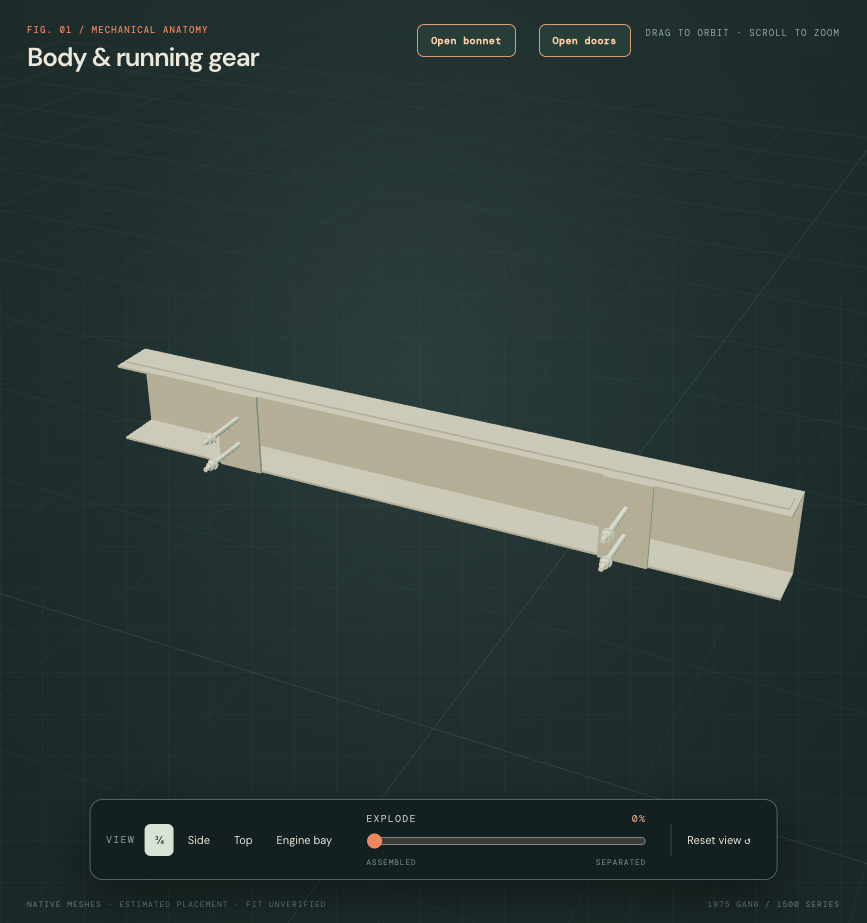
The native armature was five overlapping solids, with solid strips and no shared rivet passages.
After · shared passages
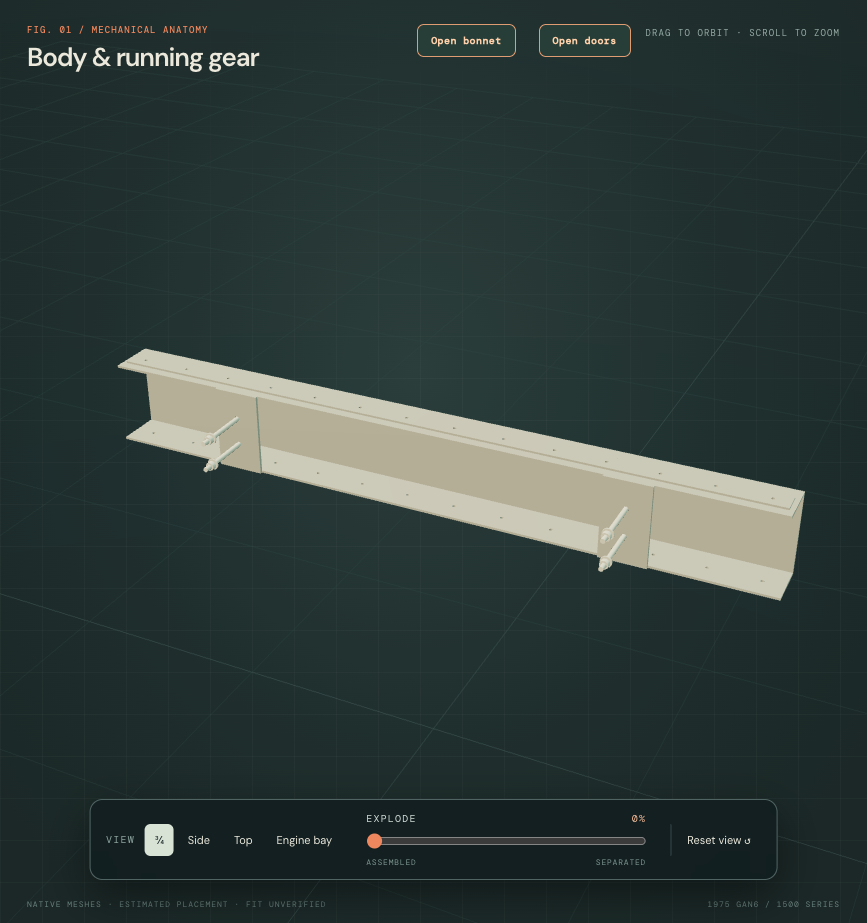
One armature and 28 open fastening axes. This diagnostic view hides the moulding and rivets to expose the internal stack.
Keep early and later armatures distinct
Factory PDF p. 269 lists BHM539 rear bar/moulding architecture, CHA244 armature before CHA536 from GAN6-158716, CHA252 upper and CHA253 lower clamping plates, 28 CHA307 rivets and four body nuts. Neither armature is identified as fitted. The 28 rivets are a catalog layout count; their modeled pitch and form are estimates, not a survey of this bumper.
The rear reference follows that rear-specific plate. Front support tube/spring arrangements are not transferred to it. Earlier rear reinforcement details on PDF p. 268 finish before GAN6 and are not assumed fitted. PDF p. 271 also distinguishes number-plate applications, including an except-North-America bracket branch; those generic supplier brackets are not installed in this North American reference.
Owner evidence and estimated station
IMG_6329 and IMG_6341 support the visible rear rubber bumper and corner-wrap context. They do not expose the hidden armature, rivets, body fixing pattern or measured bumper/body stand-off. The new main moulding center is Z −2.18 in the nominal body drawing, replacing the former thick slab’s estimated station. This is a provisional assembly pose, not measured clearance or an overall-length specification. The rear body panel is not moved to obtain fit.
All profiles, sections, moulding thickness, rivet pitch, fastener forms, mount faces and body holes are estimates. Separation exposes moulding, strips and armature; offsets do not establish rivet release, safe bumper support, body reinforcement access or a removal sequence. No impact strength, towing/lifting use, clamp preload, setting force, rivet reuse, loaded contact or verified withdrawal path is established.
Native reference files
Construction checks cover positive valid solids, STEP round-trip, an open moulding mouth with its rear face retained and the four estimated panel openings. Passing checks do not verify fitted geometry or safe service. The source body/tank/suspension and other native exports remain unchanged except the declared panel apertures.