Branched return pipe.
Open connection roles.
The whole-car heater and local hoses now sit 80 mm rearward of their inherited engine-relative drawing, following an explicit owner-photo layout estimate. This independent return comparison stays fixed. Its former common boundary with heater B is now an 80 mm drawing gap; no connecting hose, fitted splice or measured clearance is implied. Source STEP coordinates retain their original comparison frame.
A hollow three-port pipe, integral-role tab, pump-side adapter, tube nut, olive, hose, rear cuff and two clip envelopes expose the 1500 return assembly relationships. This is a reference assembly comparison: its present engine-frame pose intersects independent block and hose geometry and cannot establish an installed coolant route.
Evidence and variants
Factory PDF p. 65 lists 212935 pump-to-inlet-manifold rear pipe, 101343 adapter, 101302 tube nut and TL11 sleeve, plus manifold-hose roles. The supplier’s 212935 photograph supports a curved, branched tube with a one-hole tab. Neither supplies fitted dimensions for this car.
Later USA/Canada p. 66 and heater p. 280 distinguish changed hoses and California bypass/automatic-choke arrangements. Those branches remain unselected. Earlier 12G1785 heater-to-radiator plumbing is not applied to the 1500.
Owner IMG_6890–IMG_6892 support local heater, tap and hose context. They do not trace the complete hidden return rail or casting ports. No new direct owner measurement is applied. All new stations, diameters, walls, bends and connector geometry are estimates; inherited hose radii remain source estimates.
What the assembly exposes
Pipe and union
The hollow pipe has three open ports and a retained opposite wall beneath the branch. The tab is displayed separately for inspection but represents an integral/welded role, not a detachable joint. Smooth adapter, hex nut and uncompressed olive expose roles without reconstructing threads or compression sealing.
Three unresolved boundaries
The adapter has no assigned water-pump counterpart. The rear cuff ends open without an invented manifold nipple. A comparison hose begins at the existing untraced heater-B boundary; its tangent, identity, coupling and destination remain unverified. The separate tap/elbow-side hose remains untraced.
The substantial block overlap makes the present pose unsuitable as an installed route. Existing engine castings and heater geometry are preserved. The inlet manifold currently contains air-passage references only; no water jacket is inferred from its air mouths. No pump boss is identified or drilled by assumption.
Historical contacts before the pipe-profile revision
This table records the earlier profile. The follow-up below and its validation file report the revised source contacts; these numbers are not current whole-car fit checks.
| Source pair | Intersection volume |
|---|---|
| branched hollow 212935 role comparison exhaust manifold | 767.625 mm³ |
| branched hollow 212935 role comparison block | 21583.7 mm³ |
| integral tab separately displayed comparison block | 577.382 mm³ |
| unassigned pump end adapter comparison block | 5987.46 mm³ |
| tube nut envelope block | 864.341 mm³ |
| uncompressed olive comparison block | 138.714 mm³ |
| hose from untraced boundary comparison exhaust manifold | 2347.89 mm³ |
These are reconstruction conflicts in sampled source solids, not evidence of fitted interference or damage. Zero contact with a pump reference does not establish a connection. Resolving the shared registration and actual casting ports precedes any installed route or clearance claim.
Workshop boundary
Use selection, isolation and illustrative separation to inspect the component roles. Tab attachment, tool access, hose clips, loaded sealing, pressure/flow, safe draining and release order, and verified withdrawal paths remain unresolved. The display does not encode a replacement procedure. Existing heater and radiator studies retain their independent open boundaries.
Native files
Eight source meshes contain ten valid STEP solids. Construction checks cover three open pipe ports, retained opposite wall, and local pipe/hose/adapter nonintersection. Viewer checks assess scale, selection and declared display movement; they do not verify fitted registration.
Follow the return pipe’s bend and mounting role
A newly reviewed supplier photograph and description of replacement 212935SS show a long main run, bend near the rear, short take-off and welded tab. The supplier identifies a bellhousing-bolt mounting role. This manual-choke replacement is a comparison, not identification of the pipe on your car or a factory removal procedure.
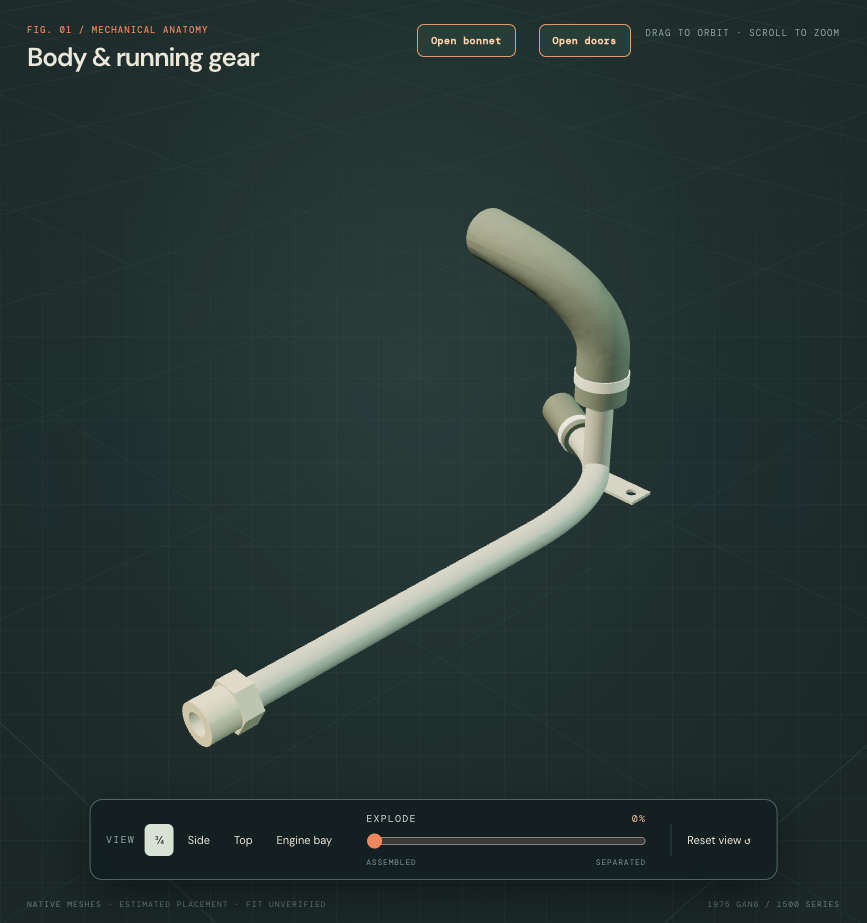
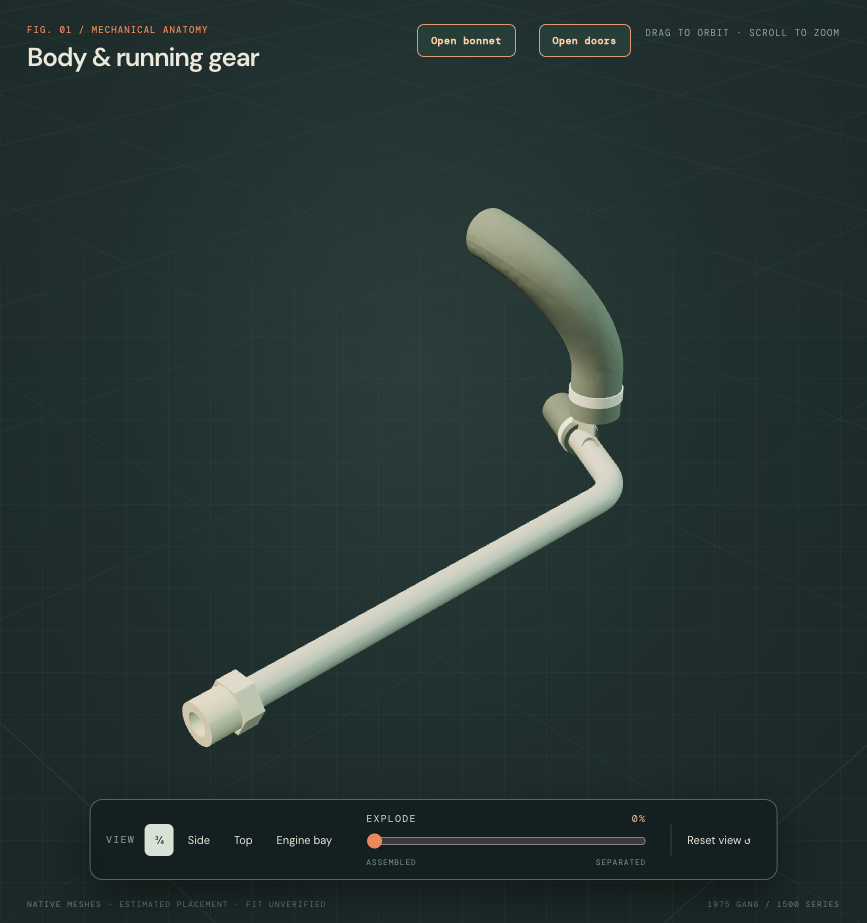
The main end stations and tangents stay. A selected 35 mm tangent bend replaces the freeform curve, and the take-off moves onto the short rear straight. Its estimated 17 mm outside / 13 mm bore matches the main tube; the former unsupported flare is removed. The tab faces the engine’s axial direction as a mounting-role reconstruction. Its position, size and hole remain estimates; no particular bellhousing bolt is assigned.
The existing heater boundary stays. The continuation hose and branch clip follow the new estimated branch mouth. Its inherited 24 mm bore now leaves a 3.5 mm radial source gap around the 17 mm pipe. No reducer, loaded rubber deformation or sealed connection is invented. Pump adapter, nut, olive and rear cuff stay, with both remote casting interfaces open.
The revised pipe still intersects the independent block reference, by about 23,925 mm³. The revised comparison hose also intersects the existing local heater-B hose by about 5,672 mm³. These are unresolved model relationships, not findings about your actual car. No casting, engine frame or body frame moves to conceal them.
The source has eight groups and nine positive valid STEP solids. Pipe and tab are individually connected; all three pipe mouths and the axial tab bore are open. Four other mesh records and native volumes stay unchanged. Geometry checks do not verify fitted routing, support strength, compatibility, coolant flow, pressure sealing, drain/disconnection sequence or an actual removal path.