British Leyland issued an overheating bulletin for 1975 Midgets in August 1975. It changed several connected parts. Use this guide to identify what is on your car before choosing a pressure cap, ordering hoses, or deciding what an overheating symptom means.
Its stated trigger was an instance of severe overheating on a 1975 MG Midget. It also instructs the mechanic to establish that ordinary faults, including head gasket trouble, loose head bolts, incorrect ignition timing and an improperly adjusted fan belt, were not the cause before making the modifications. The photos do not show that this car has overheated or that the bulletin was carried out.
Compare the bulletin with your car
The bulletin describes a package of changes. A single replacement part would not establish that the complete conversion is present. Record each finding separately.
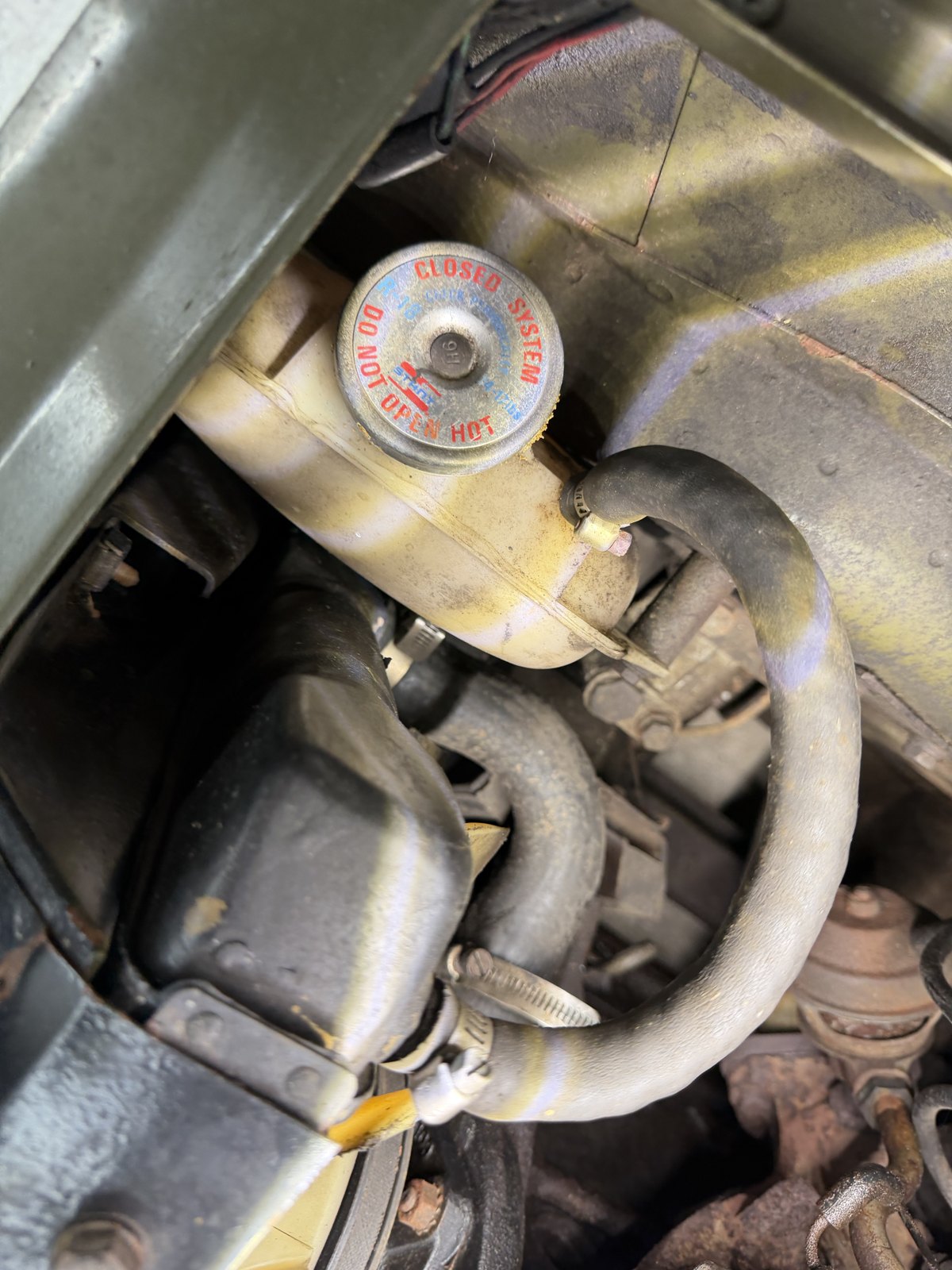
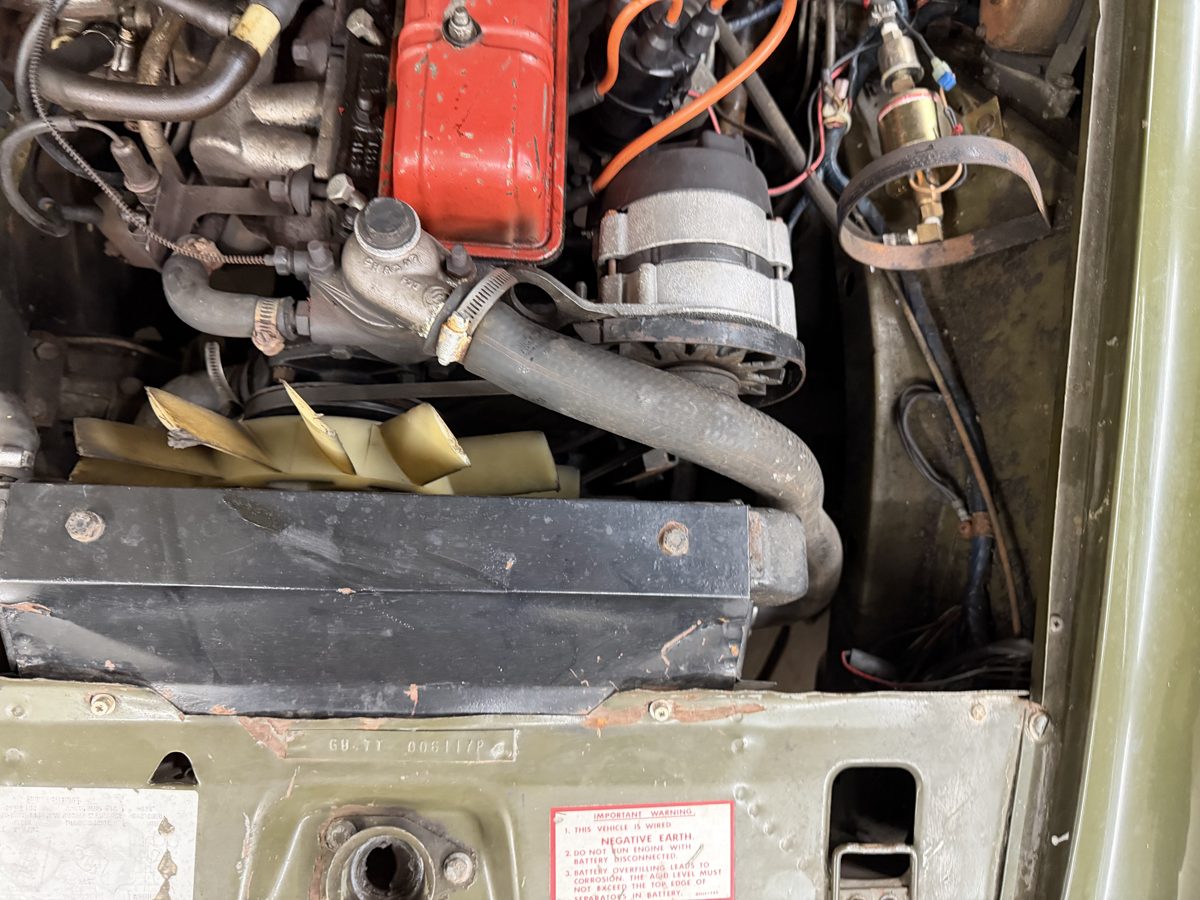
IMG_6858 · tank and cap. The tank looks pale and seamed; its material, part number and cap seals are not confirmed by this image.IMG_6853 · engine bay. Check the whole upper hose in person; this view cannot establish whether the bulletin's switch and T sleeve are fitted.
01 / TANK + CAP
Identify them together
The bulletin calls for metal expansion tank URP-1148 and a supplied double-seal pressure cap. It explicitly says that cap is not interchangeable with the original. The photographed tank has a pale, apparently seamed exterior, but the image does not prove its material or pressure-cap specification.
On the car: with the engine completely cold, photograph the tank body, any stamped or molded number, cap markings, neck and seals. Record the fitted cap before considering a replacement.
02 / TOP HOSE
Look for the added switch
The conversion places thermo-vac switch C-37430 in a 158308 T-sleeve adaptor in the top radiator hose, with vacuum and water hoses routed to the modified system. The current photos do not show the full hose clearly enough to call it present or absent.
On the car: trace the entire upper hose from radiator to thermostat housing; photograph any inserted sleeve, switch and small hose connections.
03 / CATCH BOTTLE
Check the right-hand shock mount
The bulletin adds no-loss bottle BHA-5239 on bracket CHA-585 at the right-hand upper shock absorber support plate. No current photo positively identifies this bottle.
On the car: photograph that mount area and trace any small hose from the tank or cap. Keep its actual routing in the record.
04 / OTHER CHANGES
Do not infer them from the tank
The bulletin also specifies thermostat housing CHA-595, externally vented carburettor deceleration valve AAU-2346, replacement temperature gauge AAU-2641, repositioned horns and front number plate, plus a final pressure test. None of those identities has been confirmed from the published photos.
On the car: photograph part markings and the front bumper and horn area; record what you can verify and leave the rest unknown.
What to do with the result
1
No overheating history established
Complete the cold cooling inspection and record the parts actually fitted. Do not order a cap from the model year alone. The historical bulletin is a reference for identifying the system, not proof this car needs a conversion.
2
Overheating or coolant loss observed
Record when it happened, what the gauge showed, coolant loss and any visible leaks. Let the engine cool before inspection. Check the basic cooling system and belt first, then investigate the ordinary faults named in the bulletin. Do not keep driving a car that is overheating or losing coolant.
3
Repair or change proposed
Match the fitted tank neck and cap, hose arrangement and other installed parts to a procedure for that configuration. The bulletin describes a coordinated period modification and a pressure test; its old kit number is not a substitute for an available, verified parts list today.
Evidence and limits
British Leyland Technical Service Bulletin 75-A-6, August 1975 ↗ is the primary source for the trigger, parts, diagnostic warning and installation outline. The Moss 1500 cooling plate, PDF p. 37 ↗ reproduces a short account and shows cooling components; it notes the original modification parts are no longer available. Owner photos show visible details only. The part identities and the presence of a complete modification on this car remain to be checked in person.