Peter Cooney served as a sergeant in Company M, 165th Infantry: New York’s 69th Regiment in its First World War designation. The 165th was part of the 42nd “Rainbow” Division, a National Guard division assembled from units across the United States. Its roster places him at 37 West 50th Street, New York City.
Father Francis Duffy, the regiment’s chaplain, names Cooney twice in Father Duffy’s Story. In his account of the 14 October 1918 assault, he writes that Company M lost Sergeant Peter Cooney. A later passage says Cooney “was out with the regiment in ’98.” Those two mentions make him more than a line in a casualty list: they identify an experienced Company M noncommissioned officer remembered by the chaplain who shared the regiment’s war.
14 October 1918
That morning the 165th attacked toward the fortified Côte de Châtillon during the Meuse-Argonne offensive. Duffy described artillery beginning before dawn, the infantry moving at 8:30, Companies I and M leading, shell fire crossing the advance, and German aircraft machine-gunning the lines. Company M went forward on the left toward the Côte de Maldah. By early afternoon, Duffy wrote, half the Third Battalion had been killed or wounded. His sentence about Cooney is brief because the losses were so numerous: “Company M lost Sergeant Peter Cooney.”
The Washington Times later printed his name in its casualty reporting, and the 165th Infantry roster preserves his rank and New York address. The Graves Registration card, however, is the document that carries his story beyond the day he died.
The card
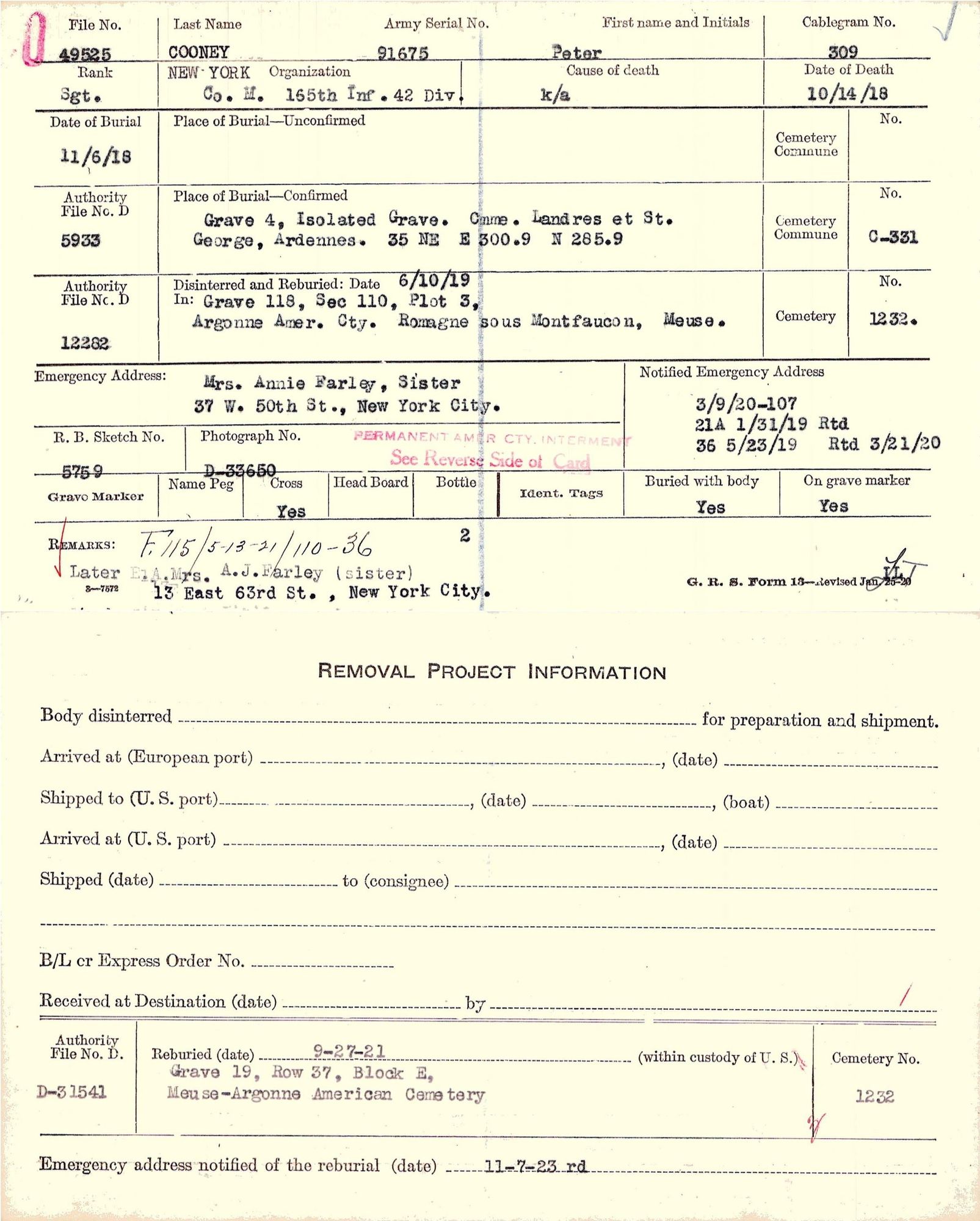
| File number | 49525 |
|---|---|
| Name | COONEY, Peter |
| Army serial number | 91675 |
| Rank and organization | Sgt.; Co. M, 165th Inf., 42 Div. |
| Cause and date of death | Killed in action; 10/14/18 |
| Date of burial | 11/6/18 |
| Confirmed first burial | Grave 4, isolated grave, Commune Landres et St. Georges, Ardennes; 35 NE E 300.9 N 285.9; cemetery no. C-331 |
| First reburial | Disinterred and reburied 6/10/19 in Grave 118, Section 110, Plot 3, Argonne American Cemetery, Romagne-sous-Montfaucon, Meuse; cemetery no. 1232 |
| Emergency address | Mrs. Annie Farley, sister, 37 W. 50th St., New York City |
| Later emergency address | Mrs. A. J. Farley (sister), 13 East 63rd St., New York City |
| Grave identification | Name peg: yes; cross: yes; buried with body: yes; on grave marker: yes |
| Permanent reburial | 9/27/21, Grave 19, Row 37, Block E, Meuse-Argonne American Cemetery |
| Notification | Emergency address notified of reburial; card notation dated 11/7/23 |
His journey, in order
Read this numbered list first; it contains all the information shown on the optional map.
- 1Derrycriff, Islandeady, County Mayo, Ireland
Possible family origin — not proved for this soldier
Approximate location. Derrycriff was the Cooney–Needham family home place, but the archive has not proved that the sergeant was the Peter born there in 1890. - 237 West 50th Street, New York City
Home of record in 1918
Approximate location. His 165th Infantry roster and Graves Registration card give this New York address. - 3Battlefield grave near Landres-et-Saint-Georges, Ardennes, France
Killed 14 October 1918; first burial recorded in November 1918
This point is worked out from the map reference written on his card, “35 NE E 300.9 N 285.9”, using the French wartime grid the American army used in 1918. It falls about six kilometres from the village, in the Landres-et-Saint-Georges and Côte de Châtillon fighting where his regiment was on 14 October 1918 — so it marks the battlefield rather than the village. He was killed near here and placed in Grave 4, an isolated grave where he fell. Accurate to roughly a kilometre. - 4Meuse-Argonne American Cemetery, Romagne-sous-Montfaucon, Meuse, France
10 June 1919 and 27 September 1921
Approximate location. He was first moved to temporary Grave 118, Section 110, Plot 3, then reburied permanently in Grave 19, Row 37, Block E. Both burials were at the same cemetery in Romagne-sous-Montfaucon.
The map could not load. The complete place list is above it.
The pins show approximate places. The line only joins them in time order; it does not prove the route travelled. Cemetery and burial places have red pins.
The line that connects him to us
The emergency-address field names “Mrs. Annie Farley, Sister,” followed by “Mrs. A. J. Farley (sister)” — Andrew J. Farley’s wife, at the West 50th Street address the regimental roster gives as the sergeant’s own. Two civil records call Andrew’s wife Mary Cooney, and the Army also named his other sisters: Bridget Horan of Jersey City and Nellie Cooney, matching this family’s Derrycriff daughters exactly. The one loose thread has since been tied: Anne Cooney married Michael Cawley and was raising his children in Manhattan through these years, so she cannot be Mrs Farley. Mary is.
Peter Cooney’s person page · Military context and sources · Document archive