Which rocker cover
is on this engine?
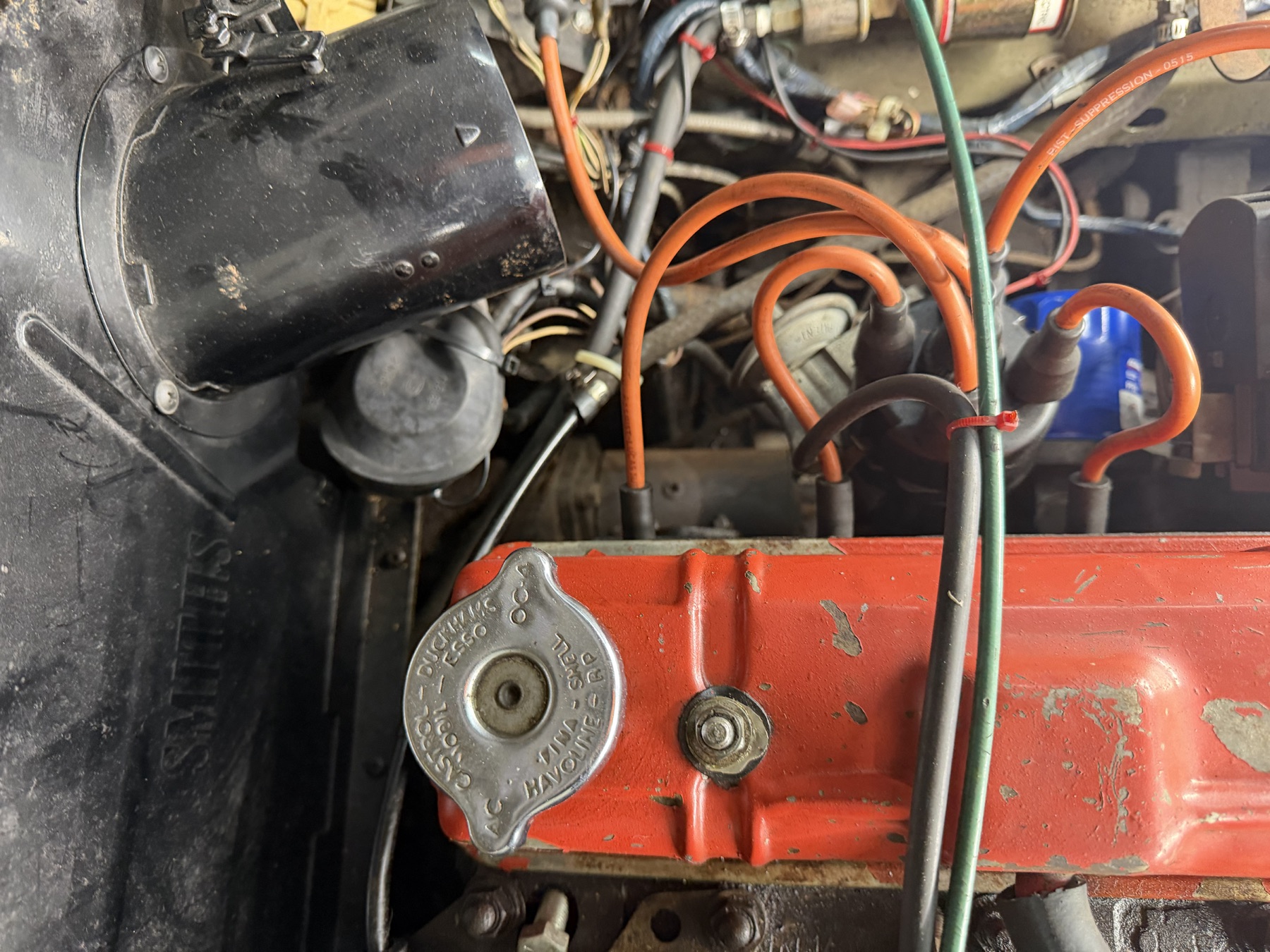
The red pressed-steel cover and a two-grip cap are visible in your photographs. The gasket profile, stud length and sealing hardware are not. Identify those before ordering a cover, gasket or fasteners, and before treating the CAD removal study as a rehearsal for this car.
Parts-plate reference
Moss’s Midget 1500 cylinder-head plate lists these catalog applications. They are a comparison checklist, not proof of what is fitted to this car. Both years retain a separate valve-cover perimeter gasket listing; the later O-rings are listed with the cover fasteners.
| Component · Moss number | Through 1976 | 1977 onward |
|---|---|---|
| Cover stud | 328-675 · 4⅛ in · two | 313-020 · 3⁵⁄₁₆ in · two |
| Fastener and seal | 310-105 nut, 365-720 plain washer and 324-680 fiber washer · two each | 072-019 cap nut, 072-020 washer and 071-092 O-ring · two each |
| Perimeter gasket | 694-100 stock gasket or 694-101 silicone option · one | |
| Oil filler cap | 834-765 original listing; 780-126 replacement listing · one. Compare the actual neck and seal. | |
Moss Sprite/Midget catalog, “Midget 1500 Cylinder Head” plate ↗
Make the fitment decision
| What you find on the car | How to use that evidence |
|---|---|
| Engine number, cover number or markings, and conventional exposed studs and nuts | Compare those identifiers and the sealing face with the through-1976 row above. This is a candidate for the early assembly; confirm the fitted gasket profile before ordering. |
| Tube-type nuts, different studs or an O-ring-style sealing arrangement | Check the 1977-on row above. Do not reuse an early fixing list just because the car is a 1975 model. |
| Alloy cover or altered breather connection | Treat it as an aftermarket assembly. Identify the cover maker, its gasket section and stud requirements; check internal rocker clearance and closed-bonnet clearance before fitting. |
| Cover still installed; underside and engine ID unreadable | Keep the variant unresolved. A replacement gasket or fastener choice based only on the red paint or cap shape is premature. |
Capture one useful evidence set
Before removal
Photograph the engine number, cover from directly above and both sides, each nut/stud, the cap stamping and underside, the breather hose and its connection, and every hose or lead near the lift path. Measure cover length, width, height, stud-center spacing and bonnet clearance where accessible. Record measurements in the CAD inspector.
With the cover safely off
Photograph the underside, gasket groove and head sealing face with a ruler in the same plane. Record gasket material and cross-section, stud projection and nut style. Keep dirt out of the valve train. Preserve the old parts until the replacement seal and fixings have been compared side by side.
Then plan the replacement
- Match the observed cover and fixing type to the Moss year rows and a current supplier plate. Rimmer lists standard AJM414, rubber-cork AJM414T, and separate silicone profiles for pressed-steel and alloy covers; the catalog listing alone does not prove which seal is on your engine. Compare gasket profiles ↗
- Trace the rocker-cover breather hose. MGOC says the sealed 1500 system routes cover vapors toward the carburetor through a T-piece; a replacement cover must preserve the relevant connection. Breather note ↗
- Use the sourced valve procedure for removal and refitting. Its factory torque for the two cover nuts is 2 lbf ft. The virtual CAD lift is illustrative until the fitted hardware, obstruction clearance and gasket are verified.