About
I’m an Assistant Teaching Professor of Law at Drexel Kline School of Law, where I teach public law, tax policy, and the regulation of technology. Across those subjects, I am interested in the same basic problem: how to make fast-moving legal systems legible to the people who have to work inside them.
I’m also a tax attorney and writer. My weekly Bloomberg Tax column, “Technically Speaking,” examines the places where tax, technology, and public policy collide—from artificial intelligence and data privacy to energy incentives and digital assets.
I contribute to Forbes on law, policy, technology, energy, and economic justice. My work has also appeared in Law360, TechCrunch, and Baseball Prospectus—one of these things is not like the others—and has been cited in scholarship and public-policy materials collected on the Impact page.
Before law school, I developed websites and software and worked in IT. I now practice in Pennsylvania and New Jersey, focusing on tax matters and technology contracts, including SaaS agreements and software licenses.
I write and host the daily legal news podcast Minimum Competence, and I run esq.social, the largest lawyer and adjacent-professional Mastodon instance on the fediverse.
My wife Gina and I own a cabin on 15 acres in the Poconos, just outside Jim Thorpe. You’ll find us traipsing about up there most weekends, or you can join us vicariously through our YouTube channel. I relish time with my wife and daughter, enjoy playing with my four dogs, and acknowledge the presence of one cat. I made the switch to electric motorcycles in 2021 and haven’t looked back — currently a 2022 Zero FX.
Research
Much of modern governance happens through text that quietly changes over time. Statutes are amended, regulations are revised, and digital contracts are updated—often without public visibility into what changed, when it changed, or how those changes alter rights and obligations.
My research focuses on making legal change observable.
Rather than studying law as a static body of rules, this work treats law as a dynamic system of continuously revised texts, both public and private. To support that inquiry, I build and maintain empirical infrastructure that tracks how legal documents evolve over time, preserving historical versions, detecting substantive changes, and making those changes inspectable and citeable.
This work currently centers on two complementary projects.
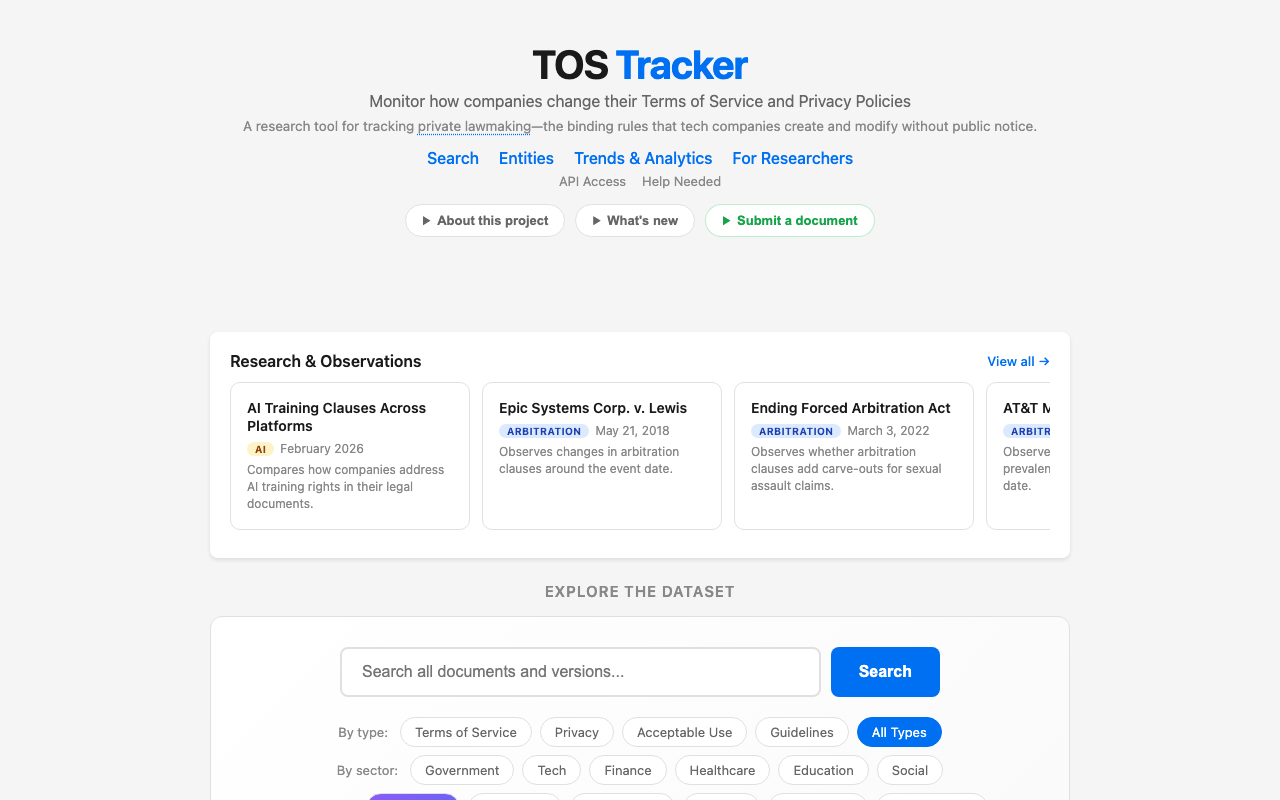
TOSTracker — Private Lawmaking
TOSTracker documents how private companies govern users through Terms of Service, Privacy Policies, and related digital contracts.
These documents function as a form of private lawmaking: they allocate rights, impose obligations, mandate arbitration, define content ownership, and shape dispute resolution—often unilaterally and without negotiation. Courts frequently treat them as binding, yet they can change overnight.
- Continuously archives official versions of Terms of Service and Privacy Policies
- Preserves historical versions with cryptographic hashes and timestamps
- Detects and scores substantive changes between versions
- Makes contract evolution visible through structured diffs and a public change feed
The project supports teaching, scholarship, journalism, and public-interest research by exposing a layer of governance that is legally consequential but typically invisible.
FRTracker — Public Rulemaking
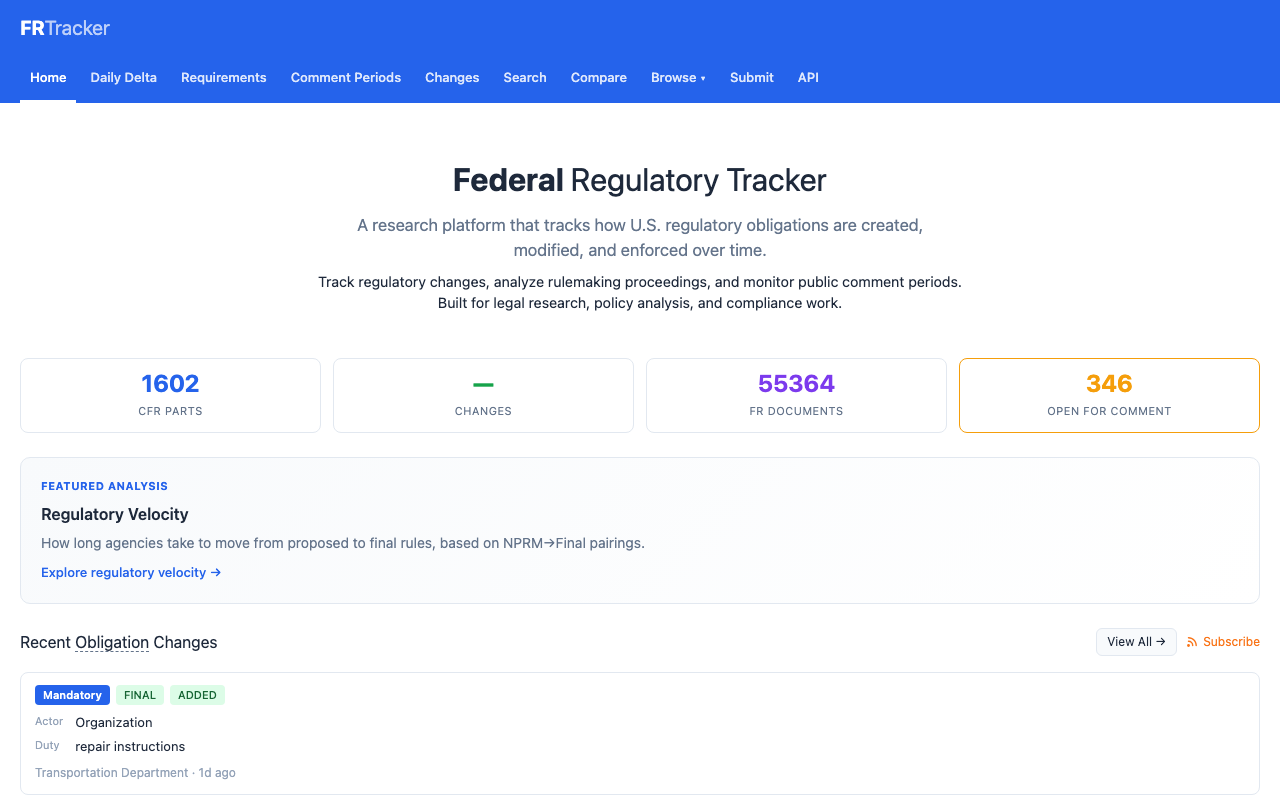
FRTracker focuses on public lawmaking through the administrative state, tracking how federal regulations move from proposal to final rule to codified law.
Regulatory change is often difficult to study empirically: proposed rules, final rules, and the Code of Federal Regulations exist in separate systems, with complex timing and attribution. FRTracker connects these stages into a coherent change record.
- Ingests Federal Register proposed and final rules across agencies
- Tracks effective-date changes to the electronic Code of Federal Regulations (eCFR)
- Preserves historical snapshots of regulatory text
- Produces redlines that show how regulatory language changes over time
- Links proposed rules, final rules, and CFR amendments into traceable "rule chains"
The goal is not prediction or commentary, but measurement: documenting how regulatory text actually changes and when those changes become legally binding.
A Shared Methodology
Both projects rely on the same core principles:
- deterministic versioning (no retroactive edits)
- provenance and source transparency
- text-based change detection rather than summary judgment
- long-term accumulation of historical data
Together, they support a broader research agenda on governance by text—how power is exercised through documents that evolve continuously, and how legal systems change in practice rather than in theory.
These tools are developed for teaching, scholarship, and public-interest inquiry. They are not commercial products, and their value grows with time, correctness, and use.